
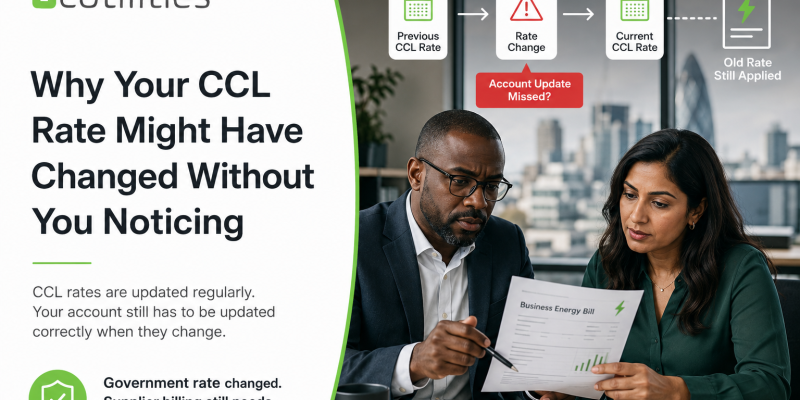
The Climate Change Levy isn’t a fixed charge that, once correctly applied, stays correct indefinitely. HMRC reviews and typically updates the rates annually, usually effective from the first of April, and every single one of those annual updates represents a moment where your billing can quietly drift out of alignment with what you should actually be paying — in either direction. Most businesses have no process at all for checking that their supplier has correctly applied each year’s updated rate, which means an error introduced at any one of these annual transition points can persist for years before anyone notices.
This is a different problem from the eligibility questions covered elsewhere around CCL relief and exemptions. Even a business correctly classified, with no eligibility for any special relief, can still be billed at an outdated or simply incorrect rate purely through an administrative error at the point the annual rate change should have been applied to their account.
Where the Rate Change Process Actually Breaks Down
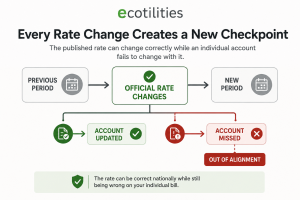
- Supplier billing systems occasionally lag behind the official rate change, continuing to bill at the previous year’s rate for a period after the new rate technically came into effect
- Manual account updates required for certain billing arrangements can be missed entirely for a specific account, even where the supplier’s systems have been updated more broadly
- Businesses on unusual contract structures or legacy accounts are statistically more likely to be missed during a systematic rate update, since these accounts often sit outside standard automated processes
- Multi-site businesses can see the rate correctly updated at some locations and not others, with no consolidated check confirming consistency across every account
Why Nobody on the Business Side Catches This
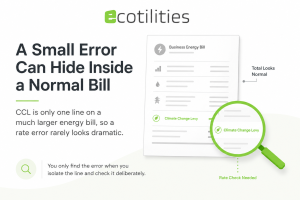
The CCL rate itself is a genuinely small figure per kilowatt-hour, and a modest miscalculation doesn’t produce an obviously anomalous bill the way a major error elsewhere might. It simply blends into the total, indistinguishable at a glance from normal month-to-month variation in consumption and wholesale pricing.
Without specifically isolating the CCL line item and checking it against the currently published rate, there’s no natural trigger that would prompt anyone to investigate.
What This Compounds Into Over Time
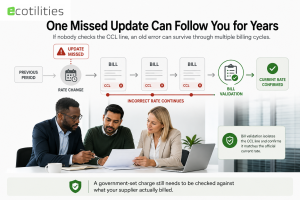
A CCL rate error, once introduced, typically persists until something specific prompts a review — a switch of supplier, an unrelated billing dispute that happens to surface it, or a dedicated validation exercise. Because CCL rates change annually, a business that has never had this specifically checked could be carrying an error dating back several rate change cycles, with each successive year’s update potentially introducing a fresh, separate discrepancy rather than simply extending the original one.
Who This Actually Hits Hardest
- Businesses that have stayed with the same supplier and billing arrangement for many years, accumulating multiple opportunities for a rate update to have been missed along the way
- Multi-site businesses where consistency across accounts has never been specifically checked following an annual rate change
- Businesses on legacy or non-standard contract arrangements that may sit outside a supplier’s standard automated rate update process
- Businesses that have never had a dedicated bill validation exercise carried out, meaning a CCL rate error would sit alongside any other unrelated billing issues, equally undetected
Signs This Is Worth Checking Specifically
- You’ve never specifically confirmed your current CCL rate against the officially published figure for the current period
- You operate multiple sites and have never checked whether the CCL rate is applied consistently across all of them
- Your billing arrangement is in any way non-standard, legacy, or has been in place for an extended period without review
- Your business has never undergone a dedicated, independent bill validation exercise covering every individual charge line
Checking this properly means isolating the CCL line specifically on recent bills and confirming it against the currently published rate for your exact consumption category — not simply assuming that because the levy is government-set, it must automatically be correctly applied by default.
| Confirm Your CCL Rate Is Actually Correct
Ecotilities checks your CCL billing against the current published rates as part of a full bill validation review, catching errors that a general glance at your total would never reveal. Visit ecotilities.co.uk/climate-change-levy or call 0333 2244 050. |
Questions Businesses Ask
How often does the CCL rate actually change?
Rates are reviewed and typically updated annually, usually effective from 1 April, meaning each year represents a fresh opportunity for the billing update to have been applied incorrectly.
Would our supplier not automatically catch and fix a rate error?
Not reliably — suppliers have no specific commercial incentive to proactively identify their own undercharging, and even overcharging errors often go unflagged unless the customer specifically raises them.
Is this a different check from confirming CCL exemption eligibility?
Yes — this is about whether the correct standard or relief rate, whichever applies to you, has actually been applied accurately, separate from the question of which rate you’re eligible for in the first place.
How far back could a rate error potentially be recovered?
Historical claims can typically be pursued going back up to six years, which is why a check covering your full recent billing history is worth doing rather than just the most recent invoice.
Does this apply even to businesses on the standard CCL rate with no special relief?
Yes — the standard rate itself changes annually, so even businesses with no eligibility for any relief can still be affected by an incorrectly applied rate update.
Is checking this something we’d be charged for?
No — this is checked as part of a standard bill validation review, free of charge, with fees only applying if a recoverable error is identified and claimed.