
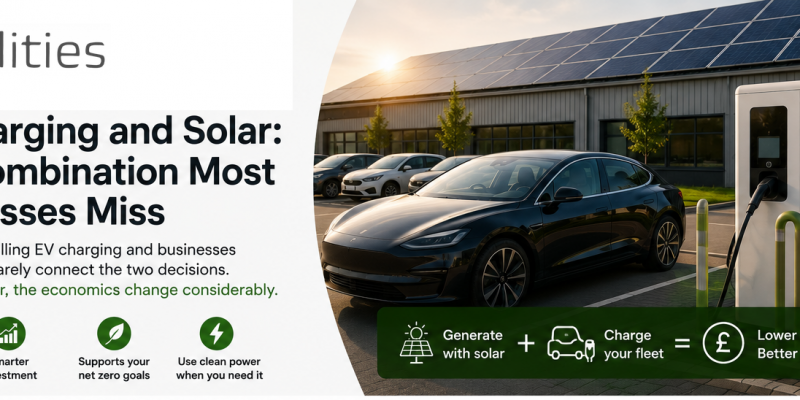
Businesses considering EV charging infrastructure and businesses considering solar panels are very often thinking about two entirely separate decisions, handled by different people, on different timelines, with different budget lines — even when both would ultimately sit on the same site, drawing from and potentially generating the same electricity supply. That separation is understandable given how each decision typically originates: fleet electrification is usually driven by operations or transport policy, while solar is usually driven by energy cost or sustainability considerations. But treated separately, both decisions miss an opportunity that only becomes visible when they’re planned together.
The connection is straightforward once it’s pointed out: EV charging represents a new, often substantial and growing electricity demand, typically concentrated during the working day when vehicles are parked on site.
Solar generation is also concentrated during daylight hours. A business installing both independently is missing the chance to directly match new demand against new generation, potentially reducing grid electricity purchase for charging significantly compared to treating the two as unrelated investments.
Why Combining Them Changes the Economics
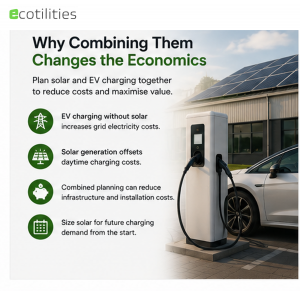
- EV charging load added to a site without solar simply increases grid electricity purchase at whatever rate the business is currently paying, with no offsetting generation to reduce that specific new cost
- Solar generation sized and timed to align with fleet charging patterns can directly offset a meaningful proportion of the electricity that charging would otherwise draw from the grid at full rate
- Combining the two investments into a single planning and funding conversation can reveal synergies in electrical infrastructure requirements, potentially reducing the combined installation cost compared to two entirely separate projects
- A business planning fleet electrification over several years has a natural opportunity to size solar generation with future charging demand in mind from the outset, rather than retrofitting solar around charging infrastructure installed with no such consideration
Where This Gets Missed in Practice
The disconnect usually comes down to organisational structure rather than any lack of logic in the idea itself. The person or team driving fleet electrification is focused on vehicle procurement, charging point specification and driver logistics — energy generation isn’t naturally part of their remit.
The person or team evaluating solar is focused on the building’s existing electricity consumption and roof suitability — future EV charging demand isn’t naturally part of their brief either. Without someone specifically bridging the two conversations, each project proceeds in isolation, and the combined opportunity is never actually evaluated as a single decision.
Why Timing Matters Considerably Here
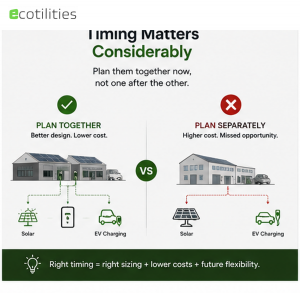
The businesses that capture the most value from combining these two investments are the ones that plan them together from the outset, rather than retrofitting one around an already-completed other. A solar installation sized purely for current building consumption, installed before EV charging plans exist, may need costly reinforcement or expansion once charging demand arrives.
Conversely, EV charging infrastructure installed without any consideration of future solar generation misses the chance to size electrical infrastructure with both loads and generation in mind from day one.
Who This Actually Hits Hardest
- Businesses actively planning fleet electrification who haven’t yet had a parallel conversation about on-site solar generation to offset the new demand
- Businesses that have already installed solar for building consumption without factoring in planned or likely future EV charging demand
- Businesses where fleet and energy decisions sit in genuinely separate departments with limited cross-communication on capital planning
- Businesses under pressure to electrify their fleet for net zero or client requirements, without realising the electricity cost implications could be significantly mitigated through combined planning
Signs This Is Worth Reviewing Together
- Your business has EV charging plans, existing installations, or fleet electrification targets that haven’t been discussed alongside your energy or solar strategy
- Your solar installation, if you have one, was sized without any reference to current or future EV charging demand on site
- Nobody in your business has modelled what combined EV charging and solar generation would look like specifically for your site and fleet size
Bringing these two conversations together, even if the investments ultimately happen on different timelines, means the electrical infrastructure, generation capacity and charging demand are all planned with each other in mind — capturing savings that two entirely independent projects, each sensible in isolation, would otherwise leave on the table.

| Plan Your Solar and EV Charging Investment Together
Ecotilities models combined solar generation and EV charging demand for your site, so both investments work together rather than as two disconnected projects. Visit ecotilities.co.uk/solar-power-scheme or call 0333 2244 050. |
Questions Businesses Ask
Do we need to install both at the same time to get the benefit?
Not necessarily at the same time, but planning them together — even if implementation is phased — allows infrastructure and capacity to be sized correctly for both from the outset.
We already have solar installed — is it too late to consider this?
No — EV charging can still be added and modelled against existing solar generation, though sizing may need reviewing to confirm current capacity can meaningfully offset the new demand.
Does this apply to businesses with a small fleet, or only large ones?
The principle applies at any scale — even a modest number of charging points represents new demand worth considering against on-site generation, though the absolute savings scale with fleet size.
Can battery storage play a role in this combination too?
Yes — storage can help bridge the gap between when solar generates and when vehicles are actually charging, particularly for fleets charging outside peak generation hours.
Does combining these two projects actually reduce our total capital cost?
It can, through shared electrical infrastructure planning, though the main financial benefit is typically in reduced ongoing electricity cost for charging rather than upfront capital savings alone.
Is modelling this combination something we’d be charged for?
No — assessing your combined solar and EV charging opportunity is included as part of a standard site review at no cost.