
Nothing seems wrong.
But what if that bill wasn’t based on an actual meter reading?
Estimated readings are easy to overlook because they don’t necessarily make a bill look unusual. Your supplier may calculate your consumption using previous usage or other available information, and the resulting figure can look perfectly plausible.
The problem is that your business may have changed since that information was last accurate. Perhaps you’ve extended your opening hours, added equipment, increased production, moved part of your operation or simply experienced a different pattern of energy use.
If your supplier is still estimating consumption using an older pattern, your bills may no longer reflect what your business is actually using.
And if that continues for several months, the difference can eventually catch up with you.
How Estimated Readings Can Create Billing Problems
An estimated reading isn’t automatically a mistake. It’s a way for your supplier to calculate a bill when an actual meter reading isn’t available.
But the longer estimates continue without being checked against actual consumption, the greater the possibility that your account won’t reflect what you’ve really used.
Here are some of the problems we recommend businesses look out for.
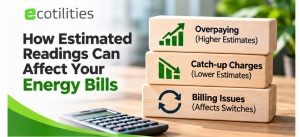
Your energy consumption has changed. If you’ve added machinery, changed shifts, expanded your premises or reduced operations, estimates based on older consumption patterns may no longer be accurate.
You could be paying too much. When estimated consumption is higher than your actual usage, you may be paying for energy you haven’t used. That difference should be corrected once an accurate reading is available.
You could be building up an unexpected bill. If your supplier has consistently underestimated consumption, the difference may eventually appear as a catch-up charge when an actual reading is obtained.
A supplier switch could complicate matters. An estimated opening reading when you change suppliers can affect the final bill from your previous supplier and the opening balance with your new supplier.
The rates may be right, but the bill can still be wrong. We don’t recommend checking unit rates alone. Even when your prices are correct, incorrect consumption figures can result in inaccurate charges.
The important distinction is that an estimated reading isn’t necessarily a billing error. The concern is whether the estimate differs materially from your actual consumption and whether that difference has been properly corrected.
Why Estimated Bills Often Go Unnoticed
One reason estimated bills can go unnoticed is that they look like ordinary energy bills.
They still contain the meter number, consumption figures, unit rates, standing charges, VAT and a total amount due. Unless you look closely at the meter-reading section, you may not realise that the consumption figure is an estimate.
If your finance team mainly checks the amount against the budget or previous invoices, the reading itself may never receive much attention.
There can also be a gap between the people responsible for energy use and the people responsible for paying the bills. Facilities may assume someone in finance submits meter readings, while finance may believe the supplier is collecting them automatically.
And if the meter is located somewhere nobody visits regularly, such as a plant room or locked utility area, manual readings can easily be forgotten.
We recommend establishing who is responsible for submitting meter readings at each site, particularly where the supplier relies on customer submissions.
Suppliers are expected to take reasonable steps to obtain meter readings and use accurate readings when available. However, this doesn’t guarantee that every bill will always be based on an actual reading.
Related Article: What a Proper Bill Audit Actually Checks That You Don’t
What Happens When the Actual Reading Finally Arrives?
Eventually, an actual meter reading may become available. When it differs from the estimates used previously, your supplier may need to recalculate the affected bills.
That correction could result in money being credited back to your business—or an additional amount being charged.
If you receive a large catch-up bill, we wouldn’t recommend accepting the total without first understanding how it was calculated. The same applies if a credit suddenly appears on your account.
Ask your supplier to explain:
- Which billing periods were previously estimated?
- Which readings are actual, and which are estimated?
- What actual reading was used to correct the account?
- How was the revised consumption allocated across the affected billing periods?
- Which charges have been recalculated?
Remember, not every charge changes when consumption is corrected.
Energy charges calculated using your kWh consumption may change, as can applicable consumption-based levies such as the Climate Change Levy. Daily standing charges, however, are generally based on the number of days in the billing period and don’t change simply because the consumption figure has been corrected.
We recommend reviewing each affected charge according to how it is calculated rather than assuming the entire invoice should change by the same proportion.
Can suppliers back-bill indefinitely?
There is an important back-billing protection for qualifying microbusinesses.
Under Ofgem’s rules, suppliers will generally be restricted from recovering charges for energy consumed more than 12 months earlier where the customer hasn’t previously received an accurate bill or statement of account for that energy.
There are exceptions, including circumstances where a customer has acted unreasonably or obstructed the supplier from obtaining accurate readings.
This protection doesn’t apply to every business, so check whether your business qualifies as a microbusiness before relying on the 12-month rule.
Your Meter May Be Automatic, But Your Bills Can Still Be Estimated
If your business has a smart meter or an advanced meter that sends readings remotely, you might assume estimated bills are no longer a concern.
Unfortunately, that isn’t always the case.
Remote meters depend on communication systems and the successful transfer of readings to your supplier. A connection fault, meter configuration problem, replacement issue or interruption in data transmission can mean actual readings stop reaching the supplier.
When that happens, your supplier may revert to estimated consumption.
So even if nobody at your business needs to visit the meter to take a reading, it is still worth checking what type of readings are appearing on your bills.
If you start receiving estimates for a meter that should be sending readings automatically, ask your supplier why the actual data isn’t coming through and what they are doing to restore accurate billing.
Don’t assume the system is working simply because it used to.
What Should a Proper Billing Correction Look Like?
Once your supplier has a valid actual reading, it has a more reliable basis for determining consumption since the previous actual reading.
But we recommend looking beyond the latest invoice.
If estimates have been used for several months, the correction should be reviewed against the full affected period. You want to understand which readings were estimates, when actual readings were obtained and how the supplier has recalculated the account.
A correction to the latest bill alone may not tell you whether the earlier estimated bills have also been properly addressed.
As part of that review:
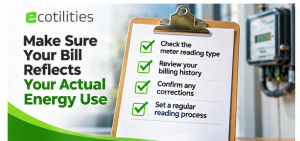
- Establish the date of the last actual meter reading.
- Identify every estimated reading used since then.
- Compare the estimated billing history with the actual meter position.
- Check the revised consumption figures.
- Review charges affected by the correction.
- Confirm that the account balance reflects the adjustment.
Once the account has been corrected, make sure somebody is responsible for checking future bills. Where manual readings are required, establish a regular schedule for submitting them. Where readings should be automatic, follow up when they stop appearing.
The goal is to avoid discovering several months of estimated billing only when a large correction arrives.
Which Businesses Are Most at Risk?
Some businesses are more likely to encounter estimated readings than others.
Businesses with meters that depend on manual readings: If nobody regularly submits meter readings, estimated billing can continue for longer than expected.
Multi-site businesses: Managing several premises makes it easier for estimated bills at one location to slip through unnoticed, especially when invoices are processed centrally.
Businesses with changing consumption: New machinery, extended operating hours, changes in production or reduced operations can make older estimates less reliable.
Businesses that have recently switched energy suppliers: Estimated opening readings can create discrepancies between the final bill from your old supplier and the account opened with your new supplier.
If any of these apply to your business, we would recommend checking your recent billing history rather than waiting for the supplier to correct it.
Five Signs Your Business May Have Been Receiving Estimated Bills
You don’t need to conduct a full energy audit to start identifying a possible issue.
Look out for these signs:
- Your bills repeatedly show estimated readings. Check the reading indicator on several consecutive invoices.
- Your consumption barely changes despite changes in operations. Your kWh figures may be based on estimates that don’t reflect your current energy use.
- Nobody has submitted a meter reading recently. If your meter depends on manual submissions, establish when an actual reading was last provided.
- You’ve received an unexplained catch-up charge or credit. Ask which estimated periods have been corrected and how the adjustment was calculated.
- You don’t know which meters are remotely read. If you’re managing multiple sites, make sure you know which meters send readings automatically and which need someone to submit them.
The first thing we would do is establish how many bills have been estimated and how long those estimates have been running.
You may find that everything is reasonably accurate. But if there is a significant difference between the estimated and actual consumption, identifying it early gives you an opportunity to investigate before further bills are affected.
Find Out How Long Your Estimated Bills Have Been Running
At Ecotilities, our Bill Validation service helps businesses examine their energy bills, identify billing errors and uncover potential rebates.
If estimated readings appear in your billing history, we can help you investigate whether they have affected your charges and what needs to be checked.
Before proceeding, ask whether the review can cover the full period in which estimates were used and whether assistance with raising or managing corrections with your supplier is included.
Don’t wait for a catch-up bill to find out.
Visit Ecotilities Bill Validation or call 0333 4422 050 to discuss your bills.
Questions Businesses Ask
How can we tell if a bill is estimated?
Check the meter-reading section of your bill. Suppliers should indicate whether a reading is estimated or actual, although the wording or abbreviation may vary. If you can’t tell, ask your supplier to confirm the reading type and provide the meter-reading history.
Are estimated bills always wrong?
No. An estimate may be reasonably close to your actual consumption, particularly if your usage has remained stable. However, changes in operating hours, equipment, production or other factors can make estimates less accurate.
Can estimated readings cause us to overpay?
Yes. If your supplier estimates more consumption than you actually use, you may pay more than necessary until the account is corrected. If the supplier estimates less than your actual consumption, you could face an additional charge later.
What should we do if we receive a large catch-up bill?
Ask for the meter-reading history covering the affected period. Identify which readings were estimated and which were actual, and request an explanation of how the supplier calculated and allocated the revised consumption.
Check the revised charges rather than accepting the total at face value.
If your business qualifies as a microbusiness, check whether Ofgem’s 12-month back-billing protection applies.
Do smart meters eliminate estimated bills?
No. Smart and advanced meters reduce the need for manual readings, but communication faults, data transmission issues and meter problems can prevent actual readings from reaching your supplier.
If your remotely read meter is generating estimated bills, ask the supplier to investigate the missing data.
Does an energy bill review cost anything?
Before proceeding, ask Ecotilities to confirm whether an initial review is free, whether additional fees apply and what support is included if a billing error is identified.
Make sure you understand the scope of the review and any charges before authorising the work.