
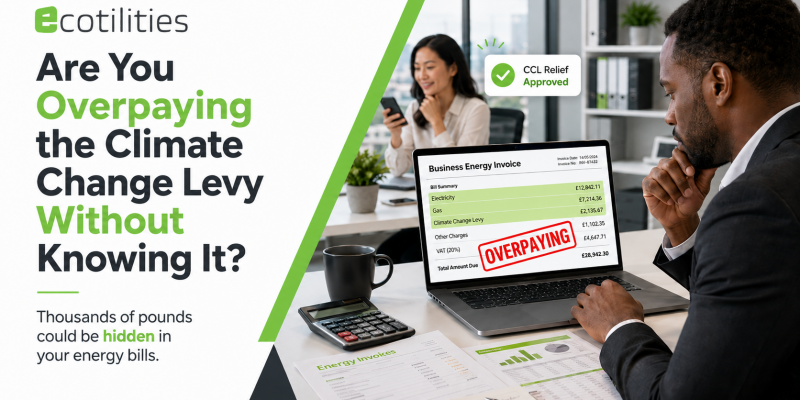
Every business energy bill in the UK carries a Climate Change Levy charge — and a striking number of businesses that qualify for a reduced rate or full exemption are quietly paying the standard rate anyway, year after year, because nobody has ever checked.
It’s not a dramatic error that jumps off the page. It’s a small line item that most finance teams never scrutinise individually, and it compounds silently, invoice after invoice, for as long as it goes unnoticed.
Current CCL Rates
| Energy Type | Standard Rate (per kWh) | Reduced Rate (if eligible) |
| Electricity | ~0.775p per kWh | ~0.775p per kWh |
| Gas | ~0.672p per kWh | ~0.169p per kWh |
| LPG | ~0.4p per kg | ~0.104p per kg |
Rates are reviewed annually by HMRC, typically effective from 1 April — figures above are indicative for the current period and should be confirmed against the latest published rates before making any financial decision based on them.
Why This Goes Unnoticed
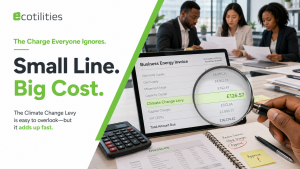
- The charge is buried as a single line among dozens on a business energy invoice, easy to skim past when reconciling a total against budget
- Eligibility for relief often depends on sector or activity classifications businesses don’t realise apply to them, particularly where a business operates across more than one type of activity
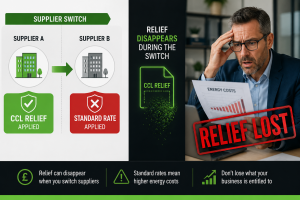
- Relief can be lost silently during a supplier switch, with nobody at either the old or new supplier flagging that a previously applied exemption has dropped off
- Finance teams typically reconcile the total, not each individual charge component, so a wrong rate never surfaces on its own unless someone is specifically looking for it
- Businesses assume that because the charge is government-set, it must automatically be correct — when in practice the correct rate depends on eligibility being actively applied by the supplier, not assumed
What’s Actually at Stake
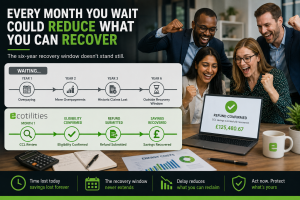
For a business consuming 200,000 kWh of electricity a year, the difference between the standard rate and an eligible reduced rate runs into thousands of pounds annually — and if that gap has existed for several years, which is common once an error goes undetected, the recoverable amount can be substantial. Claims can typically be pursued going back up to six years, meaning a small unnoticed error compounds into a much larger number than most businesses expect when they first ask the question.
The businesses most likely to be sitting on an unclaimed CCL position are those that have never had a dedicated review, those operating in sectors with specific relief eligibility they may not be aware applies to them, and those that have changed energy supplier at some point without confirming their existing relief carried over correctly to the new account.
Why Checking This Yourself Rarely Works
Confirming eligibility isn’t as simple as reading a rate off GOV.UK — it requires cross-referencing your sector classification, your specific energy use and activities, any Climate Change Agreement eligibility your business may qualify for, and your actual billing history against what you were charged across every invoice. Getting it wrong in either direction carries real risk: underclaiming leaves money on the table indefinitely with no natural trigger to revisit it, while an incorrect claim submitted without proper verification can trigger unwanted scrutiny from HMRC or friction with your supplier that outweighs the benefit of the claim itself.
There is also a timing dimension that internal reviews often miss — because the recoverable window is capped, every month spent not checking is a month of potential historical claim quietly falling outside the eligible period. A review conducted this year can typically reach further back than the same review conducted in three years’ time, simply because the earliest years within the six-year window will have already rolled out of scope by then.
Who This Actually Hits Hardest
- Energy-intensive manufacturing, food and drink processing, ceramics and paper businesses that may be eligible for a Climate Change Agreement but have never applied
- Charities and organisations running mixed business and non-business activity from the same premises without ever apportioning energy use correctly
- Multi-site businesses where relief applied correctly at one site was never replicated across the others
- Any business that has switched energy supplier in the last few years without confirming an existing relief carried over to the new account
Signs You May Already Be Overpaying
- You’ve never had your CCL rate specifically checked against your sector and activity eligibility
- Your business operates in an energy-intensive sector and nobody has ever raised a Climate Change Agreement with you
- You’ve switched energy supplier at some point and never reconfirmed your CCL position with the new provider
- Your finance team reconciles total energy spend but has never itemised the CCL line specifically
- You’re a charity or mixed-use organisation and have never apportioned business versus non-business energy use for CCL purposes
| Find Out If Your Business Is Owed a CCL Refund
Ecotilities reviews your CCL position free of charge — checking eligibility for relief and identifying any historical overpayment across up to six years of billing. Visit ecotilities.co.uk/climate-change-levy or call 0333 2244 050. |
Questions Businesses Ask Before Checking
How would we even know if we’re eligible without a review?
Most businesses don’t — eligibility depends on sector classification, consumption levels and specific activities that aren’t obvious from the outside, which is exactly why a dedicated review catches what an internal glance at the bill never would.
Is there a cost to finding out?
Ecotilities’ initial CCL review is free, with fees only applying if a recoverable amount is identified and successfully claimed — there’s no financial downside to checking, and the process requires minimal time from your team.
We switched suppliers a while back — could that have affected our rate?
Yes, this is one of the most common points at which an existing relief or exemption gets dropped without anyone noticing, since the new supplier defaults to the standard rate unless the relief is actively reapplied and confirmed during onboarding.
What information do we need to provide to get this checked?
Typically a Letter of Authority allowing the review to be carried out directly with your energy suppliers, which is a standard, low-risk authorisation that grants access to billing information only — it doesn’t affect your contracts or give anyone control over your account.
Does this only apply to large energy users?
No — while the absolute pound value of any overpayment tends to be larger for bigger energy users, smaller businesses can equally be affected, particularly those in sectors with specific relief eligibility they’ve never had assessed against their own consumption.
If we’re already claiming a relief, is there any point checking further?
Yes — it’s worth confirming the relief being applied is actually the maximum you’re entitled to, since businesses sometimes secure a partial relief early on and never revisit whether their eligibility has since improved or whether a fuller exemption applies.