
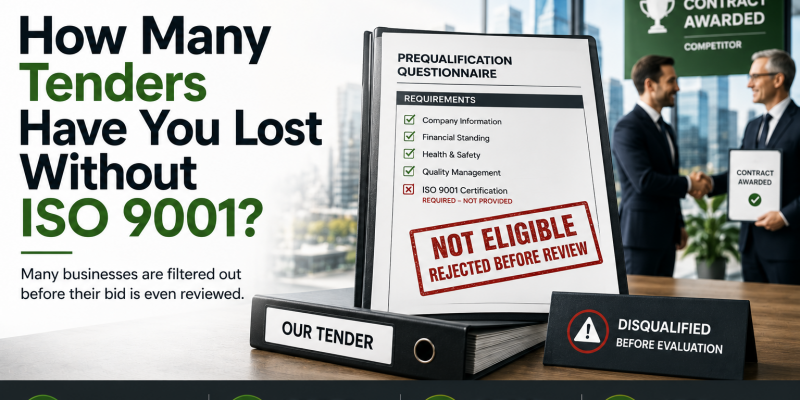
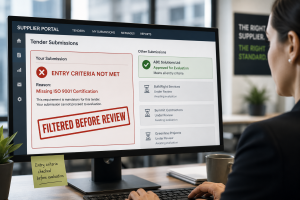
ISO 9001 is the standard buyers ask for first. It’s on nearly every public sector prequalification questionnaire and a growing share of private sector supplier onboarding forms. If your business doesn’t hold it, you’re not being quietly considered and passed over on merit — you’re often being filtered out automatically before a human even reviews your bid. The scoring never happens because the entry criteria eliminated you before the evaluation stage began.
The businesses winning contracts you’re missing out on aren’t necessarily better than yours. In a lot of cases they’re simply certified and you’re not — and that single difference is doing more to determine who wins than price, relationships or track record combined, at least at the shortlisting stage.
What Not Being Certified Is Actually Costing You
- Automatic exclusion from public sector frameworks and procurement portals that require ISO 9001 as a minimum bar before any evaluation takes place
- Losing preferred supplier status renewals to competitors who got certified in the gap year you didn’t, even where your delivery track record was equal or better
- Spending sales time and resource chasing opportunities you were never actually eligible to win, which is a cost that rarely gets tracked but adds up significantly over a year
- Watching smaller, newer competitors take contracts because they certified early and you didn’t, undermining years of relationship-building on price and delivery alone
- Being asked to reapply for existing framework positions and failing to retain them purely on a compliance technicality rather than performance
Why ‘We’ll Do It Ourselves’ Usually Fails or Drags On for a Year
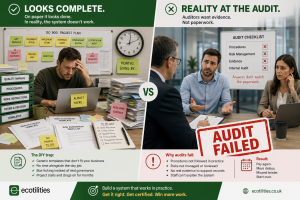
ISO 9001 is not a document-writing exercise, and treating it as one is the single biggest reason internal attempts stall or fail their audit. The standard requires a working quality management system — evidence that policies are actually followed, that risks are actually managed, that nonconformities are actually tracked and corrected over time. Auditors interview your staff directly during the Stage 2 audit. If the answers don’t match the paperwork, you fail and you’re back to square one, months later, with the tender that prompted the whole effort long gone.
Internal attempts commonly stall for three specific reasons. First, nobody internally has the capacity to run implementation alongside their day job, so the project gets deprioritised every time something more urgent comes up — which is constantly. Second, the documentation gets built from a generic template downloaded online that doesn’t reflect how the business actually works, meaning the system looks complete on paper but falls apart the moment an auditor asks a specific question about your actual operations. Third, the internal audit and management review — both mandatory before the external certification audit can even be booked — get treated as a box-ticking afterthought rather than genuine governance, which is exactly the kind of gap a certification body auditor is trained to spot immediately.
The Compounding Cost of Getting It Wrong the First Time
A failed Stage 2 audit is not a minor setback. It typically means paying the certification body audit fee again for a repeat visit, extending your project timeline by several more months while the underlying gaps are fixed, and — most damaging of all — missing whatever tender or client deadline originally triggered the certification push in the first place.
Businesses that fail once and try to self-correct often fail a second time, because the same underlying problem — a system built on paper rather than practice — doesn’t fix itself without a genuine change in approach.
What It Actually Costs to Get This Right
Costs vary by business size and how far your current practices are from what the standard requires — which is exactly why a proper gap analysis, not a generic quote pulled from a website, is the right starting point. What you should never accept is an open-ended daily rate with no ceiling on total cost, which is how ISO consultancy projects routinely balloon well past what businesses originally budgeted, sometimes doubling or tripling the anticipated spend by the time certification is finally achieved.

Who This Actually Hits Hardest
- Businesses bidding into public sector frameworks for the first time, who assume price and capability alone will carry the bid
- Subcontractors working under main contractors who are tightening their own supply chain accreditation requirements
- Growing SMEs moving from small private clients into larger corporate or public sector opportunities where the prequalification bar is materially higher
- Existing framework suppliers facing retender, where competitors have certified since the last award round and the entry bar has quietly moved
Signs You’re Already Losing Work Over This
- You’ve submitted several tenders recently with no wins and no clear feedback on why
- A prequalification questionnaire asked for a certificate you couldn’t provide
- You’ve noticed competitors with less experience or a shorter track record winning contracts you’d normally expect to be shortlisted for
- A client has mentioned reviewing their supplier accreditation requirements without specifying further
- You’ve been told informally that ‘quality management system evidence’ was a gap in a recent bid
| Get ISO 9001 Certified Without It Dragging Into Next Year
Ecotilities provides ISO 9001 certification consultancy at a fixed, agreed cost — built around how your business actually operates, not a downloaded template. We handle the gap analysis, implementation, audit and certification body liaison end to end. Visit ecotilities.co.uk/iso-standard-certification or call 0333 2244 050. |
Questions Businesses Ask Before Starting
We tried this ourselves and failed the audit once already — can we still fix it?
Yes, and it’s more common than businesses expect. A failed Stage 2 audit usually means the system was documented but not genuinely embedded. The fix is rebuilding the parts that don’t reflect real practice, not starting from zero — a proper gap analysis against your existing failed audit report identifies exactly what needs to change, which is usually faster than a first attempt because the specific weak points are already known.
Do we need ISO 9001 if we’re only bidding for private sector work?
Increasingly yes. Private sector procurement — particularly in construction, manufacturing, facilities management and professional services — has followed public sector procurement in requiring it, often as a supplier onboarding prerequisite rather than a scored differentiator, meaning you’re excluded rather than simply marked down for not having it.
What happens if we get certified but then let it lapse?
A lapsed certificate is worse for your credibility than never having one — buyers who checked your status before and see it’s gone tend to assume something went wrong internally. Certification requires ongoing annual surveillance audits; treating it as a one-off box-tick rather than a maintained system is the most common way businesses end up back at square one a few years later.
How much internal time does this actually require from our team?
Less than a full DIY attempt, but more than zero — someone needs to be available to provide information, review draft documentation and participate in the audits. The time burden shifts from your team building the system from scratch to your team validating and embedding a system built around your actual processes, which is a materially lighter lift.
Can we get certified across multiple sites under one certificate?
Yes, multi-site certification is common and often more cost-effective than certifying each site separately, though the scope needs to be defined carefully and a sample of sites will typically be visited during the audit rather than every single location.
Will the certificate actually help us if our real quality control is already good?
Yes — good informal quality control without documented evidence still fails an ISO audit, because the standard requires demonstrable, evidenced processes, not just good outcomes. Many businesses discover their existing practices are close to compliant already, which shortens the implementation timeline considerably.