
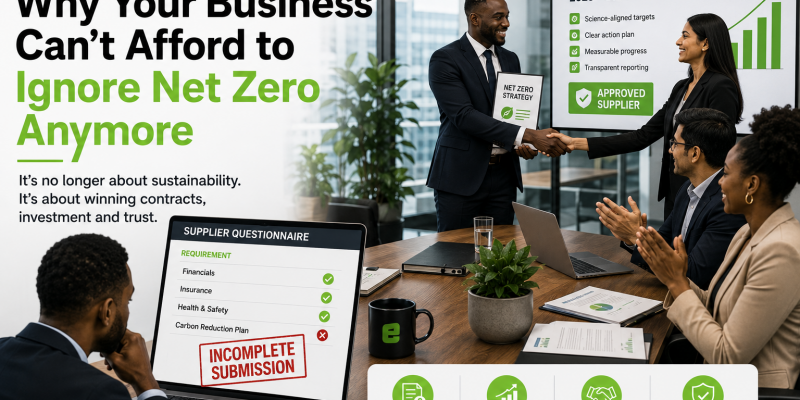
If a customer, investor or supply chain questionnaire has asked your business for a net zero plan and you’ve had to send back something vague or nothing at all, you’re not alone — and it’s costing you more than you probably realise. This isn’t a future problem confined to large corporates with dedicated sustainability teams.
It’s already showing up in lost tenders, stalled investment conversations and supply chain reviews you didn’t pass, often without anyone at your business fully understanding why the deal went quiet.

Where This Is Actually Biting Right Now
- Public sector and large corporate procurement increasingly requiring a documented carbon reduction plan as a tender prerequisite, not a nice-to-have differentiator to be scored on top of price
- Lenders and investors factoring climate risk into credit and investment decisions — businesses without a plan facing a measurably higher cost of capital than equivalent competitors with one
- Supply chain reviews from major customers asking for Scope 1, 2 and increasingly Scope 3 data you don’t currently have and have no fast way to produce
- Competitors who got ahead of this two or three years ago now routinely winning the contracts you’re being excluded from at the prequalification stage
- Insurance and risk assessments beginning to factor climate exposure and transition planning into premium calculations for commercial policies
Why a Vague Pledge Doesn’t Cut It Anymore
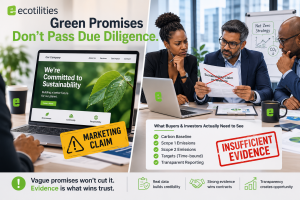
A statement on your website saying you’re ‘committed to sustainability’ no longer satisfies anyone doing real due diligence. Procurement teams, investors and journalists are increasingly trained to spot the difference between a genuine, evidenced strategy and a marketing line — and businesses caught making claims they can’t back up face real reputational damage, not just an awkward conversation in a supplier review meeting.
What buyers and investors actually want to see is specific: a measured baseline, time-bound targets, a costed plan to hit them, and transparent reporting on progress against those targets year on year.
Anything short of that gets treated as greenwashing, which is now actively worse for your credibility than having no plan at all — a business with no claims to defend is in a stronger position than one whose claims don’t survive scrutiny.
The Businesses Getting This Right Are Pulling Further Ahead
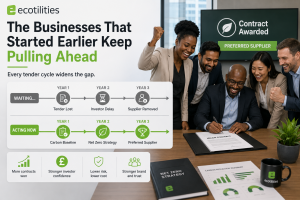
There is a widening gap between businesses that can produce credible carbon data on request and those that can’t — and that gap compounds over time rather than staying static. Every framework renewal, every new tender, every supply chain review is another point where the businesses without a strategy fall further behind those that built one early. The competitive advantage isn’t just about winning the next deal — it’s about not being systematically excluded from an increasing share of the market as more buyers adopt these requirements as standard practice rather than an exception.
Why DIY Net Zero Plans Usually Fall Apart
Building a credible strategy requires accurately measuring your baseline emissions across three separate scopes, several of which most businesses have never calculated and don’t have the internal expertise or tools to calculate reliably. It requires setting targets that hold up to external scrutiny against recognised frameworks such as the Science Based Targets initiative, rather than numbers picked because they sound achievable. And it requires a genuinely costed implementation roadmap — not a list of aspirations with no budget or ownership behind them that quietly gets deprioritised the moment another business pressure emerges.
Most internal attempts stall at exactly this point: the baseline gets estimated rather than measured properly using recognised methodology, the targets get set without checking they’re actually achievable against the business’s operational reality, and the plan sits in a drawer because nobody was made formally accountable for delivering it. A strategy with no owner and no budget line is not a strategy — it’s a document that will be produced again from scratch the next time someone asks for it, at which point the same gaps resurface.
Who This Actually Hits Hardest
- SME suppliers to large corporates who are being asked to provide carbon data as part of their customer’s own reporting obligations
- Businesses bidding for public sector contracts where a carbon reduction plan is now a scored or mandatory tender element
- Businesses in growth stage seeking investment or lending, where climate risk is increasingly factored into terms
- Businesses in consumer-facing sectors where customers and journalists are more likely to scrutinise sustainability claims directly
Signs You’re Already Behind on This
- A customer or supply chain questionnaire has asked for Scope 1, 2 or 3 data you don’t currently have
- You’ve responded to a sustainability request with a general statement rather than specific numbers
- A lender or investor conversation has raised climate risk or ESG criteria you weren’t prepared to answer
- A competitor has publicly published carbon reduction targets and you haven’t
- You’ve delayed responding to a supply chain sustainability request because you didn’t know where to start
What a Credible Response Actually Looks Like
Businesses that pass scrutiny don’t necessarily have the lowest emissions in their sector — they have the most credible evidence trail. That means a baseline built on actual consumption data rather than estimates, targets that are ambitious but demonstrably achievable given the business’s resources, and a track record of reporting progress honestly even when it falls short of target. Buyers and investors are far more forgiving of a business that is behind schedule but transparent about it than one that produces suspiciously polished numbers with no supporting evidence.
| Get a Net Zero Strategy That Actually Holds Up to Scrutiny
Ecotilities builds net zero strategies backed by real implementation — accurate carbon baselining, credible targets, and delivery through renewable energy, solar and efficiency measures we can actually install and manage for you. Visit ecotilities.co.uk/net-zero or call 0333 2244 050. |
Questions Businesses Ask Before Starting
We’ve already lost a tender over this — can we turn it around quickly?
A basic, credible baseline and near-term target plan can be in place faster than most businesses expect — the real time cost is in full Scope 3 mapping, which can be phased in after the initial plan is live and defensible, so the first deadline doesn’t have to wait for the complete picture.
Is this only relevant for large businesses?
No — SME suppliers are increasingly required to provide sustainability data as part of larger customers’ own reporting obligations, since those customers need it from every tier of their supply chain to complete their own disclosures. If your customers are large corporates or public sector bodies, this pressure will reach you even if it hasn’t yet.
What happens if we publish a plan and then don’t hit the targets?
This is exactly why the targets need to be realistic and the plan needs to be genuinely costed and resourced from the outset — an ambitious but undeliverable plan does more reputational damage than a modest, credible one that gets hit, because missed targets without explanation read as a broken promise rather than a work in progress.
How often do we need to update or report on the strategy once it exists?
Annually at a minimum for most reporting frameworks and buyer expectations, though some fast-moving supply chain relationships expect more frequent updates. The reporting cadence should be built into the strategy from the start rather than treated as an afterthought once the initial plan is published.
Do we need external validation like SBTi, or is a self-set target enough?
A self-set target is a reasonable starting point, but external validation carries significantly more weight with sophisticated buyers and investors who have seen self-set targets abandoned or quietly revised elsewhere. Where the commercial stakes justify it, validated targets are worth pursuing as the strategy matures.
What’s the very first thing we should get right before anything else?
An accurate baseline. Every target, every claim and every piece of reporting depends on it, and a strategy built on a shaky or estimated baseline unravels the moment anyone asks a specific follow-up question about the numbers behind it.