
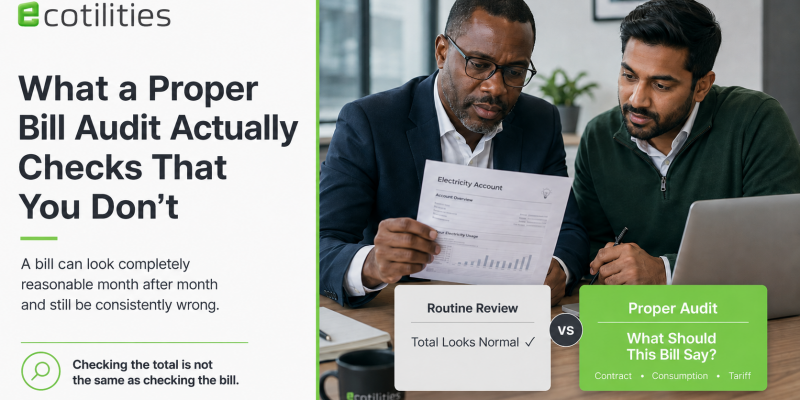
Ask most finance teams what their energy bill review process involves, and the honest answer is usually some version of: check the total against last month, check it against budget, approve it if nothing looks obviously wrong.
That process catches genuinely dramatic errors — a bill that’s doubled overnight for no apparent reason. It does almost nothing to catch the far more common category of error: one that’s wrong by a smaller, consistent margin, month after month, never dramatic enough to trigger a second look.
A proper bill audit works entirely differently. Rather than judging whether a total looks reasonable, it reconstructs what the bill should say from first principles — checking every individual component against your actual contract terms, applicable tax rates and verified consumption data — and then compares that reconstruction against what you were actually charged.
The difference between those two approaches is exactly why a business can review its bills diligently every single month for years and still miss an error a proper audit finds within days.
What Gets Checked in a Proper Audit
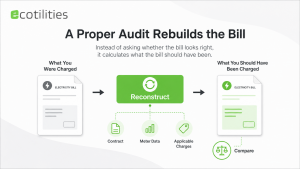
- The unit rate charged on every bill, verified line by line against the exact rate specified in your current contract, not simply assumed to be correct because it looks broadly similar to previous months
- Meter readings, checked against actual submitted or half-hourly data rather than accepted at face value, since estimated readings are a common and often unnoticed source of overcharging
- The standing charge, confirmed against your contracted rate and the correct number of days for each specific billing period, including partial periods around contract start or end dates
- VAT rate applied, checked against your business’s actual eligibility for the standard or reduced rate, not simply assumed correct because it’s always been applied the same way
- Climate Change Levy charged, verified against the currently published rate and your business’s specific relief or exemption eligibility, checked independently rather than trusted as automatically correct
- Non-commodity and third-party charges, cross-checked against published industry rates for your specific distribution region and connection type
- Historical continuity across your full available billing history, checking for duplicate charges, gaps in billing periods, and consistency around any supplier switch or meter change
Why Internal Reviews Structurally Can’t Catch What This Catches
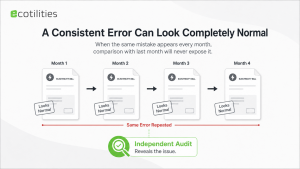
An internal review, however diligent, is fundamentally a sense check performed by someone comparing a new bill against previous bills and a rough sense of what feels normal. It has no independent reference point — if an error has been present since the very first bill on a contract, every subsequent bill looks entirely consistent with what came before it, because the error itself has become the new normal.
A proper audit doesn’t compare bills against each other; it compares every bill against an independently reconstructed, correct baseline built from the contract and tariff data directly, which is precisely why it catches errors that have been present, unnoticed, since day one.
What This Actually Uncovers in Practice
Errors identified through proper bill audits tend to fall into a small number of recurring categories: an incorrect unit rate applied from the start of a contract, a VAT or CCL rate that was never correctly set up, estimated readings that have run for far longer than they should have without a true reading correcting them, and billing discrepancies specifically around switch or meter change events.
None of these are exotic or unusual — they’re common, structural billing errors that simply require a specific, deliberate check to surface, rather than emerging naturally from routine bill approval.
Who This Actually Hits Hardest
- Businesses that have never had a dedicated, independent bill audit carried out, relying entirely on internal review as their only check
- Businesses with more complex billing arrangements — multiple meters, half-hourly settlement, historical supplier switches — where the number of individual components needing verification is considerably higher
- Businesses that have held the same contract and supplier relationship for an extended period without an external check ever being introduced
Signs You’d Benefit From a Proper Audit
- Your current bill review process consists of comparing totals month to month rather than checking individual charge components against your contract
- You’ve never had anyone independently reconstruct what your bill should say and compare it against what you were actually charged
- Your billing history includes a supplier switch, meter change, or period of estimated readings that has never been specifically checked
The distinction between an internal review and a proper audit isn’t about effort or diligence — even a very careful internal reviewer, checking totals against budget every month without fail, is structurally unable to catch an error that’s been consistent since the contract began, because consistency is exactly what an internal review is designed to treat as reassuring rather than suspicious.

| Get a Proper Bill Audit, Not Just a Total Check
Ecotilities independently reconstructs your bills from contract and tariff data and compares them line by line against what you were actually charged — catching what a routine internal review structurally cannot. Visit ecotilities.co.uk/bill-validation or call 0333 2244 050. |
Questions Businesses Ask
How is this different from what our finance team already does?
A proper audit independently reconstructs what your bill should say from your contract and current tariff data, rather than comparing new bills against previous ones — which is a fundamentally different and more rigorous check.
Does this take significant time or resource from our team?
Minimal — the process primarily requires a Letter of Authority to access your billing data directly from suppliers, with the analysis itself carried out independently.
What happens if the audit finds nothing wrong?
That’s a genuinely useful outcome too — confirming your billing is accurate provides real confidence, and the audit itself costs nothing regardless of what it finds.
How far back can a proper audit actually check?
Typically up to six years of billing history, which is also the general window within which any identified overcharge could potentially be recovered.
Does this apply even if we’re confident our supplier is reputable and unlikely to make mistakes?
Yes, billing errors aren’t generally a sign of a disreputable supplier, they’re a structural feature of a complex, multi-party billing process that affects businesses across every supplier in the market.
Is this service something we’d be charged for upfront?
No, the audit itself is free, with fees only applying if a recoverable overcharge is identified and successfully claimed on your behalf.