
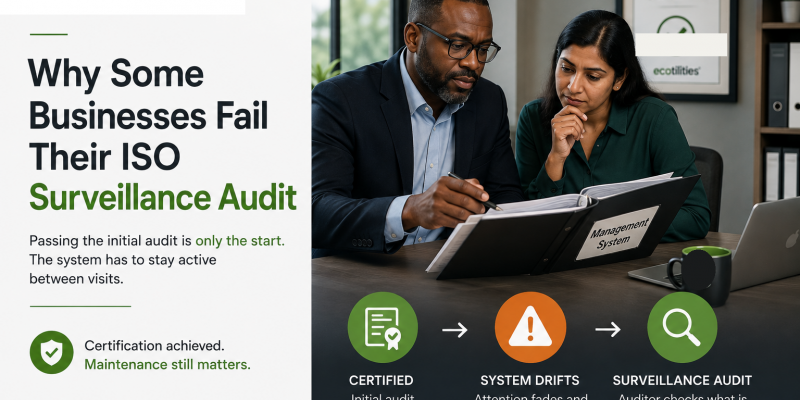
Achieving ISO certification for the first time is usually treated as the finish line — the certificate arrives, it goes up on the website, and the business moves on to the next priority. What often gets underestimated is that certification isn’t a one-time achievement at all; it’s the start of an ongoing relationship with annual surveillance audits designed specifically to confirm the management system is still genuinely operating, not simply that it existed convincingly enough to pass the original assessment.
A meaningful number of businesses that pass their initial certification audit comfortably go on to struggle at surveillance, sometimes losing certification entirely as a result.
This isn’t usually because the original system was fraudulent or deliberately built to deceive — it’s because the system was genuinely live and active at the point of certification, and then quietly allowed to lapse into dormancy once the immediate pressure of the audit had passed.
Where Surveillance Audits Typically Expose Problems
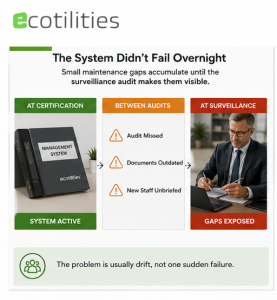
- Internal audits that were conducted rigorously in the run-up to certification but have since become infrequent, superficial, or stopped happening altogether once the immediate pressure eased
- Management reviews that have become a formality on paper rather than the genuine, substantive review of system performance the standard actually requires
- Staff turnover since certification, with new employees never properly inducted into the management system and its specific requirements the way the original team was
- Documentation that hasn’t been updated to reflect genuine changes in how the business actually operates, leaving a growing gap between what’s written down and what’s actually happening
- Nonconformities and corrective actions that were tracked diligently before certification but have since gone unrecorded or unresolved as the system’s active use has faded
Why This Pattern Is So Common
The intensity of preparing for an initial certification audit creates a natural high-water mark of engagement — everyone knows the stakes, the deadline is visible, and the system gets genuine attention as a result. Once the certificate is achieved, that same intensity has no obvious reason to continue unless the organisation has deliberately built ongoing momentum into its operating rhythm.
Without that deliberate effort, the system naturally drifts back toward whatever level of attention day-to-day operational pressures allow, which for most businesses is considerably less than what was invested during the run-up to certification.
What a Surveillance Audit Failure Actually Means
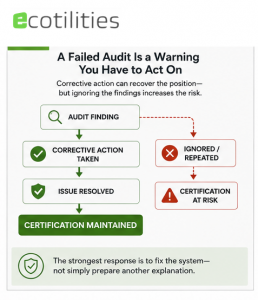
A failed surveillance audit isn’t necessarily the end of certification, but it does mean corrective action is required within a defined timeframe, and repeated or serious failures can lead to certification suspension or withdrawal.
Beyond the immediate administrative consequence, losing certification — even temporarily — after having previously held it is often viewed more negatively by clients and procurement teams than never having been certified at all, since it raises questions about the organisation’s genuine commitment to the standard rather than simply its absence.
Who This Actually Hits Hardest
- Businesses that treated their initial certification as a project with a defined end point, rather than the start of an ongoing operational commitment
- Businesses that have been through meaningful staff turnover since certification without formally updating induction processes to cover the management system
- Businesses without a clearly designated internal owner of the management system responsible for keeping it genuinely active between external audits
- Businesses that outsourced their initial certification implementation entirely to a consultant, without building sufficient internal capability to sustain the system independently afterward
Signs Your System Is Already Drifting
- Internal audits haven’t been conducted at the frequency your management system documentation actually commits to
- Your last management review was largely a formality rather than a substantive discussion of system performance and improvement opportunities
- New staff who’ve joined since certification haven’t received specific induction into the management system’s requirements relevant to their role
- Nobody could currently locate or summarise your organisation’s open nonconformities and corrective actions without searching
Avoiding a surveillance audit failure means treating the management system as a genuinely operating part of the business year-round, not a project revived only when an audit is approaching — which requires clear ongoing ownership, a realistic internal audit schedule that’s actually followed, and induction processes that keep new staff genuinely engaged with the system as the organisation naturally changes over time.
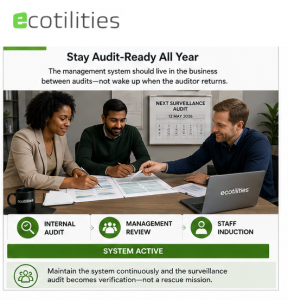
| Keep Your ISO Certification Genuinely Active Between Audits
Ecotilities supports ongoing management system maintenance, not just initial certification, helping businesses stay genuinely audit-ready rather than scrambling before each surveillance visit. Visit ecotilities.co.uk/iso-standard-certification or call 0333 2244 050. |
Questions Businesses Ask
How often do surveillance audits actually happen?
Typically annually across the three-year certification cycle, with a full recertification audit required at the end of that cycle to renew the certificate for a further term.
Can we recover from a failed surveillance audit?
In most cases yes, provided corrective action is taken within the required timeframe — the priority is addressing the specific gaps identified promptly and genuinely, not just superficially.
What’s the minimum level of ongoing effort needed to stay genuinely compliant?
This varies by standard and organisation size, but at minimum includes regular internal audits, a substantive management review, and keeping documentation aligned with how the business actually operates day to day.
Does outsourcing ongoing maintenance help, or should this stay entirely internal?
Many businesses benefit from external support to maintain momentum and objectivity, particularly for internal audits, while still building genuine internal ownership rather than relying entirely on outside involvement.
How would we know if our system has already started drifting?
The specific signs outlined above are worth checking honestly — infrequent internal audits, a superficial last management review, and untracked staff induction are the clearest early indicators.
Is support for ongoing maintenance something separate from initial certification consultancy?
It can be structured as an ongoing service alongside or following initial certification, specifically designed to keep the system active between audits rather than only engaging around certification events.