
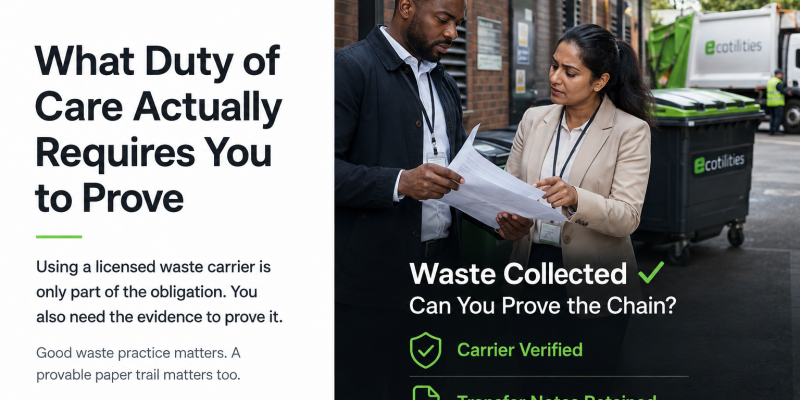
Every UK business producing waste has a legal duty of care obligation, and most business owners have a vague, correct sense that this means using a proper, licensed waste carrier.
What far fewer businesses understand clearly is that duty of care isn’t satisfied simply by using a licensed carrier in practice — it’s satisfied by being able to prove, with documented evidence, that you took reasonable steps to confirm the carrier’s credentials and that your waste was handled correctly all the way through the chain, not just at the point it left your premises.
This distinction between ‘we did the right thing’ and ‘we can prove we did the right thing’ is where a significant number of businesses discover an uncomfortable gap, usually at exactly the wrong moment — when an inspector, an insurer, or a client’s own supply chain audit asks for the paperwork and it either doesn’t exist or can’t be located.
What You Actually Need to Be Able to Produce
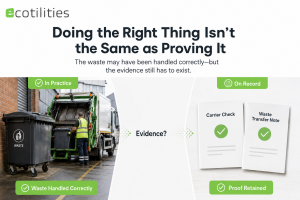
- Evidence that you checked your waste carrier held a valid waste carrier licence or was a registered exempt operator at the time the waste was collected
- Waste transfer notes for every consignment of waste, correctly completed and retained for the legally required period, describing what the waste was and confirming who took responsibility for it
- Evidence that waste was correctly described and classified, since an inaccurate description on a transfer note can itself constitute a duty of care failure regardless of what actually happened to the waste
- A reasonable degree of ongoing assurance that your waste continued to be handled appropriately after collection, not just a one-time check when the arrangement was first set up
Why Most Businesses Can’t Actually Produce This on Demand
Waste collection tends to be treated as a purely operational, background task — bins go out, a lorry collects them, life continues. The documentation duty of care actually requires is rarely built into that operational rhythm unless someone has specifically set up a system to retain it.
Waste transfer notes get generated by the carrier, sometimes emailed, sometimes not, and in a lot of businesses nobody has a clear, organised record of where those documents are or whether they’ve even been consistently retained over the required period.
Where This Becomes an Urgent Problem

The moment this gap actually matters is rarely convenient. An Environment Agency inspection, a fly-tipping investigation that traces waste back through the chain, an insurer reviewing a claim, or increasingly, a client’s own supply chain due diligence process, can all trigger a request for this specific evidence with limited notice.
A business that has to admit it cannot produce the required documentation is in a genuinely weaker position, regardless of whether its actual waste handling practices were sound — because duty of care compliance is fundamentally about the evidence trail, not just the underlying good intent.
Who This Actually Hits Hardest
- Smaller businesses using informal or inherited waste arrangements set up without anyone specifically considering the documentation requirement
- Multi-site businesses where waste transfer note retention varies inconsistently by location, with no central system consolidating records
- Businesses that have changed waste carrier at some point, where documentation from the previous arrangement may have been lost in the transition
- Businesses now facing supply chain sustainability audits from larger clients who specifically request waste handling evidence as part of their own due diligence
Signs Your Documentation Wouldn’t Hold Up
- You could not locate your waste transfer notes for the last twelve months without a significant search
- Nobody in your business has ever specifically verified your current waste carrier’s licence status
- You don’t have a clear, organised system for retaining waste documentation, relying instead on whatever the carrier happens to send
- A client, insurer or regulator has never asked for this evidence, and you’re not confident how you’d respond if they did
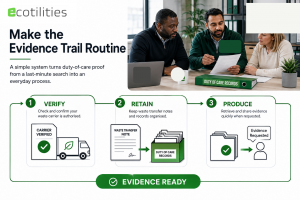
Getting this right doesn’t require overhauling how your waste is actually collected — it requires building a simple, consistent system for verifying carrier credentials and retaining transfer notes as a matter of course, so that if and when the evidence is ever requested, producing it is straightforward rather than a scramble through inboxes and filing cabinets under time pressure.
| Get Your Waste Compliance Evidence Properly in Place
Ecotilities reviews your current waste arrangements for duty of care compliance and puts a proper documentation system in place, so you’re never caught without the evidence you need. Visit ecotilities.co.uk/waste-management or call 0333 2244 050. |
Questions Businesses Ask
How long do we actually need to keep waste transfer notes for?
Waste transfer notes need to be retained for a legally specified minimum period — this is worth confirming precisely as part of any compliance review rather than assumed.
Does this apply to us even if we only produce a small amount of waste?
Yes — duty of care applies regardless of the volume of waste your business produces, and smaller businesses are often the ones with the least formal documentation system in place.
How do we check if our current waste carrier is properly licensed?
Carrier licence status can be verified through the appropriate regulatory register — this is exactly the kind of check that should be built into your ongoing waste management process rather than assumed.
What happens if we discover a gap in our documentation going forward?
The priority is establishing a proper, consistent system from this point onward — a review typically focuses on fixing the process going forward rather than dwelling on past gaps, unless a specific issue has already arisen.
Is this relevant even if we’ve never had any problems with our waste arrangements?
Yes — the absence of a problem so far doesn’t mean the evidence trail exists if it were ever needed, and duty of care compliance is specifically about being able to prove your practices, not just having good ones.
Does reviewing this cost anything?
No — reviewing your current waste compliance position is free and carries no obligation.