
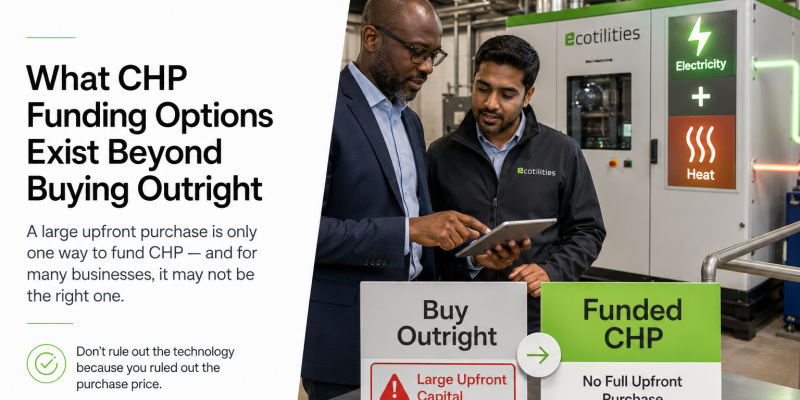
A meaningful number of businesses that would genuinely benefit from combined heat and power rule it out at the first hurdle, purely on the assumption that it requires a large capital outlay the business isn’t in a position to commit.
That assumption is understandable — CHP installations do carry significant capital cost if purchased outright — but it’s also frequently the point where the conversation ends prematurely, before anyone has actually looked at whether a funded route would remove that barrier entirely, the same way it does for commercial solar.
This matters because the underlying economics of CHP for a suitable site — continuous heat demand, substantial electricity consumption, the right load profile — don’t change based on how the installation is funded. A site that would benefit from CHP under outright purchase would generally benefit from it under a funded model too, just without the upfront capital requirement that stops the conversation before it properly starts.
The Funding Routes Available Beyond Outright Purchase
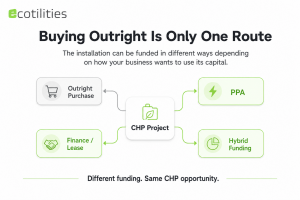
- CHP Power Purchase Agreements, where a third-party developer funds, installs, owns and maintains the CHP unit, and the business purchases the heat and electricity generated at a rate below the equivalent cost of buying both separately from the grid and a boiler
- Energy Performance Contracts, where the funding and installation cost is recovered through a share of the guaranteed energy savings the installation delivers, aligning the funder’s return directly with actual performance
- Equipment finance and lease arrangements, spreading the capital cost over a fixed term through structured payments, while the business retains ownership and captures the full energy savings from day one
- Hybrid models combining a smaller capital contribution from the business with third-party funding for the remainder, useful for businesses with some available capital but not the full amount required
Why Outright Purchase Isn’t Always the Right Comparison Point
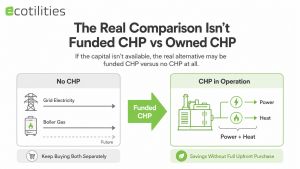
Businesses evaluating CHP often mentally compare a funded model unfavourably against outright ownership, on the basis that ownership captures the full financial benefit rather than sharing it with a funder. That comparison misses the point for a business that genuinely doesn’t have the capital available, or would rather deploy that capital elsewhere in the business.
For that business, the real comparison isn’t funded CHP versus outright CHP — it’s funded CHP versus no CHP at all, continuing to pay full grid electricity and boiler gas costs indefinitely. Against that comparison, a funded route that still delivers meaningful savings from day one, with zero capital outlay, looks considerably more attractive.
What Determines Whether a Funded Route Is Viable
Funders and PPA providers assess CHP opportunities against broadly similar criteria to solar PPA providers — consumption scale, the consistency and continuity of heat demand, property tenure and lease length, and the business’s creditworthiness as the long-term purchaser of the generated heat and power.
A site with strong, continuous heat demand and substantial combined energy spend is generally an attractive proposition for a funder, meaning the businesses most likely to benefit from CHP in the first place are often also the businesses most likely to find a funded route genuinely available to them.
Who This Actually Hits Hardest
- Businesses that assessed CHP some years ago, concluded it wasn’t affordable under outright purchase, and never revisited the decision once funded models became more widely available
- Businesses with strong, continuous heat and power demand who assume CHP is simply out of reach financially without ever exploring funded alternatives
- Businesses currently planning a boiler replacement as a capital decision, without having compared that spend against a funded CHP alternative that might deliver considerably more value for a similar or lower ongoing cost
Signs a Funded CHP Route Is Worth Exploring
- Your site has continuous or near-continuous heat demand alongside substantial electricity consumption, but CHP was previously ruled out purely on capital cost grounds
- You’re facing a boiler replacement decision without having compared it against a funded CHP alternative
- Nobody has specifically modelled what a PPA or finance-based CHP route would look like for your actual site and consumption profile
Revisiting CHP through the lens of funded options, rather than the capital purchase assumption that closed the conversation previously, is often the single change that turns a site from ‘not viable’ back into a genuine, actionable opportunity — worth doing specifically for any business whose only real objection to CHP was ever the upfront cost.
| Find Out If Funded CHP Works for Your Site
Ecotilities models CHP viability against your actual consumption profile and advises on funded routes that remove the capital barrier, including PPA and finance-based options. Visit ecotilities.co.uk/power-generators or call 0333 2244 050. |
Questions Businesses Ask
We ruled out CHP a few years ago on cost grounds — is it worth reconsidering?
Yes — funded models have become more established and widely available since, meaning a decision made purely on outright purchase cost several years ago is genuinely worth revisiting now.
Do funded CHP arrangements work the same way as solar PPAs?
The underlying principle is similar — a third party funds and owns the equipment, and you purchase the output at a favourable rate — though the specific structure and terms differ given the different technology involved.
Does our site need to already have high energy spend to qualify for funding?
Generally yes, since funders assess viability based on consumption scale and the consistency of demand, though the specific threshold varies by funder and should be checked against your actual profile.
Can this be combined with our existing boiler replacement plans?
Yes, and it’s specifically worth comparing before committing capital to a straightforward boiler replacement, since a funded CHP route may deliver considerably more value for a similar spend.
How do we know if our heat demand is consistent enough for CHP to work well?
This is exactly what a proper site assessment establishes, modelling your actual demand pattern across a full year rather than relying on a rough estimate.
Is assessing funded CHP options something we’d be charged for?
No — an initial assessment of CHP viability and funding options for your site is free and carries no obligation.