
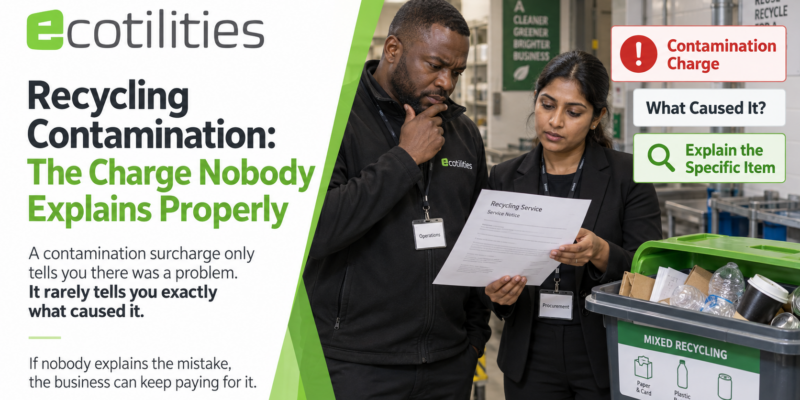
A business that segregates its waste properly, puts recycling in the correct bin, and still ends up hit with a contamination surcharge is one of the more genuinely frustrating experiences in commercial waste management — not least because the specific reason for the charge is very often never clearly explained. Contamination charges exist because recycling processing facilities reject loads containing material that shouldn’t be there, and the cost of that rejection gets passed back down the chain to the business whose bin was the source. The problem is that most businesses have never actually been told, in plain terms, what specifically counts as contamination and how easily it happens.
This isn’t a minor administrative annoyance. Contamination surcharges can be substantial, applied per incident, and in persistent cases can result in a recycling collection being downgraded to general waste rates entirely — the more expensive waste stream a business was specifically trying to avoid by segregating in the first place. A business paying these charges repeatedly, without understanding why, is often making the same avoidable mistake month after month simply because nobody has ever walked through what’s actually going wrong.
What Actually Counts as Contamination
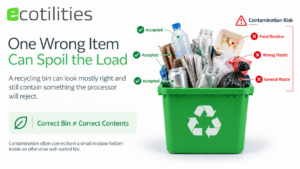
- Food waste or liquid residue in recycling containers, even in small amounts, which can contaminate an entire load and render it unsuitable for processing
- Non-recyclable plastics mixed with recyclable ones, since not all plastic types are accepted in a standard commercial recycling stream despite superficially looking similar
- Items that are individually recyclable but not accepted loose or in the specific form presented — certain packaging combinations or unbroken-down cardboard, for example
- General waste items placed in recycling bins by staff who aren’t clear on what belongs where, often due to inconsistent or absent signage at the point of disposal
- Materials that vary in acceptability between different local recycling facilities, meaning what was accepted at a previous site or under a previous provider isn’t necessarily accepted under current arrangements
Why This Keeps Happening Even in Well-Intentioned Businesses
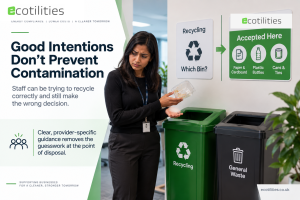
Contamination is rarely the result of a business not caring about proper segregation — it’s usually the result of unclear, inconsistent guidance actually reaching the people physically disposing of waste day to day.
Recycling rules aren’t universal or intuitive; what’s accepted varies by local facility and provider, and without clear, specific signage and staff communication tailored to your actual arrangement, well-intentioned staff make judgment calls that turn out to be wrong, repeatedly and often invisibly, until a contamination charge eventually surfaces the problem.
What a Clear Explanation Actually Changes
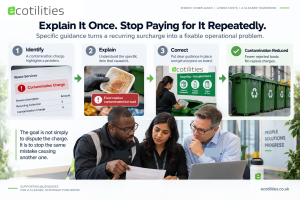
Businesses that receive a specific, itemised explanation of what caused a contamination charge — rather than a generic surcharge line on an invoice — are in a position to actually fix the underlying behaviour.
Without that explanation, the same mistake tends to repeat indefinitely, because nobody in the business has the information needed to correct it. A provider who explains contamination clearly, with specific examples relevant to your actual waste stream, is doing something that genuinely differs from one who simply applies the charge and moves on.
Who This Actually Hits Hardest
- Businesses with high staff turnover, where recycling guidance given to one cohort of employees doesn’t reliably reach the next
- Multi-site businesses where recycling rules differ by location due to different local providers, but staff guidance hasn’t been updated to reflect those differences
- Businesses that inherited their current recycling arrangement from a previous management team, with no clear record of what guidance, if any, was ever given to staff
Signs Contamination Is Quietly Costing You
- You’ve seen contamination charges on invoices without a clear, specific explanation of what caused them
- Your recycling collections have been downgraded to general waste rates at any point due to repeated contamination
- Staff at your premises have never received specific, clear guidance on what does and doesn’t belong in your recycling stream
- Your signage around waste and recycling points, if it exists at all, is generic rather than tailored to what your specific provider actually accepts
Fixing this properly means getting a clear, specific explanation of what your actual provider accepts, putting genuinely useful signage in place at the point of disposal, and briefing staff on the specific rules that apply to your arrangement — not a generic recycling poster, but guidance built around what’s actually causing your contamination charges.
| Stop Paying Contamination Charges You Don’t Understand
Ecotilities reviews your recycling contamination history, explains exactly what’s going wrong, and puts practical guidance in place to stop it recurring. Visit ecotilities.co.uk/waste-management or call 0333 2244 050. |
Questions Businesses Ask
How do we find out exactly what’s causing our contamination charges?
This requires a specific conversation with your provider about the actual rejected loads — a proper review pushes for this level of detail rather than accepting a generic surcharge explanation.
Does contamination guidance really vary that much between providers?
Yes — what’s accepted in a commercial recycling stream varies by local processing facility and provider, meaning guidance that was correct under a previous arrangement may no longer apply.
Can we dispute a contamination charge if we believe it was applied incorrectly?
Yes, this is worth raising directly if you have reason to believe the charge doesn’t reflect what was actually in your collection, though a clear explanation from the provider is the first step either way.
Will better signage alone actually solve this?
Signage tailored to your specific provider’s rules helps considerably, though staff briefing and periodic reinforcement, particularly given staff turnover, tends to be needed alongside it for a lasting fix.
Is this relevant even if we’ve never actually been charged for contamination?
It’s still worth confirming staff understand your specific recycling rules clearly, since undetected contamination can also result in loads simply being downgraded without a separate itemised charge appearing.
Does reviewing this cost anything?
No — reviewing your contamination history and putting practical guidance in place is included as part of standard waste management support.