

Every qualifying organisation facing ESOS has a choice to make that isn’t always presented clearly at the outset: pursue a standard energy audit each phase, or invest in ISO 50001 certification and use it as an alternative compliance route. Both satisfy the regulation. Neither is universally better. And a surprising number of organisations end up on whichever route they happened to hear about first, rather than the one that actually suits their specific circumstances, size and future compliance cycles.
Getting this choice wrong isn’t catastrophic, but it is expensive in a quieter way — an organisation that would have been well served by ISO 50001’s ongoing framework instead repeats a standalone audit every four years without ever capturing the compounding value that a certified management system builds over time, while an organisation better suited to a straightforward audit route can find itself over-investing in a certification programme that delivers more infrastructure than it actually needs.
What Each Route Actually Involves
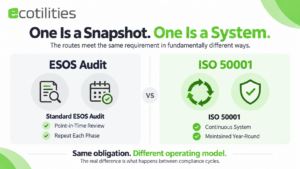
- A standard ESOS energy audit is a point-in-time assessment, conducted by a Lead Assessor, that captures a snapshot of your energy consumption and improvement opportunities every four-year phase, with no requirement for ongoing certification maintenance between cycles
- ISO 50001 certification establishes an ongoing, continuously operating energy management system, independently audited and requiring annual surveillance, which can then be used to satisfy the ESOS audit requirement for any areas the certification genuinely covers
- The audit route requires less sustained organisational commitment between assessment cycles, but also delivers less structured, continuous energy management value in between those cycles
- The ISO 50001 route requires greater upfront investment and ongoing annual maintenance, but builds a genuine, continuously improving energy management capability that a standalone audit, by its nature, cannot replicate
Who the Audit Route Genuinely Suits
Organisations with relatively stable, simple energy profiles, without ambitions to build a formal energy management function, and without other drivers — client requirements, tender prequalification, or a parallel net zero strategy — that would independently justify ISO 50001 investment, are often genuinely well served by the standard audit route.
It satisfies the legal requirement cleanly, without committing the organisation to an ongoing certification programme it may not otherwise need or want.
Who the ISO 50001 Route Genuinely Suits
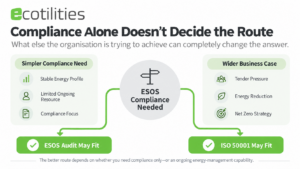
Organisations that are also pursuing tender opportunities where energy management certification is increasingly requested, that have genuine ambitions around structured energy cost reduction beyond the minimum compliance requirement, or that are building a wider net zero strategy where a certified management system would provide real ongoing value, tend to get considerably more out of the ISO 50001 route.
The certification cost is then justified by benefits that extend well beyond ESOS compliance alone, rather than being carried purely as a compliance overhead.
Why This Decision Deserves More Attention Than It Usually Gets
Because both routes technically satisfy the same regulatory requirement, the decision often gets made based on whichever option a Lead Assessor happens to specialise in, rather than a genuine assessment of which route best fits the organisation’s broader circumstances.
An assessor whose primary offering is standard audits will naturally present that as the default path; one with ISO 50001 expertise will naturally lean the other way. Neither bias is necessarily wrong for a given organisation, but neither should be the deciding factor either — the decision deserves to be made on its own merits, specific to your organisation.
Who This Actually Hits Hardest
- Organisations that pursued ISO 50001 certification without a clear secondary business case beyond ESOS compliance, and are now questioning whether the ongoing investment was genuinely justified
- Organisations that have completed multiple standard ESOS audit cycles without ever properly evaluating whether ISO 50001 would now deliver better cumulative value
- Organisations facing tender or client pressure for energy management certification who haven’t connected that requirement to their existing ESOS compliance decision
Signs This Decision Deserves Revisiting
- You’ve completed at least one ESOS phase via standard audit and haven’t formally considered whether ISO 50001 would now suit your organisation better
- You’re facing external pressure — from clients, tenders, or your own sustainability strategy — that ISO 50001 would help address alongside ESOS
- Your original route decision was made primarily based on what your assessor at the time happened to specialise in, rather than a genuine comparison
Making the right choice means honestly weighing your organisation’s broader energy management ambitions, external pressures, and appetite for ongoing certification maintenance against the simplicity of a standalone audit — not defaulting to whichever route was easiest to access at the time the decision was originally made.

| Work Out Which ESOS Route Genuinely Fits Your Organisation
Ecotilities offers both standard ESOS assessments and ISO 50001 certification, and will advise honestly on which route actually suits your organisation rather than defaulting to one option. Visit ecotilities.co.uk/esos or call 0333 2244 050. |
Questions Organisations Ask
Is ISO 50001 always more expensive overall than repeated standard audits?
Not necessarily over the long term — while the upfront and ongoing certification costs are higher, the cumulative value of an ongoing management system can outweigh the cost of repeating standalone audits every phase, depending on your circumstances.
Can we switch from one route to the other between ESOS phases?
Yes — the route is a decision made for each compliance cycle, and organisations can move between the audit route and ISO 50001 as their circumstances and priorities change.
Does ISO 50001 satisfy ESOS automatically once we’re certified?
It can satisfy the audit requirement for the areas the certification genuinely covers, though a Lead Assessor still needs to confirm scope and sign off compliance — it isn’t fully automatic.
How do we know if our energy profile is simple enough to suit the standard audit route?
This is exactly what a proper comparison conversation establishes, looking at your consumption complexity, site count and any external drivers relevant to your specific organisation.
If we already have ISO 9001 or 14001, does that make ISO 50001 easier to add?
Yes — shared structural elements across ISO standards typically make adding another certification more efficient than starting entirely from scratch.
Is there a wrong answer here, or does it genuinely not matter which we choose?
It genuinely does matter for many organisations — the wrong route for your specific circumstances can mean either overpaying for infrastructure you don’t need or missing value you would have captured, which is why the decision deserves proper consideration.