
When a customer, investor or procurement team asks about your net zero plans, purchasing carbon credits can seem like the quickest answer available. Credits can be purchased without immediately changing equipment, processes or operating practices.
For a business under time pressure, with no measured emissions baseline and no reduction plan, it may seem like a straightforward way to demonstrate climate action.
But purchasing credits does not automatically reduce the emissions generated by your own business. It does not tell customers how much energy you consume, whether your operations are becoming more efficient or whether your emissions are moving in the right direction.
That distinction matters. Buyers, regulators, auditors and journalists increasingly expect businesses to explain the evidence behind their environmental claims. A claim built mainly on offsetting, without a credible reduction programme or a clear explanation of the credits purchased, can invite questions that a stronger strategy would be better equipped to answer.
Why Offsetting Looks So Attractive
- It is relatively quick. Carbon credits can often be purchased more quickly than businesses can implement major operational changes such as replacing equipment, improving processes or changing energy systems.
- It is visible. A certificate or retirement record is easy to present, while operational emissions reductions may take longer to measure and demonstrate.
- It does not directly change operations. Purchasing credits does not require the business to change its equipment, contracts or operating practices, although responsible purchasing still requires due diligence.
- It can be purchased as a single transaction. This can appeal to businesses that lack the time or internal expertise to develop a broader emissions reduction programme.
- It can appear to offer a solution without measuring the footprint properly. This is where problems begin. Without a credible emissions baseline, a business cannot reliably determine what it needs to address or whether the credits purchased relate to its actual footprint.
The attraction is understandable. The mistake is treating the purchase of credits as a replacement for understanding and reducing the emissions your business generates.
Where Offset-Led Strategies Fall Apart
Recognised net zero frameworks, including the Science Based Targets initiative’s Corporate Net-Zero Standard, expect businesses to make substantial reductions across their own operations and value chains. Carbon credits purchased outside the company’s value chain cannot simply be counted as reductions against its science-based targets.
Carbon removals have a different role. Under recognised net zero frameworks, businesses are expected to neutralise residual emissions at their net zero target year through carbon removals that meet the applicable requirements for durable storage.
This means a business that purchases credits while making little progress in reducing its own emissions is not demonstrating the same thing as a business following a credible net zero pathway.
Several problems commonly undermine offset-led strategies:
- The emissions baseline was never properly measured, so the amount of credits purchased has no reliable relationship to the business’s actual footprint.
- Credits were purchased for the easiest emissions to estimate, while the largest sources of emissions remained unaddressed.
- Credit quality was not examined, leaving the business dependent on projects whose claimed climate benefits may be uncertain.
- The business cannot explain whether its credits represent emissions reductions, carbon removals or a combination of both.
- The environmental claim describes the business as net zero or carbon neutral without clearly explaining the emissions covered, the reductions achieved and the role of credits.
- Purchased credits are presented as progress against emissions reduction targets when the applicable framework does not permit them to be counted that way.
Carbon credits can support climate action, including through mitigation projects outside a company’s value chain. However, they should not be confused with reductions in the emissions generated by the business itself.
What Scrutiny Actually Looks Like
Environmental claims can be examined from several directions.
In the UK, advertising rules require environmental claims to be clear, accurate and supported by appropriate evidence. The Advertising Standards Authority applies the CAP Code to marketing communications within its scope, including relevant business-to-business advertising. Claims that imply a business is carbon neutral or net zero need particular care because the wording can give customers an impression that goes beyond what the underlying evidence supports.
Consumer-facing environmental claims are also subject to consumer protection law. The Competition and Markets Authority’s Green Claims Code provides guidance on making environmental claims accurately and transparently. The Digital Markets, Competition and Consumers Act 2024 strengthened the CMA’s direct enforcement powers in relation to relevant consumer protection breaches.
The precise rules depend on the audience, the type of claim and the circumstances in which it is made. But the underlying expectation is consistent: businesses should be able to substantiate what they say about their environmental performance.
Customers’ procurement teams may ask for evidence rather than general statements. Auditors may examine the calculation method and supporting records. Journalists and other stakeholders may look for inconsistencies between a public claim and the underlying emissions information.
None of these readers needs to be hostile for an offset-led claim to attract scrutiny. They only need to ask a straightforward question: what have you actually reduced?
If the honest answer is very little, the business needs to explain the difference between the emissions it has reduced and the climate projects it has supported through purchased credits.
What a Credible Strategy Puts First
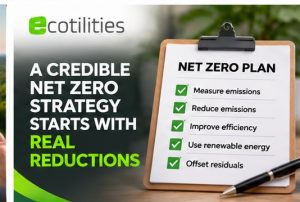
A credible net zero strategy starts with a measured emissions baseline, a clearly defined reporting boundary and time-bound reduction targets.
It then focuses on reducing emissions at source across the business’s operations and relevant value chain. This may involve improving energy efficiency, changing energy sources, investing in renewable electricity, installing on-site generation, electrifying suitable equipment and reducing emissions associated with purchased goods and services.
The business should monitor its progress and update its plans as better information becomes available.
Carbon credits, where used, need to be reported transparently and kept distinct from reductions in the company’s own emissions inventory. Credits used to support climate action beyond the company’s value chain can make a contribution, but they do not replace progress against its reduction targets.
Carbon removals have a specific role under recognised net zero frameworks: neutralising residual emissions that remain when the business reaches its net zero target, subject to the applicable requirements.
This approach provides a stronger commercial and reputational position because the business can explain its starting point, the reductions it has achieved and the work still required.
The Commercial Case for Reducing First
There is a practical business argument for putting emissions reductions ahead of relying on carbon credits.
Measures such as energy efficiency improvements, on-site solar and suitable electrification projects can reduce energy consumption, lower exposure to energy price volatility or improve operational performance. The actual savings and financial returns depend on the technology, installation costs, site conditions and how the equipment is used.
For example, an efficiency upgrade may reduce the amount of electricity required to operate a building or production process. On-site solar may reduce the volume of electricity purchased from the grid, depending on generation and consumption patterns. Electrification can reduce reliance on fossil fuels, although it may also increase electricity demand and require investment in new equipment or infrastructure.
Renewable electricity procurement can also contribute to a business’s energy and emissions strategy. However, the effect on reported emissions depends on the contractual arrangement and applicable accounting rules. Purchasing renewable electricity does not automatically demonstrate that the business has physically reduced emissions across the wider electricity grid.
Carbon credits have a different commercial function. They do not, by themselves, reduce the buyer’s energy consumption, improve equipment efficiency or lower its operational energy costs. They may support climate mitigation and deliver other environmental or social benefits, depending on the project, but those benefits are different from the direct operational savings that some reduction measures can deliver.
A strategy that spends its entire sustainability budget on credits while leaving practical efficiency and emissions reduction opportunities unexplored may therefore miss opportunities to improve both environmental performance and business operations.
What to Do With Offsets You Have Already Bought
Existing carbon credits do not necessarily need to be discarded. The important thing is to understand what was purchased, what the credits represent and whether the environmental claims made about them are justified.
Start by documenting:
- The project type and location.
- The standard or methodology under which the credits were issued.
- The project baseline and evidence of additionality.
- The independent validation and verification arrangements.
- Whether the credits represent emissions reductions or carbon removals.
- How permanence, reversal risks and potential double counting are addressed.
- Whether the credits have been retired and can be linked to the relevant environmental claim.
Credit quality varies considerably. A low purchase price does not automatically mean a credit is poor quality, just as a higher price does not guarantee a strong climate benefit. The underlying project, methodology, verification and risks all matter.
The business should also review how it describes the credits. If it has previously made a carbon-neutral or net zero claim, it should check the applicable standard, the emissions covered and the evidence supporting that statement. Where the claim is unclear or overstated, the wording should be corrected rather than defended without sufficient evidence.
Credits used to support climate action beyond the company’s value chain can be described transparently as a contribution, provided the wording accurately reflects what was purchased and does not imply that the company’s own emissions have been reduced.
The aim is not to ignore previous climate action. It is to distinguish that contribution from the emissions reductions the business still needs to achieve.
Who This Hits Hardest

- Businesses that have purchased carbon credits and describe themselves as carbon neutral without a documented emissions reduction programme behind the claim.
- Consumer-facing businesses whose environmental claims are visible to customers and may attract public or regulatory scrutiny.
- Suppliers whose customers have established emissions reduction targets and request evidence of progress throughout their supply chains.
- Businesses preparing tenders that specifically request emissions reduction evidence or a documented carbon reduction plan.
- Organisations that have made public sustainability commitments but cannot produce a measured baseline or explain the role of purchased credits.
Signs Your Strategy Is Leaning Too Hard on Offsets
- Purchasing carbon credits is the main or only action behind your public environmental claim.
- You cannot show a year-on-year trend in the emissions generated by your own operations and value chain.
- You do not have a documented emissions baseline or time-bound reduction targets.
- You have not examined the quality, methodology and retirement records of the credits you purchased.
- Your environmental claims do not clearly distinguish emissions reductions from credits used to support climate projects.
- You have not assessed practical opportunities to reduce energy consumption or emissions across your operations.
Moving from an offset-led approach to a credible strategy does not mean discarding everything the business has already done. It means putting measurement and emissions reduction first, understanding the role of credits and being transparent about what has actually been achieved.
Businesses that make this shift can change the conversation with customers. Instead of simply defending an environmental label, they can explain their progress: here is our baseline, here is what we have reduced, here is what we plan to address next and here is how we are dealing separately with the emissions that remain.
That is a much stronger position to communicate and substantiate.
Replace an Offset-Led Claim With a Strategy That Holds Up
A credible net zero strategy should be built around what your business can measure, reduce and demonstrate.
Ecotilities supports businesses with Net Zero planning and decarbonisation solutions, including renewable energy, solar and energy efficiency options. Speak to the team about understanding your energy use, identifying practical reduction opportunities and developing a more evidence-based approach to your sustainability goals.
Visit ecotilities.co.uk/net-zero or call 0333 4422 050.
Read Further: Scope 3 Emissions: What Your Customers Will Ask About First
Questions Businesses Ask
Is offsetting always wrong?
No. Carbon credits can support climate action by financing projects that reduce or remove greenhouse gas emissions. They should not, however, be treated as a substitute for reducing the emissions generated by your own business. Under recognised net zero frameworks, credits used for wider climate contributions are distinct from reductions against a company’s own targets. Carbon removals can also have a role in neutralising residual emissions when a business reaches its net zero target, subject to the applicable requirements.
What is the difference between carbon neutral and net zero?
The terms are not interchangeable. Carbon-neutral claims can be based on different standards and approaches, and may rely on purchasing credits to compensate for emissions within a stated boundary. The basis of the claim should be clearly explained, including the emissions covered, reductions achieved and credits used.
Net zero under recognised science-based frameworks requires deep emissions reductions across a company’s operations and value chain. Any residual emissions remaining at the net zero target year must then be neutralised through eligible carbon removals. Simply purchasing credits does not make a business net zero.
Could we face challenge over claims we have already made?
Yes, if an environmental claim is misleading, unclear or cannot be supported by appropriate evidence. A claim may attract scrutiny if the business does not explain which emissions are covered, how much has actually been reduced or how purchased credits have been used. Review existing claims against the relevant standards and advertising requirements, and correct wording that overstates what has been achieved.
How do we tell whether credits are good quality?
Look beyond the purchase price. Examine the project type, methodology, baseline, additionality and independent verification. You should also consider permanence, reversal risks, leakage and whether the credits have been retired to prevent double counting. The relevant registry and project documentation should provide information that allows you to understand what the credits represent and what climate benefit is being claimed.
Where do we start if we have only offset so far?
Start with a measured emissions baseline and a clear understanding of where your largest emissions come from. Establish a reporting boundary, identify practical reduction opportunities and set targets that can be monitored over time. You can then review existing credits separately and decide how to describe their contribution accurately. This gives your environmental claims a more credible foundation.
Does a first conversation cost anything?
Contact Ecotilities to confirm whether an initial discussion is free, what it covers and whether any subsequent Net Zero planning or implementation support carries a fee.