
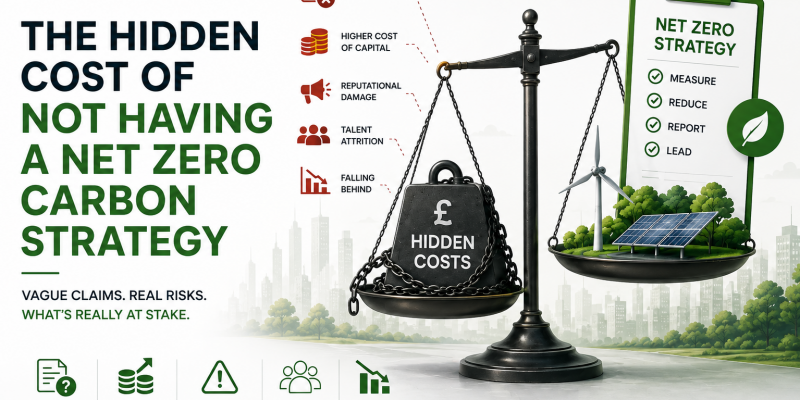
There’s a gap opening up between businesses that can produce a real net zero strategy on request and businesses that have a sentence about sustainability on their website.
That gap is now showing up directly in who wins contracts, who gets favourable lending terms, and who survives increasingly rigorous supply chain due diligence — and it’s widening fast as more of the market adopts these checks as routine rather than exceptional.
What ‘Real’ Looks Like – and Why Most Businesses Don’t Have It
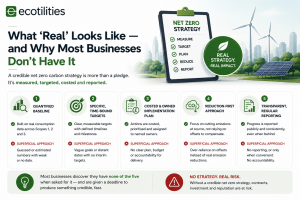
A genuine net zero carbon strategy is measured, targeted, costed and reported. It is not a pledge, a policy statement or a page of good intentions sitting on a website nobody has updated in two years. The five things that separate a credible strategy from a superficial one are a quantified baseline built on real consumption data, specific time-bound targets rather than a distant, vague date, a costed and owned implementation plan with named accountability, a reduction-first approach to emissions rather than reliance on offsetting to paper over inaction, and transparent, regular reporting that continues even when progress is behind schedule.
Most businesses that get asked for this by a customer or investor for the first time discover they have none of the five — and are given a deadline to produce something credible, fast, under real commercial pressure, often with the contract or investment decision hanging on the response.
Where This Actually Bites
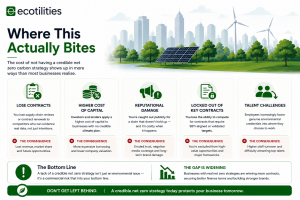
- Losing a supply chain review or contract renewal to a competitor who could evidence real data, not just intentions, when both suppliers were otherwise comparable on price and delivery
- Investors and lenders applying a higher cost of capital to businesses with no credible climate plan, treating the absence of one as a proxy for wider governance weakness
- Being caught out publicly for a claim that doesn’t hold up — increasingly scrutinised by journalists, campaigners and even competitors looking for an opening, and reputationally costly when it happens
- Losing the ability to compete for contracts that require SBTi-aligned or equivalent validated targets, which is becoming a standard clause in larger procurement frameworks
- Employee attrition and recruitment difficulty in sectors where candidates increasingly factor an employer’s genuine environmental credentials into where they choose to work
Why This Is Harder to Get Right Than It Looks
The businesses that get caught out aren’t usually lying deliberately — they’re mostly just guessing at their own numbers because proper measurement across Scope 1, 2 and 3 emissions is genuinely difficult without the right tools, data access and methodology. A baseline built on estimates rather than actual data falls apart the moment someone asks a follow-up question about the assumptions behind it, and a strategy built on a shaky baseline is worse than no strategy at all — because now you’ve made a claim you can’t defend under any real scrutiny, which is a materially worse position than simply not having claimed anything yet.
Scope 3 emissions in particular — covering purchased goods, business travel, waste and the emissions embedded in your supply chain — are where most businesses have the least visibility and the most work to do. For many organisations, Scope 3 represents the majority of their total footprint, meaning a strategy that only addresses Scope 1 and 2 is addressing the smaller part of the problem while claiming to have solved the whole thing.
The Compounding Effect of Delay
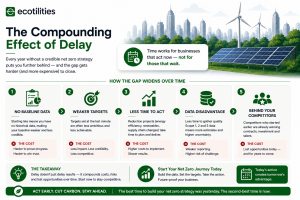
Every year without a credible strategy is a year further behind competitors who started earlier, because carbon strategies genuinely benefit from time — targets set further in advance are more achievable, baseline data collected over multiple years is more robust, and reduction measures like renewable energy contracts and efficiency upgrades take time to implement and show results.
A business starting from scratch under deadline pressure from a lost tender is in a fundamentally weaker position than one that began building this capability proactively, well before it was demanded of them.
Who This Actually Hits Hardest
- Businesses in the supply chain of large listed companies with their own mandatory climate disclosure obligations to satisfy
- Businesses in sectors with high public scrutiny — food and drink, retail, manufacturing — where sustainability claims are more likely to be checked
- Businesses pursuing ESG-conscious investors or acquirers who conduct genuine due diligence on carbon claims, not just a website check
- Businesses that made an early sustainability claim without the data to support it, now facing pressure to substantiate it
Signs Your Current Claims Won’t Survive Scrutiny
- Your published carbon figures are estimates rather than figures calculated from actual consumption and activity data
- You’ve made a public sustainability claim you couldn’t fully explain if a journalist or customer asked a follow-up question
- Your targets were set to sound ambitious rather than checked against what your business can realistically deliver
- You have no Scope 3 data at all, despite it likely being the largest part of your footprint
- Nobody in the business is formally accountable for tracking or reporting progress
|
Questions Businesses Ask Before Starting
A customer has given us a deadline to produce a plan — can this move fast?
A credible Scope 1 and 2 baseline with near-term targets can be produced quickly enough to meet most customer deadlines — full Scope 3 mapping takes longer and can be flagged as in progress, which is standard practice and accepted by most reviewers who understand the genuine complexity involved.
We already have a sustainability policy — isn’t that enough?
Not for buyers or investors doing real due diligence. A policy is a statement of intent; a strategy is measured, targeted and costed. The two get asked for separately increasingly often, and a policy alone won’t satisfy a request for the latter, particularly from procurement teams that have seen the difference before.
What if our numbers aren’t good and we’re worried about how they’ll look?
A poor baseline with a credible improvement plan is viewed far more favourably than no data at all or a suspiciously polished claim with nothing behind it — transparency about where you’re starting from is part of what makes a strategy credible, and most reviewers are far more concerned with the trajectory than the starting point.
How detailed does Scope 3 reporting actually need to be to satisfy most requests?
This varies significantly by who is asking and why, but most initial requests can be satisfied with a reasonable estimate of your largest Scope 3 categories rather than a complete inventory of every category from day one — precision can be built up over successive reporting cycles as data access improves.
Can we use offsetting while we work on genuine reduction?
Sparingly and transparently, yes — but it should never be presented as equivalent to reduction, and it should be positioned clearly as a bridge for residual emissions rather than the primary strategy. Buyers and investors are increasingly wary of businesses that lead with offsetting rather than reduction.
What’s the biggest single mistake businesses make when building this for the first time?
Publishing a target before confirming it’s achievable given the business’s actual resources and timeline. An ambitious target set to look impressive, then missed without explanation a year later, does more damage than a modest target that gets hit consistently.