

Identifying a billing error is only half the job. The other half — actually getting the supplier to accept the claim and issue a refund — is where a meaningful number of otherwise valid claims quietly fail, not because the underlying error wasn’t real, but because the claim wasn’t built well enough to survive the supplier’s own review process. Suppliers don’t refund money simply because a discrepancy is pointed out; they require a properly evidenced case, and the gap between spotting a probable error and building a claim that actually gets paid is considerably wider than most businesses expect.
This distinction matters enormously in practice. A business that identifies what looks like an overcharge, raises it informally with a phone call or a brief email, and receives a generic rejection, often concludes there was never really a valid claim in the first place. In reality, the claim may have been entirely valid — it simply wasn’t presented in a way the supplier’s own dispute process was set up to accept.
Why Claims Get Rejected Even When the Underlying Error Is Real
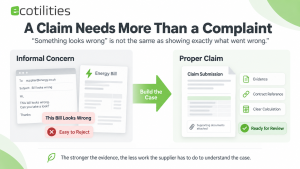
- Insufficient supporting evidence — a claim asserting an error without the specific contract clauses, meter data and calculation showing exactly how the correct figure was derived gives the supplier no clear basis to agree
- Claims raised informally through general customer service channels, which are typically not equipped or authorised to investigate detailed billing discrepancies the way a dedicated dispute or claims process is
- Vague framing that describes a general sense that something seems wrong, rather than a precise, quantified figure with a clear calculation the supplier can directly verify or dispute
- Claims submitted without reference to the specific contract terms or tariff documentation that establish what the correct charge should have been in the first place
- A lack of persistence — many suppliers’ first response to any claim is a standard rejection, and a claim that isn’t escalated or followed up often ends there regardless of its underlying merit
What a Properly Built Claim Actually Includes

A claim with a genuine chance of success sets out precisely what was charged, precisely what should have been charged, the specific contract clause or published tariff rate supporting that calculation, and the exact billing periods affected — presented in a format the supplier’s dispute team can verify against their own records without having to reconstruct the argument themselves. The more work the claim does to make verification straightforward for the supplier, the higher the likelihood of a timely, favourable outcome rather than a reflexive rejection.
Why Suppliers’ Default Response Tends Toward Rejection
It’s worth understanding the incentive on the other side of this conversation. A supplier’s dispute team processes a high volume of claims, many of which are genuinely unfounded or based on a misunderstanding of the contract terms. A quick, generic rejection is often the path of least resistance for a first response, and it costs the supplier nothing if the claimant doesn’t push back. This isn’t necessarily bad faith — it’s simply how a high-volume process defaults to behave, and it means a claim’s success often depends as much on how it’s pursued after an initial rejection as on the merit of the original claim itself.
Who This Actually Hits Hardest
- Businesses that identify a probable billing error internally but lack the specific expertise to build a properly evidenced claim around it
- Businesses that raise concerns informally through general customer service channels rather than a dedicated billing dispute process
- Businesses that accept a first rejection at face value without escalating or providing additional supporting evidence
Signs a Past Claim May Have Been Wrongly Rejected
- You previously raised a billing concern that was rejected, but the rejection didn’t specifically address the calculation or evidence you provided
- Your original claim was based on a general sense that a bill seemed high, rather than a precise, contract-referenced calculation
- You didn’t escalate or follow up after an initial rejection, and the matter was simply left there
Getting a legitimate historical claim across the line means building it properly from the outset — precise, evidenced, and referenced against the specific contract terms — and being prepared to escalate and follow through rather than accepting a first-response rejection as the final word, since that first response is often more a reflection of the supplier’s default process than a genuine assessment of the claim’s underlying merit.

| Get Your Claim Built Properly the First Time
Ecotilities builds fully evidenced billing claims and manages the process through to resolution, including escalation where an initial response falls short. Visit ecotilities.co.uk/bill-validation or call 0333 2244 050. |
Questions Businesses Ask
We had a claim rejected before — is it worth revisiting?
Often yes, particularly if the original claim wasn’t backed by detailed evidence or wasn’t escalated beyond a first rejection — a properly rebuilt claim can succeed where an informal one didn’t.
How long does a properly built claim typically take to resolve?
This varies by supplier and complexity, but a well-evidenced claim generally moves faster through a supplier’s process than one requiring back-and-forth clarification.
Do we need to have raised the issue with our supplier first before pursuing this properly?
Not necessarily — a fresh, properly evidenced claim can be the first formal approach, and often achieves a better outcome than an informal query followed up later.
What if the supplier still rejects a properly evidenced claim?
A well-built claim can be escalated further, including through formal dispute resolution routes where appropriate, rather than accepted as final at the first response.
Does building a proper claim require us to prove anything beyond what we already suspect?
It requires converting a suspicion into a precise, evidenced calculation referenced against your specific contract — which is exactly the part most businesses lack the expertise or time to do well themselves.
Is there a cost to having a claim built and pursued on our behalf?
No — this is included as part of the bill validation service, with fees only applying if the claim is successful and a refund is secured.