
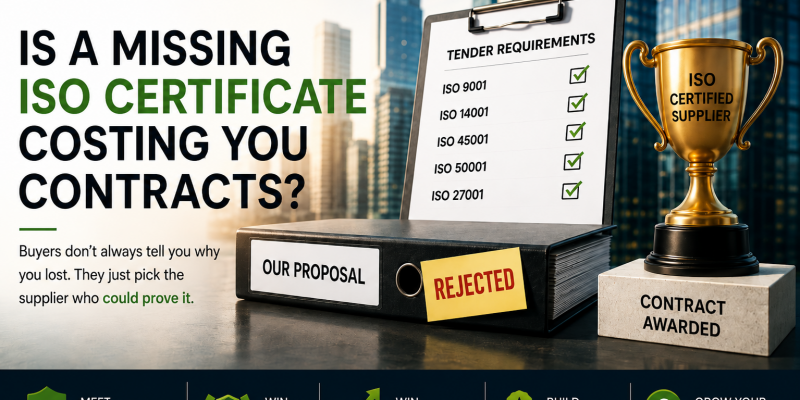
If your business has been shortlisted for a tender and then quietly dropped once the buyer reached the compliance section, there’s a decent chance the reason was sitting in a checkbox you couldn’t tick — ISO 9001, ISO 14001, ISO 45001, ISO 50001 or ISO 27001. Procurement teams don’t always tell you why you were rejected. They just move on to the supplier who could evidence it, and you never find out that a certificate — not your price, not your capability — was the reason you lost.
This is not a niche problem. UKAS-accredited certification is now a standard prequalification requirement across public sector frameworks and a growing number of large private sector supply chains — construction, manufacturing, facilities management, professional services, technology and finance all now filter suppliers this way as a matter of course. Every tender cycle you sit out because you can’t tick that box is revenue going straight to a competitor who invested in certification before you did.
The Real Cost of Not Being Certified
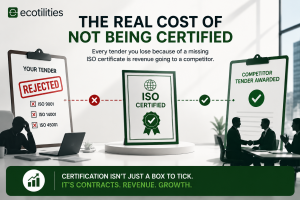
- Automatic disqualification from public sector frameworks that mandate ISO 9001 or ISO 14001 as a minimum entry requirement — you don’t get evaluated on price or capability, you’re simply not in the pool
- Exclusion from large corporate supply chains that increasingly require ISO 27001 for any supplier handling their data, regardless of how good your security actually is in practice
- Losing ground to smaller, less experienced competitors who simply got certified first and now appear more credible on paper than you do
- Higher insurance premiums and harder-to-win client trust in sectors where ISO 45001 signals safety maturity to clients and insurers alike
- Missed access to the ESOS compliance efficiencies that ISO 50001 unlocks for qualifying organisations, meaning you pay twice for overlapping compliance work you didn’t need to duplicate
Which Standard Is Actually Blocking You?
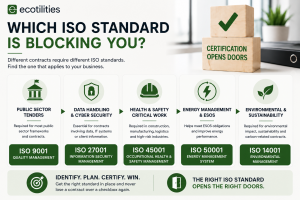
Most businesses only discover which standard they need after losing a tender because of it — the certificate requirement is often buried in a prequalification questionnaire that gets skim-read under deadline pressure, and the rejection that follows doesn’t come with a clear explanation. Rather than wait for the next rejection to tell you what you’re missing, here is the fast way to work out where your exposure actually sits:
- Losing public sector tenders → ISO 9001 is almost always the first gate, with ISO 14001 close behind on anything involving environmental impact
- Losing supply chain deals over data handling questions → ISO 27001, particularly in finance, legal, technology and healthcare
- Working in construction, manufacturing or logistics and getting extensive safety questionnaires → ISO 45001
- Carrying ESOS obligations you’d rather simplify, or facing energy management questions from clients → ISO 50001
- Being asked for sustainability or carbon evidence you can’t currently produce → ISO 14001
Certification is not something you can bolt on the week before a tender deadline. The audit process, evidence-gathering and implementation period mean the businesses that win tenders are the ones who got certified months before the opportunity appeared — not the ones scrambling once they see it on a questionnaire with two weeks to submission.
Why Most Businesses Get This Wrong Doing It Alone
ISO certification looks straightforward from the outside — a policy document here, a procedure there, a certificate at the end. In practice, the businesses that fail their Stage 2 audit are almost always the ones that treated it as a paperwork exercise rather than building a system that genuinely reflects how they operate. Auditors interview staff directly. They ask for evidence, not policies — records of actual decisions, actual nonconformities, actual corrective actions taken. A management system built from a downloaded template, with your logo added and no real implementation behind it, gets picked apart in the audit room within the first hour.
The businesses that pass first time are the ones where the documentation matches what staff actually say happens day to day — which means the system has to be built around your real processes, not a generic best-practice framework that doesn’t map onto how your business actually operates. That distinction is where most self-managed and cut-price certification attempts fall down.
What Happens While You Wait
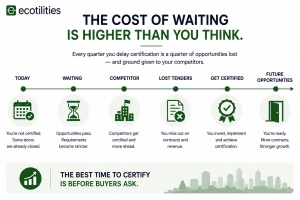
Every quarter without certification is a quarter where the tender pipeline you can see — the frameworks you know require it, the supply chain reviews you know are coming — stays closed to you while competitors who already hold the certificate keep winning. The gap doesn’t stay static either: as certification becomes more standard across your sector, buyers get less tolerant of suppliers without it, and the businesses still uncertified increasingly look like the outliers rather than the norm.
Who This Actually Hits Hardest
- Construction, engineering and manufacturing subcontractors bidding into main contractor supply chains that mandate ISO 9001 and ISO 45001 as standard entry conditions
- Technology, finance and healthcare suppliers being asked for ISO 27001 evidence before a data processing agreement will even be considered
- Facilities management and outsourced service providers competing for public sector framework positions that renew every three to four years
- Fast-growing SMEs stepping up from smaller private clients into their first public sector or corporate framework opportunity, and discovering the entry bar has moved
Signs You’re Already Exposed
- You’ve been shortlisted for a tender and then heard nothing further with no real explanation given
- A prequalification questionnaire has asked for a certificate number you don’t have
- A client or prospect has mentioned they’re ‘reviewing supplier accreditation’ without further detail
- A framework you’ve previously supplied into has reopened for retender with tightened entry criteria
- Competitors smaller than you are appearing on preferred supplier lists you’re not on
| Stop Losing Tenders Over a Certificate You Don’t Have
Ecotilities provides fixed-cost ISO consultancy for 9001, 14001, 45001, 50001 and 27001 — built around how your business actually operates, not a generic template. Find out which standard is costing you work and what it takes to fix it. Visit ecotilities.co.uk/iso-standard-certification or call 0333 2244 050. |
Common Questions From Businesses Losing Tenders Over ISO
How fast can we actually get certified before a deadline?
It depends entirely on how far your current practices are from the standard’s requirements — which is exactly what a gap analysis establishes in the first conversation. Businesses that start early consistently win more tenders than those trying to compress the process against a deadline, so the honest answer is usually ‘not for this specific tender, but in time for the next one.’
Can we get certified in just one standard and add others later?
Yes — most businesses start with ISO 9001 as it’s the most commonly required, then add ISO 14001 or others as specific tenders or clients demand them. Standards sharing the Annex SL structure (9001, 14001, 45001) are cheaper and faster to add together than pursued separately later, so it’s worth mapping out likely future requirements before you commit to just one.
Is a cheap, fast ISO certificate from a non-UKAS body worth it?
No — and this catches businesses out regularly. Non-UKAS certification is not accepted by most public sector buyers or large corporate procurement teams, so a business can end up holding a certificate that doesn’t actually open the doors it was bought to open. Always confirm UKAS accreditation before committing to any certification body.
We’ve been rejected from a tender before — how do we find out if ISO was the reason?
Most public sector procurement is required to provide feedback on request, and it’s worth asking directly. If the feedback references compliance, accreditation or quality management systems, that’s almost always pointing at a missing ISO certificate rather than anything to do with your actual bid quality.
Does having ISO 9001 guarantee we’ll win more tenders?
No — it removes a disqualification risk, it doesn’t win the bid for you. What it does is put you back in competition for opportunities you were previously excluded from before evaluation even started, which for many businesses is the larger part of the problem.
How long does certification typically stay valid before we need to worry about it lapsing?
Three years, with annual surveillance audits in between to keep it active. A lapsed certificate is often worse for your credibility with a buyer who checked your status before than never having held one — treating it as maintained infrastructure rather than a one-off achievement matters.