
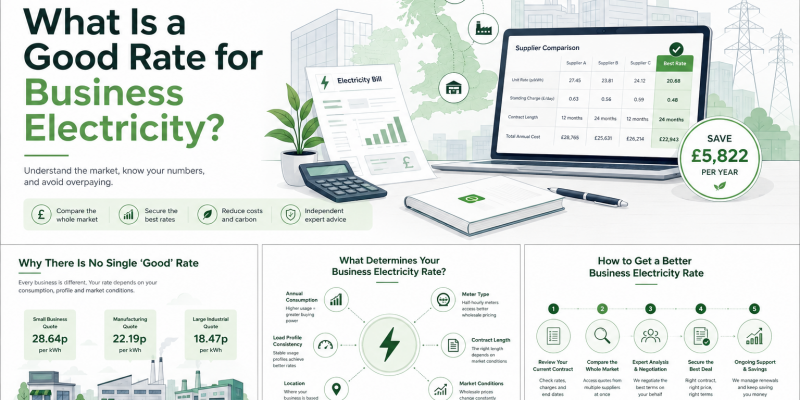
One of the most common questions we hear from business owners and finance managers is: are we paying a good rate for our electricity? It is a deceptively simple question with a surprisingly complex answer — because what constitutes a good rate depends on a range of factors specific to your business, and because the market is constantly moving.
This guide gives you a clear, honest picture of what business electricity rates look like in 2026, what factors determine the rate your business can access, the warning signs that suggest you are overpaying, and what practical steps you can take to secure a better deal.
Why There Is No Single ‘Good’ Business Electricity Rate
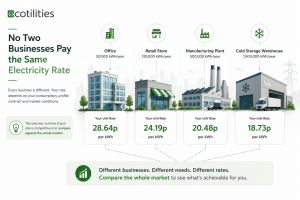
Unlike domestic energy — where the price cap creates a reference point everyone can compare against — business electricity has no equivalent benchmark. Every business electricity contract is priced individually by suppliers based on your specific consumption profile, and the rate that represents excellent value for one business may be above market rate for another.
This is important to understand because it means you cannot judge your rate against a single published figure and conclude you are getting a good deal. The only way to know whether your current rate is competitive is to compare it against live quotes from the whole market — which is exactly what an independent energy broker does.
That said, understanding the typical ranges that different types of businesses pay — and the factors that push rates up or down — gives you a useful framework for assessing where you stand.
Average Business Electricity Rates in the UK in 2026
Business electricity rates fluctuate with the wholesale energy market, so any published figures become outdated quickly. With that caveat clearly stated, here is a broad picture of the ranges typically seen for business electricity unit rates in the UK in early 2026:
| Business Type | Typical Unit Rate Range | Key Factor |
| Small business (low consumption) | 24p – 32p per kWh | Higher unit rates due to lower buying power |
| Medium business (moderate consumption) | 20p – 27p per kWh | Access to more competitive rates with right broker |
| Large business (high consumption / HH meter) | 18p – 25p per kWh | Bespoke tender pricing; best rates through whole-market procurement |
| Out-of-contract / deemed rate | 35p – 50p+ per kWh | Significantly above market — switch immediately |
Important: these are indicative ranges only. Your actual rate will depend on your specific consumption profile, contract type, meter type, location and the market conditions at the time you procure. The only way to know your achievable rate with certainty is a live whole-market comparison.
It is also worth noting that the unit rate is only part of your total electricity cost. Your bill also includes a daily standing charge and a range of non-commodity charges — network distribution fees, climate levies and balancing charges — which can account for 40 to 60 percent of your total bill depending on your contract type. A low unit rate with high non-commodity charges can easily end up more expensive than a slightly higher unit rate on a well-structured fully-fixed contract.
What Determines Your Business Electricity Rate?
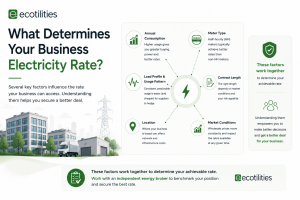
Understanding the factors that influence your rate helps you identify where you have room to negotiate and what actions are likely to improve your position.
Annual Consumption Volume
The single biggest factor. Higher consumption gives you greater buying power — suppliers offer lower unit rates to larger customers because the margin opportunity is bigger. A business consuming 500,000 kWh per year will consistently achieve better unit rates than one consuming 50,000 kWh, everything else being equal.
Meter Type
Businesses with half-hourly (HH) meters — typically those consuming more than 100,000 kWh annually — are settled in the wholesale market every 30 minutes, giving suppliers a much more detailed and accurate picture of consumption. This reduces risk for the supplier and typically translates into better rates for the customer. Non-half-hourly (NHH) meters are settled on estimates and profiles, which means suppliers price in more risk.
Load Profile and Usage Pattern
When and how consistently you use energy matters. A business with a smooth, predictable usage pattern across the day and week is easier and cheaper for a supplier to hedge than one with sharp peaks and troughs or highly seasonal patterns. Businesses with favourable load profiles often achieve better rates as a result.
Contract Length
Longer contracts give suppliers more certainty and can result in marginally better rates. However, locking in for three years when the market is at a high can significantly outweigh any discount for contract length. The right contract length depends on where the market is at the time of procurement — which is why market intelligence matters.
Credit Rating and Payment History
Suppliers assess your credit risk before offering pricing. Businesses with strong credit ratings and clean payment histories are seen as lower risk and can access better rates. Late payments, CCJs or poor credit scores can result in surcharges or security deposits that effectively increase your effective unit rate.
Wholesale Market Conditions at Time of Purchase
The wholesale price of electricity at the point you fix your contract is embedded in your rate for the duration of that contract. This is why timing matters — businesses that procure when the wholesale market is elevated lock in high costs, while those that procure at lower points in the cycle benefit for the entire contract term.
How You Procure
How you go about buying energy matters enormously. Businesses that accept renewal quotes from their existing supplier without comparing the market almost always pay more than necessary. Those that run a competitive whole-market tender through an independent broker consistently achieve better rates — because competition between suppliers drives pricing down.
Warning Signs That You Are Paying Too Much for Business Electricity
Even without running a formal comparison, several signals suggest your current electricity rate may not be competitive:
- You are out of contract — if your contract has expired and you have not switched, you are almost certainly on a deemed or out-of-contract rate that is significantly above market. This is one of the most expensive situations to be in and should be addressed immediately.
- You have not compared in over 12 months — the energy market moves continuously. A rate that was competitive 18 months ago may now be above the current market, particularly if wholesale prices have moved significantly in that period.
- You accepted your supplier’s renewal quote without shopping around — suppliers routinely offer renewal rates that are higher than what is achievable through competitive procurement. Accepting the first quote is almost never the most cost-effective approach.
- Your unit rate is above 30p per kWh — while this is not a hard rule, most medium-sized and large businesses should be able to achieve rates below this level through competitive procurement in the current market.
- Your bills have never been independently validated — billing errors are more common than most businesses realise. Duplicate charges, incorrect meter readings, wrong VAT rates and CCL overcharges regularly appear on business energy bills and go undetected. An energy bill validation service can identify and recover these overcharges.
- Your energy costs have risen faster than consumption — if your bills have increased significantly but your usage has not changed materially, your rate has likely risen through an unfavourable contract rollover or renewal.
Is Business Electricity Cheaper Than Domestic Electricity?
This is one of the most frequently asked questions about business energy, and the honest answer is: it depends.
For large businesses with high consumption, access to bespoke wholesale-linked pricing means the unit rate can be lower than typical domestic tariffs. For small businesses, the unit rate may actually be comparable to or even higher than domestic rates — particularly when the business lacks the volume to attract competitive pricing.
There are also two important differences that mean direct rate comparisons between business and domestic are misleading:
- VAT — domestic electricity is charged at 5% VAT. Business electricity is charged at 20% VAT (though charities, certain manufacturing businesses and other qualifying organisations may be eligible for the reduced 5% rate — speak to your energy advisor to check eligibility).
- No price cap — domestic energy is subject to the government’s energy price cap, which limits what suppliers can charge. Business energy has no equivalent protection. This means business rates are fully exposed to wholesale market movements — both upward and downward.
The bottom line: business electricity is not automatically cheaper than domestic. Whether you achieve better or worse rates than a domestic customer depends on your consumption, procurement approach and contract type.
How to Get a Better Business Electricity Rate
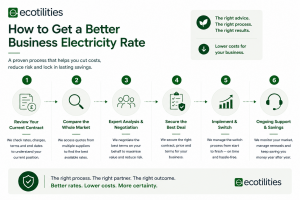
If you suspect you are not on the best available rate, or if any of the warning signs above apply to your business, here are the practical steps that will make the biggest difference:
- Run a whole-market comparison — the single most impactful action you can take. An independent energy broker will approach the full market on your behalf and present like-for-like quotes from multiple suppliers. This takes a few days and costs you nothing — brokers are paid by suppliers.
- Get your bills independently validated — before you switch, it is worth having your recent bills checked for errors. Bill validation often identifies overcharges that can be recovered — sometimes going back up to six years.
- Consider your contract type carefully — do not simply renew on the same contract structure out of habit. Your business circumstances and risk appetite may have changed. A broker can advise on whether a fixed, flexible, pass-through or fully-fixed contract best suits your current situation.
- Time your renewal strategically — if your contract is up for renewal in the next six months, consider where the wholesale market currently sits relative to historic levels. Your broker can advise on whether locking in now or waiting is likely to deliver better outcomes.
- Explore renewable options — 100% renewable electricity contracts are frequently available at equivalent or competitive rates compared to standard contracts. Switching to renewable energy supports your sustainability objectives at no additional cost premium in many cases.
- Review your meter type — if your consumption has grown significantly, it may be worth discussing whether upgrading to a half-hourly meter would give you access to better pricing. Your broker can advise on whether this makes financial sense for your business.
How Ecotilities Helps Businesses Find the Best Available Electricity Rate
Ecotilities is an independent business energy broker with access to the whole UK energy market. We work with businesses of all sizes — from small offices to large multi-site operations — running competitive tenders across our full supplier panel to find the most advantageous rates available.
What makes our approach different is that we do not just look at the unit rate. We compare the full cost of every contract — unit rate, standing charge, non-commodity charges, contract terms and exit provisions — and present our clients with a genuinely like-for-like comparison so the decision is straightforward.
We also provide ongoing account management throughout your contract — monitoring the market, providing weekly energy insights, alerting you to favourable renewal windows, and validating your bills to catch any errors before they accumulate.
Our service is free to businesses — we are paid by commission from the supplier you choose, which means there is no cost to you and no obligation to proceed if the rates we find are not competitive enough.
| Not Sure If You’re on a Good Business Electricity Rate?
Ecotilities runs a free whole-market comparison for your business — presenting live quotes from our full supplier panel so you can see exactly what is available. No obligation, no cost, no pressure. Visit ecotilities.co.uk/gas-electricity or call 0333 2244 050 to find out what rate is achievable for your business today. |
Frequently Asked Questions About Business Electricity Rates
What is the average business electricity rate per kWh in the UK?
As of early 2026, business electricity unit rates typically range from around 18p to 32p per kWh depending on consumption volume, contract type and market conditions. Larger businesses with higher consumption and half-hourly meters consistently achieve rates at the lower end of this range. Businesses on out-of-contract deemed rates can pay significantly more — sometimes 35p to 50p or above.
Are business electricity rates cheaper than domestic?
Not automatically. Large businesses with high consumption can access wholesale-linked rates that compare favourably with domestic tariffs, but small businesses often pay similar or higher unit rates than domestic customers. It is also important to note that business electricity is charged at 20% VAT versus 5% for domestic, and business rates are not protected by the domestic price cap.
What is a typical standing charge for business electricity?
Business electricity standing charges typically range from around 25p to 80p per day, though this varies considerably by supplier, meter type and location. It is also possible to access zero standing charge contracts, which are particularly cost-effective for businesses with low or intermittent energy use — you pay only for what you consume with no fixed daily charge.
How do I know if I am on an out-of-contract deemed rate?
Check your most recent energy bill or contact your supplier directly. If your contract end date has passed and you have not signed a new agreement, you will be on a deemed or out-of-contract rate — which is typically the most expensive tariff a supplier offers. If this applies to you, getting a market comparison and switching should be your immediate priority.
How often do business electricity rates change?
The wholesale energy market moves daily, and supplier pricing reflects these movements continuously. For businesses on flexible purchasing contracts, rates can change with every tranche of energy purchased. For businesses on fixed contracts, your rate is locked for the contract duration — but the rate available to new customers changes constantly. This is why timing your renewal well can make a significant difference to costs.
Can I negotiate my business electricity rate?
Yes — and you should. Business energy is not a take-it-or-leave-it product. Suppliers compete for business contracts and will often improve their initial quote when faced with genuine competition. Running a whole-market tender through an independent broker is the most effective way to create that competition and drive rates down — because suppliers know they are being compared directly against rivals.