
For large UK organisations, ESOS compliance is not optional. It is a legal obligation — and one that comes with a clear set of requirements, strict deadlines and meaningful penalties for those who fall short. Yet despite being in its fourth phase, a significant number of qualifying organisations still approach each compliance cycle reactively, scrambling to meet deadlines rather than managing the process strategically.
This guide is written for compliance officers, finance directors, sustainability managers and operations leads who need a clear, practical understanding of what ESOS compliance requires, what has changed in Phase 4, and what steps to take to ensure your organisation meets its obligations on time.
A Quick Recap: What Is ESOS and Who Must Comply?
ESOS — the Energy Savings Opportunity Scheme — is a mandatory energy assessment scheme for large UK organisations, introduced under the Energy Savings Opportunity Scheme Regulations 2014. It requires qualifying organisations to carry out structured audits of their energy use across buildings, industrial processes and transport, and to report their findings to the Environment Agency.
Your organisation qualifies for ESOS if it meets any one of the following criteria on the qualification date:
- 250 or more employees
- Annual turnover exceeding £44 million
- Annual balance sheet total exceeding £38 million
ESOS compliance applies at group level — meaning that if a parent company qualifies, all UK group members and subsidiaries are included within scope, regardless of their individual size. For a more detailed overview of who qualifies and what an assessment involves, see our guide: What Is ESOS? The Complete Guide for UK Businesses.
What Does ESOS Compliance Actually Require?
Achieving ESOS compliance means satisfying a set of specific obligations within each four-year compliance cycle. At its core, compliance requires your organisation to:
- Carry out an energy audit covering all areas of significant energy consumption across buildings, processes and transport
- Have the assessment signed off by a qualified ESOS Lead Assessor registered with an approved professional body
- Produce an ESOS report identifying energy saving opportunities and associated recommendations
- Prepare a written action plan setting out the measures your organisation intends to take (new requirement in Phase 4)
- Submit a Notification of Compliance to the Environment Agency via the ESOS online portal by the compliance deadline
- Report progress against your action plan at specified intervals throughout the compliance cycle
It is important to note that ESOS does not require you to implement the energy saving measures identified — only to carry out the assessment, produce the report and action plan, and submit your notification. However, Phase 4 has significantly strengthened the accountability requirements around action plans, making it harder to treat compliance as a paper exercise.
ESOS Phase 4 Compliance Timeline
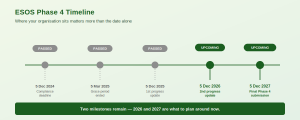
Phase 4 is the current ESOS compliance cycle. Understanding where your organisation sits relative to the key Phase 4 milestones is essential for planning your compliance activity.
| Date | Status | Milestone |
| 5 December 2024 | PASSED | Phase 4 compliance deadline — action plan required |
| 5 March 2025 | PASSED | Grace period for action plan submission ended |
| 5 December 2025 | PASSED | First progress update against action plan due |
| 5 December 2026 | UPCOMING | Second progress update against action plan due |
| 5 December 2027 | UPCOMING | Final ESOS Phase 4 submission deadline |
If your organisation has missed any of the passed deadlines above, it is not too late to act — but you should seek advice from a qualified ESOS Lead Assessor promptly. Late compliance is significantly preferable to continued non-compliance, and early engagement with the Environment Agency where deadlines have been missed is generally viewed more favourably than waiting to be contacted.
The Three Routes to ESOS Compliance
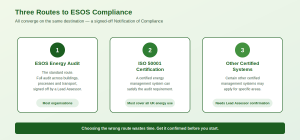
There are three recognised routes through which an organisation can achieve ESOS compliance. Understanding which route or combination of routes applies to your organisation is an important early step in the compliance process.
Route 1: ESOS Energy Audit
The most common route. A qualified Lead Assessor conducts a structured energy audit covering your organisation’s buildings, processes and transport. The audit identifies significant energy consumption areas and energy saving opportunities. This route applies to all organisations that do not qualify under Route 2 or Route 3 for the relevant areas.
Route 2: ISO 50001 Certified Energy Management System
Organisations holding a valid ISO 50001 certification that covers all of their UK energy consumption can use this as an alternative compliance route for the areas covered by the management system. ISO 50001 is a rigorous international standard for energy management — achieving certification demonstrates that your organisation has embedded systematic energy management into its operations, which satisfies the intent of ESOS for those areas.
It is important to note that ISO 50001 certification must cover the totality of the organisation’s energy use to fully satisfy ESOS. Where it covers only part of the business, an ESOS energy audit (Route 1) is still required for the uncovered areas. A Lead Assessor must still be involved to confirm the scope and approve compliance.
Route 3: Other Certified Energy Management Systems
Certain other certified energy management or environmental management systems — such as ISO 14001 where it includes a compliant energy audit — may satisfy ESOS requirements for specific areas. This route is more limited and requires careful assessment by a Lead Assessor to confirm eligibility.
What Is an ESOS Action Plan and Why Does It Matter in Phase 4?
One of the most significant changes in ESOS Phase 4 is the mandatory requirement for an action plan. In previous phases, organisations could complete the assessment and submit their notification without committing to any specific follow-up actions. Phase 4 changes this fundamentally.
Your ESOS action plan must:
- Document the energy saving measures your organisation intends to implement based on the assessment findings
- Set timelines and ownership for each measure
- Be referenced in subsequent ESOS assessments to demonstrate progress
- Include explanations where committed measures have not been implemented
This shift signals a clear policy direction: ESOS is no longer intended to be a compliance-only exercise. The Environment Agency expects organisations to use the assessment findings to drive genuine energy efficiency improvements — and Phase 4’s accountability mechanisms are designed to create that expectation formally.
For organisations that approach ESOS strategically, the action plan also provides a natural starting point for a broader net zero strategy — translating compliance data into a practical roadmap for decarbonisation.
Common Reasons Businesses Fail ESOS Compliance
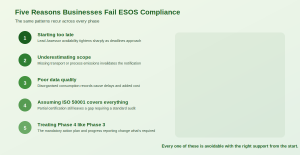
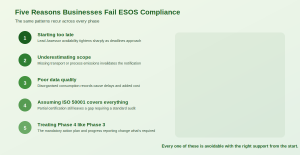
Having worked with organisations across multiple ESOS phases, the same patterns of non-compliance tend to recur. Being aware of them is the first step to avoiding them.
Starting too late
Qualified ESOS Lead Assessors are in high demand as deadlines approach. Organisations that leave the process too late find that assessor availability is limited, timelines are compressed, and the quality of the assessment suffers. Starting at least six months before the compliance deadline is strongly recommended.
Underestimating scope
Many organisations focus on their buildings and overlook transport and industrial processes. ESOS requires coverage of all significant energy consumption areas. Missing a material energy stream from the assessment can invalidate your compliance notification.
Poor data quality
ESOS assessments are only as good as the underlying data. Organisations that lack organised, accessible records of their energy consumption — particularly for transport and processes — experience significant delays and additional costs during the assessment process.
Assuming ISO 50001 covers everything
ISO 50001 certification is a valuable ESOS compliance route, but only where it genuinely covers all UK energy consumption. Organisations that assume their certification satisfies the full ESOS obligation — without verifying scope with a Lead Assessor — can find themselves non-compliant.
Treating Phase 4 like previous phases
Phase 4 introduces the mandatory action plan and progress reporting requirements. Organisations that approach Phase 4 with the same minimal-effort mindset from earlier phases risk non-compliance through failing to produce or report on their action plan.
How to Become ESOS Compliant With Ecotilities
Ecotilities provides fully managed ESOS compliance support for qualifying UK organisations. We handle every stage of the process so your compliance team can focus on running the business rather than managing the assessment.
Our ESOS compliance service includes:
- Initial scoping to confirm whether your organisation qualifies and which compliance route applies
- Matching you with the right Lead Assessor from our pool of qualified specialists, selected for their experience in your specific sector
- Full site audits covering buildings, processes and transport with clear data collection support
- ESOS report production and action plan development
- Notification of Compliance submission to the Environment Agency
- Progress reporting support at the Phase 4 interim deadlines in 2026 and 2027
We also connect ESOS findings with our wider range of energy and sustainability services — including ISO 50001 energy management certification, net zero pathway planning and renewable energy procurement — so your compliance work becomes the foundation of a broader, long-term energy strategy rather than a standalone obligation.
| Need Support Achieving ESOS Compliance?
Whether you are starting your Phase 4 assessment or need help with progress reporting, our team of qualified Lead Assessors is ready to help. Don’t let deadlines catch your organisation unprepared. Visit ecotilities.co.uk/esos or call 0333 2244 050 to speak to our ESOS team today. |
Frequently Asked Questions About ESOS Compliance
What is ESOS compliance?
ESOS compliance means satisfying all of the legal requirements of the Energy Savings Opportunity Scheme within the current four-year compliance cycle. This includes carrying out a qualifying energy assessment, having it approved by a Lead Assessor, producing an action plan, and submitting a Notification of Compliance to the Environment Agency by the required deadline.
What are the ESOS compliance requirements?
The core requirements are: a qualifying energy audit or certified management system covering all significant UK energy use, sign-off from a qualified Lead Assessor, an ESOS report and action plan, and submission of a Notification of Compliance to the Environment Agency. Phase 4 also requires progress updates against your action plan in 2026 and 2027.
Can ISO 50001 replace an ESOS assessment?
ISO 50001 certification can satisfy the energy auditing requirement for areas it covers, but it does not automatically replace the full ESOS assessment. A Lead Assessor must still confirm scope and approve compliance. For areas not covered by the ISO 50001 system, a standard ESOS energy audit is still required.
What is ESOS compliance guidance?
The Environment Agency publishes official ESOS compliance guidance on GOV.UK, which sets out the legal requirements, qualification criteria, compliance routes and submission process. This guidance is updated when significant changes are made — such as the Phase 4 updates introducing mandatory action plans. Your Lead Assessor should always be working from the most current version of this guidance.
What happens if we miss the ESOS compliance deadline?
Missing the ESOS compliance deadline exposes your organisation to civil penalties from the Environment Agency. Penalties are applied on a case-by-case basis but can be substantial. If you have missed a deadline, the best course of action is to begin the compliance process immediately and, where appropriate, engage proactively with the Environment Agency. Late compliance is far preferable to continued non-compliance.
How is ESOS compliance different from SECR?
ESOS requires a detailed energy audit every four years and focuses on identifying energy saving opportunities. SECR (Streamlined Energy and Carbon Reporting) requires large UK companies to disclose their annual energy use and carbon emissions in their directors’ report. Both may apply to your organisation, and the data gathered for one can often support the other — a point worth discussing with your energy adviser.