
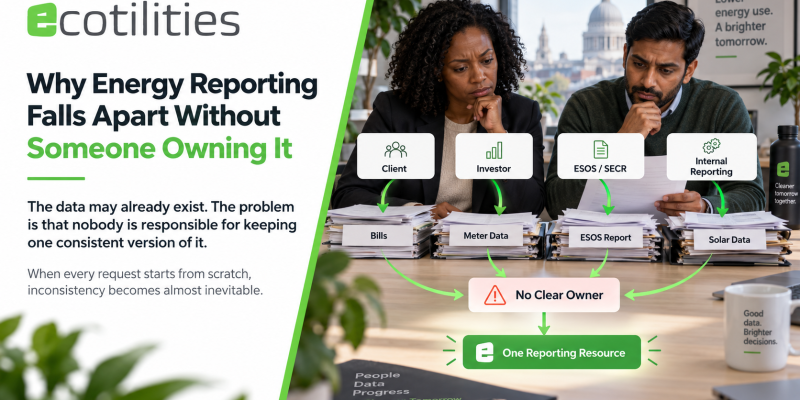
Requests for energy data now arrive at businesses from more directions simultaneously than at almost any point before — clients running supply chain due diligence, investors assessing ESG criteria, regulators enforcing SECR or ESOS, insurers reviewing risk, and internal stakeholders wanting visibility into cost trends.
Each request lands separately, often addressed to whoever happens to be available at the time, and answered in isolation without reference to what’s already been provided elsewhere. The result, in a lot of businesses, is a genuinely fragmented, inconsistent picture of energy performance that nobody has actually pulled together properly.
This fragmentation isn’t usually a sign that the underlying data doesn’t exist — most businesses do have energy consumption figures somewhere, in bills, in meter readings, in an ESOS report filed away after submission. The problem is that nobody has been given explicit ownership of consolidating that data into something coherent and consistently reportable, so every new request effectively starts from scratch, reconstructed under time pressure by whoever received it.
What Happens Without Clear Ownership
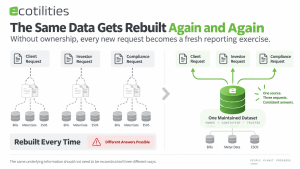
- Different departments respond to different energy data requests independently, sometimes providing inconsistent figures for what should be the same underlying consumption because each response was compiled separately without cross-reference
- Requests get answered reactively and often incompletely, under the specific time pressure of whatever deadline prompted the request, rather than drawn from an already-maintained, accurate dataset
- Genuinely valuable data — from ESOS assessments, from bill validation exercises, from solar generation records — sits in separate silos, never connected into a single coherent picture despite significant overlap between them
- The business’s ability to respond quickly and credibly to a new request depends entirely on who happens to receive it and how much time they can personally dedicate to reconstructing an answer under pressure
Why This Gets Worse, Not Better, Over Time
As more stakeholders begin asking for energy and sustainability data — a trend that shows no sign of reversing — the volume and frequency of requests only increases.
A business without clear ownership of this function finds the burden growing steadily heavier each year, with no corresponding improvement in how efficiently those requests are handled, because the underlying structural gap — nobody owns this — never gets addressed simply by absorbing more requests reactively.
What Clear Ownership Actually Changes
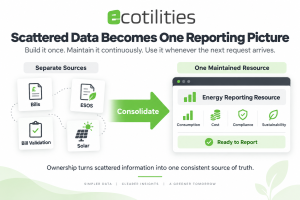
A business with someone explicitly responsible for energy data and reporting maintains a single, consistent, continuously updated picture of consumption, costs, compliance status and sustainability metrics — built once, then drawn on repeatedly for whatever specific request arrives next, rather than reconstructed from scratch each time.
This isn’t simply more efficient administratively; it also means every response is consistent with every previous one, which matters considerably when a sophisticated client or investor is cross-referencing what your business has said in different contexts over time.
Who This Actually Hits Hardest
- Growing businesses facing an increasing volume of client and investor sustainability requests without energy reporting ever having been formally assigned as anyone’s specific responsibility
- Multi-site businesses where energy data is held separately at each location, with no consolidated group-level reporting capability
- Businesses that have completed ESOS assessments, bill validation exercises, or solar installations, each producing valuable data that has never been connected into a single reporting resource
Signs Your Reporting Needs a Genuine Owner
- Different people in your business have provided inconsistent energy or sustainability figures to different external parties without anyone noticing the discrepancy
- Every new data request is treated as a fresh, standalone task rather than drawn from an existing, maintained resource
- You have valuable energy data scattered across ESOS reports, bill validation findings and other sources that has never been consolidated
- Nobody in your business could currently produce a consistent, accurate energy summary without needing several days to pull it together
Fixing this doesn’t necessarily mean hiring a dedicated internal role — it means someone, whether internal or an external specialist, taking explicit ownership of consolidating and maintaining your energy data as an ongoing function, so that whatever request arrives next, from whichever direction, can be answered quickly, consistently and credibly rather than reconstructed under pressure each time.

| Get Someone Genuinely Owning Your Energy Reporting
Ecotilities consolidates your energy data — procurement, compliance, sustainability — into a single, maintained resource, so every reporting request gets a fast, consistent, credible answer. Visit ecotilities.co.uk/bureau-services or call 0333 2244 050. |
Questions Businesses Ask
Does this require hiring a dedicated internal energy manager?
Not necessarily — this function can be provided externally as an ongoing service, which is often more cost-effective than a dedicated internal hire, particularly for small and mid-sized businesses.
What kind of requests does this actually help with?
Client supply chain questionnaires, investor ESG requests, regulatory reporting such as SECR or ESOS, insurer risk assessments, and internal cost reporting all draw on the same consolidated underlying data.
How long does it take to get from fragmented data to a properly consolidated picture?
This depends on how much existing data your business already has and how scattered it currently is, which a proper initial review establishes.
Does this connect to our existing ESOS or bill validation work?
Yes — this is specifically about connecting data you may already have from those exercises into a single, ongoing resource rather than duplicating work already done.
Is this only relevant for larger businesses facing frequent requests?
No — smaller businesses facing even occasional requests benefit from having a consistent, ready answer rather than reconstructing one from scratch each time, since the effort saved compounds over every future request.
Is an initial review of our current reporting position something we’d be charged for?
No — reviewing your current energy data and reporting position is free and carries no obligation.