

When a business gathers several commercial solar quotes side by side, it’s natural to gravitate toward the lowest number on the page. That instinct makes sense for most straightforward purchases, but commercial solar isn’t a commodity product where every quote represents an identical thing at a different price. A significantly cheaper quote is often cheaper because something material has been left out, downgraded, or assumed away — and the businesses that discover this do so after installation, when it’s considerably harder and more expensive to fix.
This isn’t to say every low quote is problematic, or that the most expensive option is automatically the best one. It’s simply that price comparison on its own, without understanding what’s actually included in each figure, is close to meaningless for a decision this significant, and businesses that skip the deeper comparison are effectively gambling on assumptions they haven’t verified.
Where the Gap Usually Hides
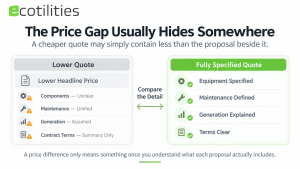
- Panel and inverter quality varies considerably between manufacturers, and cheaper components with shorter warranties and lower long-term efficiency retention are a common way to bring a headline quote down
- Installation standards and workmanship guarantees differ significantly between providers, with cut corners on mounting, cabling and structural assessment sometimes only becoming apparent years later through reduced performance or maintenance issues
- Maintenance and monitoring commitments are sometimes minimal or absent entirely from cheaper quotes, leaving the business responsible for identifying underperformance itself rather than having it proactively flagged
- Some quotes are based on optimistic generation estimates that don’t hold up against your actual site conditions, meaning the promised savings figure was never realistic in the first place
- PPA rate structures can include escalators or minimum purchase obligations buried in the small print that aren’t reflected in a simple headline rate comparison
Why This Is Particularly Risky With PPA Arrangements

With a funded PPA model specifically, the appeal of a lower headline rate is especially strong because there’s no upfront capital cost creating a natural moment of financial scrutiny.
A business signing a 15 to 25 year agreement based primarily on comparing headline PPA rates, without checking the escalator, the minimum purchase terms, the maintenance commitments and the transferability provisions behind each offer, is committing to a long-term arrangement on incomplete information — precisely the kind of decision that benefits most from proper due diligence before signing.
What a Genuinely Comparable Quote Actually Includes
A quote worth comparing properly should specify the exact panel and inverter manufacturers and models being proposed, the generation estimate methodology and assumptions behind the projected savings, the specific maintenance and monitoring commitments included, the full PPA rate structure including any escalator, and clear transferability and end-of-term provisions.
A provider unwilling or unable to provide this level of detail is, in itself, a meaningful signal worth paying attention to.
Who This Actually Hits Hardest
- Businesses under time or budget pressure who gather quotes quickly and default to the lowest number without a deeper comparison of what’s actually included
- Businesses without prior experience of commercial solar procurement, who don’t yet know which specific details separate a genuinely comparable quote from a superficially similar one
- Businesses relying on a single provider’s quote without ever benchmarking it against genuine market alternatives
Signs a Quote Deserves Closer Scrutiny
- A quote is noticeably lower than others you’ve received without an obvious explanation for the difference
- The provider has been vague or evasive about specific component manufacturers, generation methodology, or maintenance commitments when asked directly
- The proposed savings figures seem optimistic relative to what you understand about your site’s actual consumption and generation potential
- You haven’t seen the full PPA contract terms, only a summary headline rate, before being asked to commit
Getting genuine value from commercial solar means comparing quotes on the full picture, not the headline number alone — asking specifically what’s included, what’s assumed, and what happens if generation underperforms the initial estimate, before committing to an agreement that will likely run for a decade or more.
| Get a Solar Quote With Nothing Hidden in the Small Print
Ecotilities provides full, transparent commercial solar proposals with every component, assumption and contract term clearly set out — so you’re comparing like for like, not just headline numbers. Visit ecotilities.co.uk/solar-power-scheme or call 0333 2244 050. |
Questions Businesses Ask
How do we compare quotes properly if the formats look completely different?
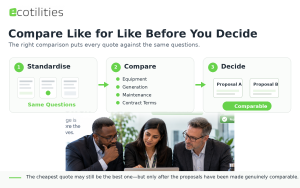
Asking every provider the same specific questions — component brands, generation methodology, maintenance terms, full PPA structure — is the most reliable way to create a genuinely comparable picture across different quote formats.
Is the cheapest quote ever actually the right choice?
Sometimes, if the lower price reflects genuine efficiency rather than missing detail — the key is establishing which of those two explanations actually applies before deciding.
What questions should we specifically ask a provider before committing?
Ask about component manufacturers and warranties, the methodology behind generation estimates, what maintenance is included, the full PPA rate structure including any escalator, and transferability terms.
Can we get an independent second opinion on a quote we’ve already received?
Yes — having an existing quote reviewed independently before signing is a reasonable and worthwhile step, particularly for a commitment of this length.
Does a more expensive quote always mean better quality?
Not automatically — price alone doesn’t confirm quality any more than it confirms a problem; the specifics behind the number are what actually matter.
Is getting a quote reviewed something we’d be charged for?
No — reviewing an existing quote or providing a comparable proposal of our own is free and carries no obligation.