
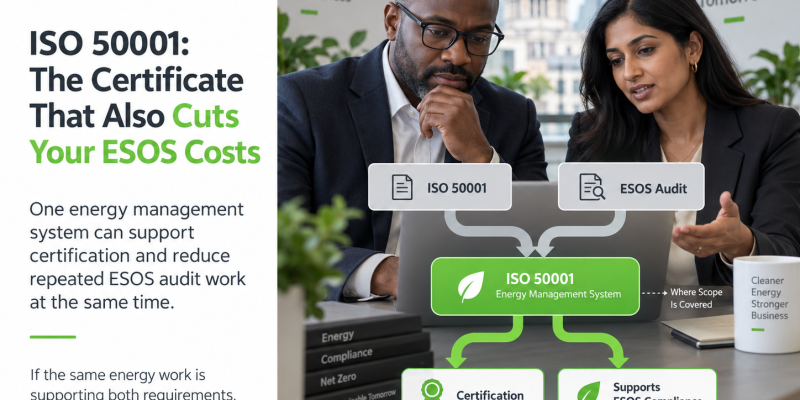
Most ISO standards deliver value in a single lane — quality, environmental management, information security, safety. ISO 50001 is unusual in that it does genuine double duty for qualifying UK organisations: it’s a respected energy management certification in its own right, and it can simultaneously reduce the cost and administrative burden of ESOS compliance for organisations that also fall under that separate regulatory obligation. Businesses that pursue the two requirements entirely separately, without recognising the overlap, are effectively paying twice for closely related work.
The connection exists because ISO 50001 certification can be used as an alternative compliance route for the ESOS energy audit requirement, for any areas the certification genuinely covers. An organisation that holds valid, properly scoped ISO 50001 certification doesn’t need to commission a full separate ESOS energy audit for those areas each phase — the certified management system satisfies the audit requirement directly, provided a Lead Assessor confirms the scope and signs off compliance.
Why This Combination Delivers Real Value
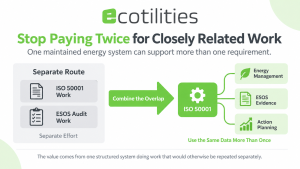
- A single, ongoing energy management system replaces the need for a separate standalone ESOS audit every four-year phase, reducing the repeated cost of commissioning fresh audit work each cycle
- The continuous, ongoing nature of ISO 50001 — with annual surveillance and structured improvement targets — delivers genuine energy management value between ESOS phases, unlike a standalone audit that captures only a point-in-time snapshot
- Data and processes built for ISO 50001 certification directly support ESOS Phase 4’s mandatory action plan and progress reporting requirements, since both are fundamentally asking for the same kind of structured, evidenced energy improvement planning
- Organisations already using ISO 50001 data for ESOS reporting have a natural, evidenced head start on wider net zero or carbon strategy work, since the underlying energy consumption data serves multiple purposes at once
What This Actually Costs Compared to Separate Routes
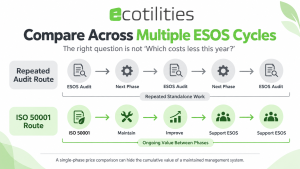
ISO 50001 certification carries genuine upfront and ongoing costs — implementation, certification body fees, annual surveillance — that a standalone ESOS audit doesn’t. But an organisation weighing the two options purely on the headline cost of certification versus a single audit is comparing the wrong things.
The proper comparison is the total cost across multiple ESOS phases: repeated standalone audits every four years, each commissioned separately, against one certification programme that satisfies ESOS on an ongoing basis while also delivering continuous energy management value the audit route simply doesn’t provide between cycles.
Where the Overlap Isn’t Complete
It’s worth being precise about the limits of this connection, since overstating it causes its own problems. ISO 50001 certification must genuinely cover all areas of UK energy consumption to fully replace the ESOS audit requirement — where certification only covers part of the organisation, a standard ESOS audit is still required for the uncovered areas.
A Lead Assessor also still needs to be involved to confirm scope and formally sign off compliance; the certification doesn’t remove that step entirely, it changes what underlies it.
Who This Actually Hits Hardest
- Organisations that have completed multiple ESOS phases via standalone audits without ever properly evaluating whether ISO 50001 would now be more cost-effective across future cycles
- Organisations already investing meaningfully in energy management internally, where formalising that work into ISO 50001 certification would capture recognised value they’re not currently getting credit for
- Organisations facing both ESOS obligations and separate client or tender pressure for energy management certification, who haven’t recognised these as a single combined opportunity
Signs This Combination Is Worth Evaluating
- Your organisation has completed at least one ESOS phase via standalone audit and is now approaching the next compliance cycle
- You’re facing separate pressure — from clients, tenders, or your own net zero strategy — for energy management certification alongside your existing ESOS obligation
- Nobody in your organisation has formally compared the total cost of repeated standalone audits against ISO 50001 certification across multiple future phases
Evaluating this properly means looking at your organisation’s energy management ambitions and ESOS obligations together as one connected decision, rather than treating certification and compliance as entirely separate budget lines handled by different people with no reason to compare notes.

| Find Out If ISO 50001 Would Cut Your ESOS Costs
Ecotilities provides both ISO 50001 certification and ESOS assessment services, and can model the genuine cost comparison between routes for your specific organisation. Visit ecotilities.co.uk/iso-standard-certification or call 0333 2244 050. |
Questions Organisations Ask
Does ISO 50001 completely remove the need for ESOS involvement?
No — a Lead Assessor still needs to confirm scope and sign off compliance, but the underlying audit work for covered areas is satisfied by the certification rather than commissioned separately.
How do we know if ISO 50001 would genuinely be cheaper for us over time?
This depends on your organisation’s size, number of ESOS phases ahead, and any other drivers for certification — a proper cost comparison across multiple cycles gives a clearer answer than looking at a single phase in isolation.
Can ISO 50001 cover only some of our sites, with ESOS audits for the rest?
Yes — this is a common approach, provided the split is properly documented and a Lead Assessor confirms the overall coverage meets ESOS requirements.
Is ISO 50001 certification difficult to achieve if we already have good energy data from ESOS?
Existing ESOS data is a genuine head start, since much of what ISO 50001 requires overlaps directly with data already collected for previous assessments.
How long does it take before ISO 50001 starts satisfying ESOS requirements?
Once certification is achieved and properly scoped, it can be used for the next relevant ESOS compliance point, though the certification itself needs to be valid and in place before that submission.
Does this connection also help with net zero or carbon reporting?
Yes — the structured energy data required for both ISO 50001 and ESOS provides a strong, evidenced foundation for broader carbon and net zero reporting as well.