
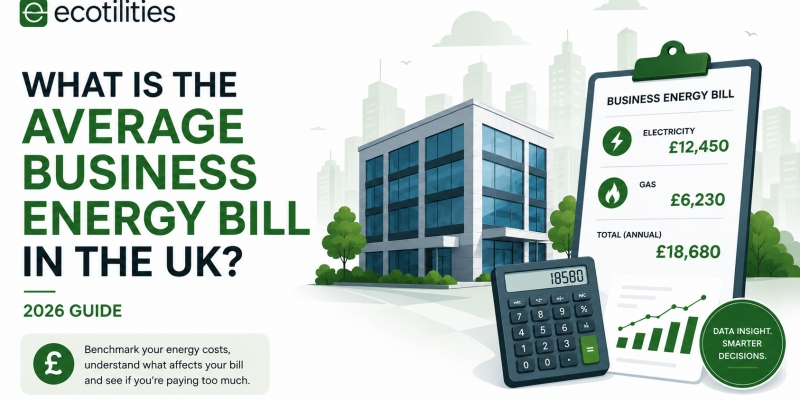
Knowing what the average business energy bill looks like in the UK is one of the most useful benchmarks a business owner or finance manager can have. If your energy spend is significantly above the typical range for a business of your size and type, it is a strong signal that you are overpaying — and that a whole-market comparison could deliver meaningful savings.
This guide sets out the typical business energy bill figures for different sizes and types of UK businesses in 2026, explains the factors that cause bills to vary so significantly between similar organisations, and tells you exactly what to do if your costs are above where they should be.
Why Business Energy Bills Vary So Much Between Similar Businesses
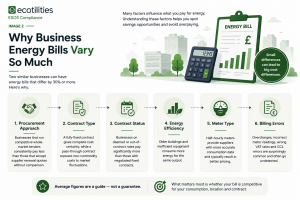
Before looking at typical figures, it is important to understand why two businesses that appear similar — same sector, same size, similar premises — can have energy bills that differ by 30 percent or more. The main reasons are:
- When and how they procured their energy — businesses that run competitive whole-market tenders consistently pay less than those that accept supplier renewal quotes without comparison
- Their contract type — a fully fixed contract gives complete cost certainty while a pass-through contract exposes non-commodity costs to market fluctuations
- Whether they are in or out of contract — businesses on deemed or out-of-contract rates pay significantly more than those on negotiated fixed contracts
- Energy efficiency of their premises and equipment — older buildings and inefficient equipment consume more energy for the same output
- Their meter type — half-hourly meters give suppliers more accurate consumption data and typically result in better pricing
- Billing errors — overcharges, incorrect meter readings, wrong VAT rates and CCL errors are surprisingly common on business energy bills and go undetected in many organisations
This variability is exactly why average figures should be used as a directional benchmark rather than a precise target. What matters most is not whether your bill matches the average — it is whether your bill is competitive given your specific consumption, location and contract.
Average Business Electricity Bills by Business Size in 2026
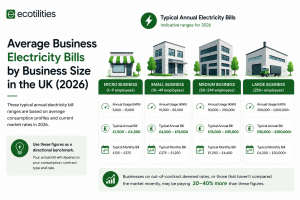
The table below sets out typical annual electricity bills for UK businesses of different sizes, based on average consumption profiles and current market rates in 2026. These are indicative figures — your actual bill will depend on your specific consumption, contract type and rate.
| Business Size | Annual Usage (kWh) | Typical Annual Bill | Typical Monthly Bill |
|---|---|---|---|
| Micro business (1–9 employees) | 5,000 – 15,000 | £1,500 – £4,500 | £125 – £375 |
| Small business (10–49 employees) | 15,000 – 50,000 | £4,500 – £15,000 | £375 – £1,250 |
| Medium business (50–249 employees) | 50,000 – 200,000 | £15,000 – £55,000 | £1,250 – £4,600 |
| Large business (250+ employees) | 200,000 – 1,000,000+ | £50,000 – £250,000+ | £4,200 – £20,000+ |
These figures are based on a unit rate of approximately 22p to 28p per kWh plus standing charges and non-commodity costs, which is a reasonable mid-market range for businesses procuring competitively in 2026. Businesses on out-of-contract deemed rates, or those that have not compared the market recently, may be paying 20 to 40 percent more than these figures.
Average Business Gas Bills by Business Size in 2026
For businesses that use gas — for heating, hot water or industrial processes — the gas bill is typically a significant cost alongside electricity. Here are typical annual gas bill ranges for UK businesses in 2026:
| Business Size | Annual Usage (kWh) | Typical Annual Bill | Typical Monthly Bill |
|---|---|---|---|
| Micro business (1–9 employees) | 5,000 – 20,000 | £300 – £1,200 | £25 – £100 |
| Small business (10–49 employees) | 20,000 – 100,000 | £1,200 – £6,000 | £100 – £500 |
| Medium business (50–249 employees) | 100,000 – 500,000 | £6,000 – £28,000 | £500 – £2,300 |
| Large business (250+ employees) | 500,000 – 5,000,000+ | £28,000 – £250,000+ | £2,300 – £20,000+ |
Gas unit rates in 2026 typically range from around 3p to 7p per kWh for business customers procuring competitively, with higher rates for smaller consumption volumes and lower rates for large users with bespoke tender pricing. Gas bills are heavily seasonal — businesses using gas for heating will see significantly higher costs in winter months.
Average Business Energy Bills by Sector
Business size is only one dimension of energy cost benchmarking. The sector your business operates in has a significant impact on energy consumption — and therefore on what a typical energy bill looks like. Here is a broad overview of how energy intensity varies across common business sectors:
| Sector | Energy Intensity | Key Driver of Energy Cost |
| Office / professional services | Low–Medium | Lighting, heating, cooling, IT equipment |
| Retail | Medium | Lighting, refrigeration, heating, EPOS systems |
| Hospitality (hotels, restaurants) | High | Catering equipment, refrigeration, laundry, heating |
| Manufacturing / industrial | Very High | Process machinery, compressed air, heating, lighting |
| Healthcare / care homes | High | Heating, medical equipment, laundry, 24-hour operation |
| Education (schools, colleges) | Medium | Heating, lighting, IT — seasonal usage patterns |
| Logistics / warehousing | Medium–High | Lighting, heating, refrigeration, vehicle charging |
| Agriculture | Medium | Heating, ventilation, refrigeration, irrigation pumps |
High-energy-intensity sectors such as manufacturing, hospitality and healthcare typically have the most to gain from professional energy procurement — both because their absolute spend is higher and because the complexity of their energy profile means the difference between a well-negotiated and poorly-negotiated contract is greater.
What Makes Up Your Business Energy Bill?
Many business owners focus entirely on the unit rate when thinking about their energy bill — but the unit rate is only one of several components that together make up your total cost. Understanding what you are actually paying for is essential to interpreting your bill correctly and identifying where savings are available.
Unit Rate (Commodity Cost)
The price you pay per kilowatt-hour of energy consumed. This is the element most influenced by wholesale market conditions and your procurement approach. It typically represents around 40 to 60 percent of your total bill.
Standing Charge
A fixed daily charge regardless of consumption. Business standing charges typically range from 25p to 80p per day for electricity and 20p to 60p per day for gas. For businesses with low consumption, the standing charge can represent a disproportionately large share of the total bill — which is why zero standing charge contracts can be highly cost-effective for certain business types.
Non-Commodity Charges (Third-Party Costs)
This is the element of your bill that most businesses do not fully understand — and it is typically between 40 and 60 percent of the total. Non-commodity charges include:
- Distribution Use of System (DUoS) charges — the cost of delivering electricity through the local distribution network
- Transmission Network Use of System (TNUoS) — the cost of using the national high-voltage transmission grid
- Balancing Services Use of System (BSUoS) — the cost of balancing supply and demand across the grid
- Climate Change Levy (CCL) — a government environmental tax charged per kWh on non-domestic energy consumption
- Renewables Obligation (RO) and Contracts for Difference (CfD) — levies that fund renewable energy generation
These charges are set by Ofgem and industry regulators — they are not negotiable in the same way as the commodity rate. However, understanding them is important because they vary by contract type (pass-through vs fixed), and because certain businesses may be eligible for CCL relief or exemptions that they are not currently claiming.
VAT
Business energy is subject to 20% VAT, compared to 5% for domestic energy. However, businesses whose energy use is predominantly for non-business or charitable purposes — or certain manufacturing processes — may qualify for the reduced 5% rate. If your business has never reviewed its VAT eligibility on energy, it is worth discussing with your energy advisor.
Signs Your Business Energy Bill Is Higher Than It Should Be
If your energy costs fall above the typical ranges for your business size and sector, there are several likely causes — each with a specific remedy:
You are out of contract or on a deemed rate
This is the single most expensive energy situation a business can be in. Deemed rates are typically 30 to 50 percent above the best available contracted rates. If your contract has expired and you have not signed a new one, switching to a competitive contract should be your immediate priority.
You accepted your supplier’s renewal quote without comparing
Suppliers routinely offer renewal rates that are above what is available through competitive procurement. If you have renewed with your existing supplier without running a whole-market comparison, there is a strong likelihood you are paying more than necessary.
Your bills have never been independently validated
Billing errors are more common than most businesses realise. Incorrect meter readings, duplicate charges, wrong VAT rates, CCL overcharges and errors in third-party cost calculations all appear regularly on business energy bills — and are rarely corrected by suppliers without being challenged. An independent energy bill validation service checks your bills for these errors and recovers any overcharges, sometimes going back up to six years.
Your premises or equipment are energy inefficient
If your building is poorly insulated, your lighting is not LED, your heating and cooling systems are old, or your equipment is inefficient, your consumption will be higher than it needs to be. Every extra unit of energy consumed is charged at your unit rate — so reducing consumption has a compounding effect on your bill.
You fixed your contract when wholesale prices were elevated
If your current fixed contract was agreed during a period of high wholesale prices — for example, late 2021 or 2022 — you may be locked into a rate that is now above the current market. Depending on your exit provisions, it may be worth modelling whether an early termination and switch to a current market rate would deliver net savings.
What to Do If Your Business Energy Bill Is Too High
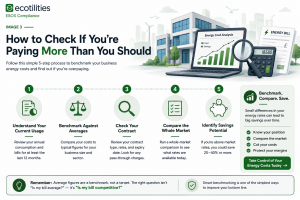
If your energy costs are above the typical ranges for your size and sector, or if any of the warning signs above apply, here are the steps that will make the biggest difference:
- Run a whole-market comparison immediately — contact an independent energy broker and ask them to run a competitive tender across the full market. This costs nothing and takes a few days. The result will tell you definitively whether you are overpaying and by how much.
- Get your bills independently validated — particularly if you have been with the same supplier for several years or have never had your bills checked. Billing errors compound over time and the amounts recoverable can be significant.
- Check your CCL liability — many businesses pay the Climate Change Levy at the standard rate when they are eligible for a reduced rate or full exemption. Reviewing your CCL position can deliver immediate savings on every bill.
- Review your VAT rate — if your business qualifies for the reduced 5% VAT rate on energy but is currently being charged 20%, reclaiming the overcharge and correcting your account going forward can make a material difference to your costs.
- Consider onsite renewable generation — a commercial solar installation can generate 20 to 30 percent of your electricity at a fixed cost significantly below the grid rate. Fully funded solar PPA options are available requiring zero capital investment.
- Invest in energy efficiency — reducing consumption is the most permanent solution to a high energy bill. Even modest investments in LED lighting, smart heating controls and equipment upgrades typically pay back within two to three years and deliver savings indefinitely.
How Ecotilities Helps Businesses Reduce Their Energy Bills
Ecotilities is an independent business energy broker and consultancy that helps UK businesses of all sizes take control of their energy costs. Our services address every dimension of business energy expenditure — from the rate you pay for each unit of energy to the accuracy of your bills and the efficiency of your consumption.
Whether your business is a small office paying a few thousand pounds per year for energy, or a large manufacturing site with an energy spend in the hundreds of thousands, we have the expertise, supplier relationships and market intelligence to help you pay less.
Our most relevant services for businesses looking to reduce their energy bill include:
- Whole-market energy procurement — competitive tender across our full supplier panel for the most advantageous rate and contract structure
- Energy bill validation — independent checking of current and historical bills for errors, overcharges and recoverable amounts
- CCL refund and relief — identifying businesses eligible for Climate Change Levy refunds or exemptions they are not currently claiming
- Commercial solar PPA — fully funded solar panel installation delivering savings of 20 to 30 percent against grid electricity from day one
- Net zero strategy — connecting energy cost reduction to your broader decarbonisation objectives for maximum financial and reputational return
| Is Your Business Energy Bill Higher Than It Should Be?
Ecotilities runs a free whole-market comparison to show you exactly what your business should be paying — and helps you get there. No obligation, no cost to your business. Visit ecotilities.co.uk/gas-electricity or call 0333 2244 050 to find out if your business is overpaying. |
Frequently Asked Questions About Business Energy Bills
What is the average business electricity bill per month in the UK?
The average monthly business electricity bill varies enormously by size. Micro businesses typically pay between £125 and £375 per month. Small businesses pay between £375 and £1,250. Medium businesses pay £1,250 to £4,600. Large businesses pay £4,200 or more per month. These figures assume competitive procurement — businesses on deemed rates or those that have not compared the market recently are likely paying more.
How much does the average business spend on energy per year?
For a small business with 10 to 49 employees, total annual energy spend — electricity and gas combined — typically falls in the range of £6,000 to £21,000. For medium businesses, this rises to £21,000 to £83,000. Large businesses often spend £100,000 or more on energy annually, with manufacturing and industrial operations spending considerably more.
Why is my business energy bill so high?
The most common reasons for an above-average business energy bill are: being out of contract on a deemed rate, accepting a supplier renewal quote without comparing the market, having billing errors that have gone undetected, having energy-inefficient premises or equipment, or having fixed a contract during a period of high wholesale prices. An independent broker can quickly identify which of these applies to your business.
Can I reduce my business energy bill without switching supplier?
Yes — there are several actions that can reduce your bill regardless of supplier. Getting your bills independently validated can identify and recover overcharges. Reviewing your CCL and VAT position may reveal savings. Investing in energy efficiency measures reduces consumption. Installing onsite solar generation reduces the volume of grid electricity you consume. However, for most businesses, switching to a more competitive supplier through a whole-market comparison delivers the largest and most immediate saving.
What is the Climate Change Levy and does my business have to pay it?
The Climate Change Levy (CCL) is a government environmental tax charged per kWh on non-domestic gas and electricity consumption. Most businesses pay CCL at the standard rate. However, certain businesses — including charities, those in qualifying industrial sectors and organisations with Climate Change Agreements — may be eligible for a reduced rate or full exemption. Many businesses overpay CCL without realising it. Ecotilities can review your CCL position and help you claim any refund or exemption you are entitled to.
How do I find out if I am getting a good business energy rate?
The only reliable way to know whether your current rate is competitive is to run a live whole-market comparison through an independent energy broker. Published averages give a useful directional benchmark, but because business energy is individually priced, only a current market tender will tell you definitively what your business should be paying. Ecotilities provides this comparison free of charge.