
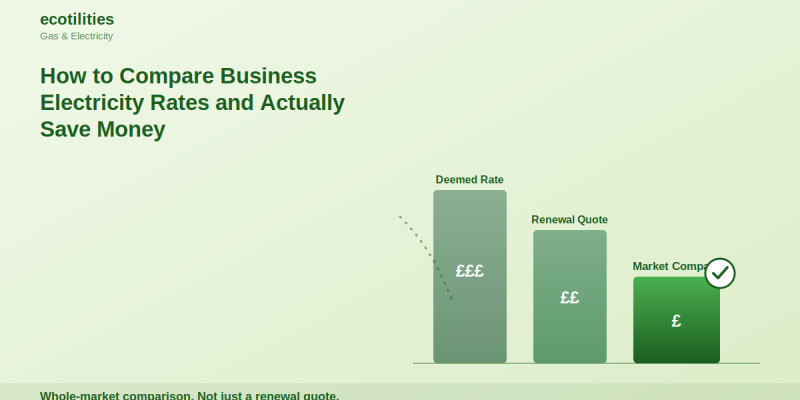
Business electricity is one of the most significant and controllable costs on your profit and loss statement — yet most businesses either stay with the same supplier out of habit, or accept the first renewal quote they receive without question. In a market where rates can vary by 30% or more between suppliers for the same consumption, that decision can cost thousands of pounds every year.
This guide explains how to compare electricity rates for business properly — not just by looking at the headline unit rate, but by understanding the full picture of what you are paying for, which contract type suits your business, and how an independent energy broker can access rates that simply are not available on comparison websites.
Why Business Electricity Rates Vary So Much Between Suppliers
Unlike domestic energy, where suppliers offer standardised tariffs to millions of customers, business electricity pricing is bespoke. Suppliers price each contract individually based on a combination of factors specific to your business:
- Your annual consumption (in kWh) — larger users typically attract better rates
- Your load profile — when and how consistently you use energy throughout the day
- Your meter type — whether you have a half-hourly (HH) meter or a non-half-hourly (NHH) meter
- Your credit rating and payment history
- The contract length — one, two or three years
- Current wholesale energy market conditions at the time of purchase
Because all of these variables interact, the same business could receive very different quotes from different suppliers on the same day — and a quote that looked competitive six months ago may now be above market rate. This is why regularly comparing business energy rates is not just good practice, it is financially essential.
What to Look for When You Compare Business Electricity Rates
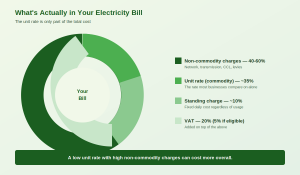
Many businesses make the mistake of comparing only the unit rate — the pence-per-kWh figure — when evaluating suppliers. In reality, the total cost of a business electricity contract is made up of several components, and a low unit rate can easily be undermined by higher charges elsewhere.
Here is what you need to examine in any business electricity quote:
| Cost Component | What It Means |
| Unit rate (p/kWh) | The price you pay per kilowatt-hour of electricity consumed. This is the most visible cost but not the only one. |
| Standing charge (p/day) | A fixed daily charge regardless of how much electricity you use. Can significantly affect small businesses or those with low consumption. |
| Non-commodity charges | Third-party costs including network distribution charges, climate levies, and balancing charges. These can make up 40–60% of your total bill. |
| Contract type | Fixed, flexible, pass-through and zero standing charge contracts each carry different risk and cost profiles (see below). |
| Renewal terms | When and how the supplier notifies you of renewal, and what happens if you miss the renewal window. |
A thorough comparison requires looking at all of these elements together — not just the headline rate. This is where working with an independent energy broker gives businesses a significant advantage, as brokers present like-for-like comparisons across all cost components, not just unit rates.
Business Electricity Contract Types Explained
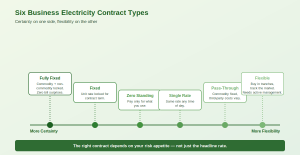
One of the most important decisions when comparing business energy rates is choosing the right contract structure. Different contract types suit different businesses depending on their risk appetite, consumption patterns and budget requirements.
Fixed Contract
Your unit rate is locked in for the duration of the contract — typically one to three years. Provides budget certainty and protects against price rises, but you will not benefit if wholesale prices fall significantly. Best for businesses that prioritise cost predictability.
Fully Fixed Contract
Both the commodity cost (energy itself) and non-commodity costs (network charges, levies) are fixed. Offers total peace of mind with no bill surprises. Typically carries a slight premium over a standard fixed contract but removes all uncertainty.
Flexible Purchase Contract
You purchase energy in tranches at different points in time, accessing wholesale market prices directly. Requires active management and market knowledge — best suited to large businesses with the resources and expertise to monitor the market. Ecotilities manages flexible contracts on behalf of clients, tracking the wholesale market and advising on optimal purchase timing.
Pass-Through Contract
The commodity price is fixed, but non-commodity costs (which make up a substantial portion of your bill) vary with the market. More complex and less predictable, but can be cost-effective for businesses whose non-commodity costs are relatively low.
Zero Standing Charge
You pay only for the electricity you actually consume, with no fixed daily standing charge. Particularly cost-effective for businesses with low or intermittent energy use — for example, offices closed at weekends or seasonal operations.
Single Rate
You pay the same unit rate regardless of when you consume electricity. Simple and straightforward — best for businesses with fairly consistent energy use throughout the day and week.
SME vs Large Business — Does Your Size Affect the Rates You Can Access?
Yes, significantly. The energy market broadly divides businesses into two categories based on annual spend and meter type:
- SMEs — typically spending below £20,000 per year on energy. These businesses can often receive same-day quotes and benefit from simpler contracts. Instant pricing tools are available, though not always at the most competitive rates.
- Large businesses — typically spending £20,000 or more per year on energy, often with half-hourly (HH) meters. These businesses access bespoke tender prices directly from suppliers, with the potential for significantly lower rates. However, the procurement process is more complex and typically requires professional energy management support.
Large businesses that attempt to compare energy rates without professional support often miss the best available prices, as the most competitive rates come through direct supplier relationships and bespoke tender processes — not public comparison tools.
How a Business Energy Broker Makes the Comparison Process Work Harder for You
An independent business energy broker does not work for any single supplier. Instead, they access the whole market on your behalf — running a competitive tender across multiple suppliers simultaneously and presenting the results in a clear, comparable format.
The advantages of working with an independent broker include:
- Access to wholesale and broker-specific rates not available on public comparison sites
- Like-for-like comparisons across all cost components, not just unit rates
- Advice on the right contract type for your specific business profile
- Ongoing market monitoring — alerting you to the right time to renew or lock in prices
- Handling the switch process end-to-end, including supplier communications and meter readings
- Bill validation to check for errors and overcharges on your current or historical bills
At Ecotilities, our energy brokers work with a panel of reputable suppliers — including British Gas, Shell Energy, Drax, ENGIE, NPower, Brook Green, SEFE and Pacific Energy — running competitive tenders to secure the most advantageous rates for each client. We provide a full breakdown of charges from every supplier so the comparison is completely transparent.
When Is the Right Time to Compare Business Electricity Rates?
Timing matters enormously in business energy procurement. Here are the situations where comparing rates is most urgent and most valuable:
- Contract renewal approaching — Start comparing at least three to six months before your current contract ends. Leaving it to the last minute reduces your negotiating position and limits supplier options.
- Out of contract or on a deemed rate — If your contract has already expired, you will almost certainly be on a significantly higher deemed rate. Comparing and switching immediately should be a priority.
- Wholesale prices have dropped significantly — If market prices have fallen considerably since you fixed your contract, it may be worth assessing whether the savings from early termination outweigh the exit fees.
- Your business has grown — Higher consumption usually means access to better rates. If your energy spend has increased significantly, a fresh comparison will likely yield better pricing.
- You have never formally compared — Many businesses have never run a competitive tender for their energy. If this applies to you, the potential savings from a first comparison can be substantial.
How to Compare Electricity Rates for Business Through Ecotilities: Step by Step
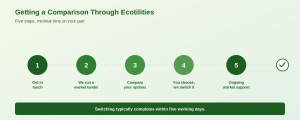
Getting a competitive business energy comparison through Ecotilities is straightforward and takes very little time on your part:
- Get in touch — call 0333 2244 050 or complete the quote request form. We will ask for basic information about your business and current energy contract.
- We run a market tender — our brokers approach our full panel of suppliers simultaneously, requesting bespoke pricing based on your specific consumption profile.
- We present your options — you receive a clear, like-for-like comparison of quotes from multiple suppliers, with a full breakdown of all charges.
- You choose and we handle the rest — once you select your preferred supplier and contract, we manage the switching process entirely. It typically takes around five working days to switch suppliers.
- Ongoing support — your Ecotilities account manager continues to monitor the market, alert you to favourable renewal windows, and provide weekly energy market insights throughout your contract.
| Ready to Compare Business Electricity Rates?
Ecotilities is an independent business energy broker with access to the whole market. We run a free competitive tender across our full supplier panel and present you with a transparent, like-for-like comparison — with no obligation to switch. Visit ecotilities.co.uk/gas-electricity or call 0333 2244 050 to get started. |
Frequently Asked Questions About Comparing Business Electricity Rates
How often should I compare business energy rates?
We recommend comparing at least once every contract renewal cycle — typically every one to three years depending on your contract length. However, if wholesale prices move significantly or your consumption changes materially, it is worth a comparison even mid-contract to understand your options.
Can I switch business energy supplier mid-contract?
Yes, but most contracts carry early termination fees. Whether switching mid-contract makes financial sense depends on the size of the termination fee versus the savings available with a new supplier. Your Ecotilities broker can model this for you.
Is business energy cheaper than domestic energy?
Business electricity is not subject to the same price cap as domestic energy, which means it can be higher or lower depending on the market and your contract. However, larger businesses typically benefit from economies of scale that domestic customers cannot access. VAT on business energy is charged at 20% (vs 5% for domestic), though charities and some other organisations may qualify for the reduced rate.
What is the average business electricity rate in the UK?
Business electricity rates fluctuate with the wholesale market, so a precise current figure changes regularly. As of early 2026, typical business unit rates range broadly from around 20p to 30p per kWh depending on contract type, consumption volume and market conditions. To know what rate is achievable for your specific business, a live market comparison is the only reliable way to find out.
How long does it take to switch business energy suppliers?
A business energy switch typically completes within five working days. Ecotilities manages the full switching process including all communications with your outgoing and incoming suppliers, so there is minimal disruption to your business.
Do you offer 100% renewable business electricity?
Yes. Ecotilities offers 100% renewable electricity backed by Renewable Energy Guarantee of Origin (REGO) certificates, and Carbon Neutral Gas backed by Renewable Gas Guarantee of Origin (RGGO) certificates. In many cases, renewable contracts are available at comparable or even lower rates than standard contracts — contact us to find out what is available for your business.