
Updated: 30 October 2026
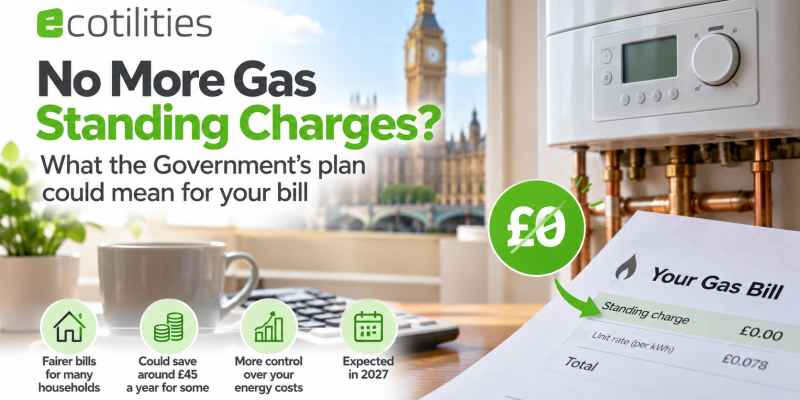
Millions of UK households could see a change in how they pay for gas following the Government’s announcement that it plans to remove standing charges from household gas bills in 2027.
The proposal could make energy bills fairer, particularly for households that use relatively little gas. However, it does not mean that the underlying costs of supplying gas will disappear or that every household will automatically pay less.
So, what exactly has the Government announced, who stands to benefit, and when could consumers notice a difference?

What has the Government announced?
On 28 October 2026, the UK Government announced plans to ask energy regulator Ofgem to remove standing charges from household gas bills in 2027, or as soon as possible afterwards.
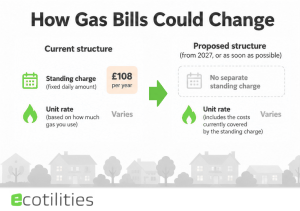
Under the proposed arrangement, the fixed costs currently recovered through gas standing charges would instead be incorporated into the unit price of gas.
According to the Government, the average household currently pays around £108 a year in gas standing charges.
The change is intended to give households greater control over their bills and reduce the burden of fixed daily charges, regardless of how much gas they consume.
The proposal forms part of the Government’s wider Autumn Budget 2026 measures to address household energy costs.
Official announcement: Chancellor abolishes standing charges on gas bills — GOV.UK.
What is a gas standing charge?
A gas standing charge is a fixed daily amount that an energy supplier adds to a customer’s bill. It covers certain costs associated with supplying gas, maintaining the energy network and administering the account.
The important distinction is that this charge applies regardless of how much gas a household uses.
For example, a household that uses very little gas during a particular period may still have to pay its standing charge for every day of that period.
This can be frustrating for people who are away from home for extended periods, use gas sparingly or are trying to reduce their energy consumption.
Under the Government’s proposal, this separate daily charge would be removed from household gas bills, with the associated costs recovered through the price paid for each unit of gas consumed.
Who could benefit from the removal of gas standing charges?
The impact will depend largely on how much gas a household uses and how suppliers implement the changes.

1. Households that use relatively little gas
Households with low gas consumption could benefit because they would no longer face a separate daily standing charge.
Instead, more of their bill would depend on the amount of gas they actually consume.
This could be particularly helpful for people who use gas occasionally, live in smaller properties or spend significant periods away from home.
However, the eventual saving will depend on the new unit rate and the household’s consumption.
2. Households that are away from home frequently
People who travel regularly or leave their homes unoccupied for periods may find the proposed arrangement easier to manage.
Under the current system, a standing charge can continue to accrue even when no gas is being used.
Removing that separate daily payment would mean households no longer face a distinct gas standing charge during periods of zero consumption. They could still incur other costs, depending on their energy arrangements.
3. Households managing tight budgets
For households carefully managing their spending, removing a fixed daily charge could provide greater flexibility.
The Government estimates that around 60% of households with gas accounts could save an average of £45 a year following the change.
This is a Government estimate, not a guaranteed saving for every household. Actual results will depend on consumption and the final tariff arrangements.
Will every household pay less for gas?
No. This is one of the most important details to understand.
Removing a standing charge does not eliminate the costs that the charge currently covers. Those costs will instead be incorporated into the unit rate.
Consequently, households that use less gas may benefit, while those that consume substantially more gas could experience smaller savings or potentially higher bills, depending on the final rates and their usage.
The Government expects a typical household with median gas consumption to benefit, but individual outcomes may differ.
For this reason, consumers should compare the total annual cost of their gas tariff rather than focusing only on whether a standing charge appears on the bill.
When will gas standing charges be removed?
The Government has said it will ask Ofgem to deliver the change in 2027 or as soon as possible afterwards.
This means the announcement should not be mistaken for an immediate change to existing gas bills.
The detailed implementation and the resulting tariffs will determine when consumers begin to see the effects.
Until the changes take effect, households should continue to check their current bills and tariff terms rather than assume their standing charge has already been removed.
Does this change apply to electricity standing charges?
The announcement specifically concerns standing charges on household gas bills.
It should not be interpreted as confirmation that electricity standing charges will also be removed under the same proposal.
Consumers should continue to review their electricity tariff separately and check any future Government or Ofgem announcements for further changes.
What should consumers do now?
Although the proposed change is not immediate, there are several practical steps households can take.
Check your current gas tariff. Understand the daily standing charge and the unit rate you currently pay.
Know your annual consumption. Your gas usage is important when comparing tariffs and estimating whether a change in pricing structure could benefit you.
Compare the total cost, not just the standing charge. A tariff without a separate standing charge is not automatically the cheapest option if its unit rate is higher.
Watch for implementation updates. The final arrangements and effective date will determine how the change affects individual households.
Avoid switching based on the headline alone. Consider your actual consumption, contract terms and the total estimated annual bill before making a decision.
What does this mean for businesses?
The Government’s announcement concerns household gas bills. Businesses should not assume that the same change will automatically apply to their commercial energy contracts.
Business energy tariffs can have different contractual terms, pricing structures and standing charges. Companies should review their own agreements and confirm any changes directly with their supplier or energy adviser.
For organisations looking to understand their business gas and electricity arrangements, Ecotilities’ gas and electricity services provide a starting point for reviewing energy costs and contract options.
The bottom line
The proposed removal of household gas standing charges could make energy bills fairer for many consumers, particularly those who use relatively little gas.
However, the costs currently covered by standing charges will not disappear. They will be recovered through the unit price of gas, meaning the eventual benefit will depend on household consumption and the tariffs introduced.
The key message is simple: a gas tariff should be judged by its total cost, not by the presence or absence of a standing charge alone.
As implementation details become available, consumers should compare their options carefully to understand how the change could affect their bills.
Official source: UK Government announcement on removing gas standing charges.