
ESOS Phase 4 is not business as usual. While previous phases of the Energy Savings Opportunity Scheme required qualifying organisations to carry out an energy assessment and submit a notification of compliance, Phase 4 introduces significant new obligations — most notably the requirement for a written action plan and mandatory progress reporting. For organisations that approach Phase 4 the same way they approached Phase 3, compliance is at risk.
This guide provides a comprehensive overview of ESOS Phase 4 — what it is, who is affected, what has changed, the critical deadlines you cannot miss, and what practical steps your organisation needs to take right now. Whether you are starting your Phase 4 assessment from scratch or need to understand the progress reporting requirements, this is everything you need to know.
A Quick Recap: What Does Phase 4 Affect?
Your organisation is subject to ESOS Phase 4 if, on the qualification date of 31 December 2022, it met any one of the following criteria:
- 250 or more employees
- Annual turnover exceeding £44 million
- Annual balance sheet total exceeding £38 million
As with previous phases, ESOS qualification applies at group level — so all UK subsidiaries and group members of a qualifying parent company are included in scope, regardless of their individual size. If you are unsure whether your organisation qualifies, our detailed guide What Is ESOS? The Complete Guide for UK Businesses covers the qualification criteria in full.
ESOS Phases 1 to 4: How the Scheme Has Evolved
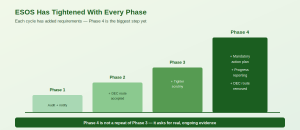
To understand what makes Phase 4 different, it helps to see how the scheme has developed since its introduction:
| Phase | Compliance Deadline | Qualification Date | Key Additions |
| Phase 1 | 5 Dec 2015 | 31 Dec 2014 | First phase — basic audit and notification introduced |
| Phase 2 | 5 Dec 2019 | 31 Dec 2018 | Display Energy Certificates accepted as compliance route |
| Phase 3 | 5 Dec 2023 | 31 Dec 2022 | Increased regulatory scrutiny; some route restrictions tightened |
| Phase 4 | 5 Dec 2027 | 31 Dec 2022 | Mandatory action plan; progress reporting; DEC route removed |
The pattern is clear: each phase has progressively tightened the requirements. Phase 4 represents the most significant step change since the scheme was introduced, shifting ESOS from a compliance-only framework to one that requires demonstrable action and accountability.
What Has Changed in ESOS Phase 4? The Six Key Differences
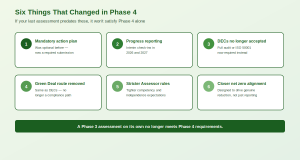
Phase 4 introduces six material changes that organisations need to understand and plan for:
1. Mandatory Written Action Plan
In all previous phases, completing the energy assessment and submitting the notification of compliance was sufficient. In Phase 4, organisations must also produce a written action plan documenting the energy saving measures they intend to implement based on the assessment findings. This plan must include timelines, ownership and intended outcomes for each measure.
The action plan is not a wish list — it is a formal commitment that the Environment Agency can review. Organisations that produce vague or token action plans risk scrutiny and potential challenge.
2. Mandatory Progress Reporting
Phase 4 introduces interim progress reporting obligations at defined points during the compliance cycle. Organisations must report on whether the measures in their action plan have been implemented. Where measures have not been implemented, a written explanation must be provided. This creates ongoing accountability — not just a single compliance event every four years.
3. Display Energy Certificates No Longer Accepted
In Phase 2, organisations could use Display Energy Certificates (DECs) as an alternative compliance route for their buildings. This option has been removed in Phase 4. All qualifying organisations must now undergo a full ESOS energy audit or hold a valid ISO 50001 certification covering the relevant areas. Organisations that relied on DECs in previous phases need to ensure they have arranged a full assessment.
4. Green Deal Assessments No Longer Accepted
Green Deal Assessments, which were previously an accepted compliance route for buildings, are no longer recognised in Phase 4. Again, organisations that used this route previously must now arrange a full ESOS audit or ISO 50001 certification.
5. Strengthened Lead Assessor Requirements
Phase 4 tightens the requirements for Lead Assessors, with clearer expectations around competency, independence and the depth of review required. Organisations should ensure their Lead Assessor is registered with an approved professional body and has demonstrable experience relevant to their sector and energy profile.
6. Closer Alignment With Net Zero Objectives
While not a formal regulatory change, Phase 4 is designed to more closely align ESOS with the UK’s net zero commitments. The mandatory action plan and progress reporting requirements are explicitly intended to drive genuine emissions reductions — not just identify them. Organisations that approach Phase 4 with net zero planning in mind will find that the assessment data provides a strong foundation for their broader decarbonisation strategy.
ESOS Phase 4: The Full Deadline Timeline
Phase 4 has a longer compliance cycle than previous phases, with multiple interim milestones. Here is the complete timeline your organisation needs to plan around:
| Date | Status | Requirement |
| 31 December 2022 | PASSED | Qualification date — organisations meeting thresholds on this date are in scope for Phase 4 |
| 5 December 2024 | PASSED | Primary compliance deadline — ESOS assessment, notification of compliance and action plan required |
| 5 March 2025 | PASSED | Grace period ended — action plan submission no longer has extended deadline |
| 5 December 2025 | PASSED | First progress update deadline — organisations must report on action plan implementation |
| 5 December 2026 | UPCOMING | Second progress update deadline — continued reporting on action plan progress required |
| 5 December 2027 | UPCOMING | Final Phase 4 submission deadline — end of current compliance cycle |
The two upcoming milestones — December 2026 and December 2027 — are the ones that qualifying organisations need to be actively preparing for right now. If your organisation completed its Phase 4 assessment and submitted its action plan by the December 2024 deadline, your immediate priority is ensuring your progress reporting for December 2026 is in order.
If your organisation has not yet completed its Phase 4 assessment or submitted a notification of compliance, it is in breach of the regulations. In this situation, the most important step is to engage a qualified Lead Assessor immediately and begin the compliance process — late compliance, combined with proactive engagement with the Environment Agency, is significantly preferable to continued non-compliance.
The Phase 4 Action Plan: What It Must Include
The mandatory action plan is the defining feature of Phase 4 and the element most organisations need to think about most carefully. It is not enough to produce a list of recommendations from your energy assessment — the action plan needs to be a credible, specific commitment to action.
A compliant Phase 4 action plan should include:
- A clear list of energy saving measures identified in the ESOS assessment that the organisation intends to implement
- Estimated energy and cost savings for each measure
- Target implementation timelines for each measure
- Named ownership or responsibility for implementation within the organisation
- A prioritisation rationale — explaining why certain measures have been prioritised over others
- For subsequent assessments: a record of which measures from the previous action plan were implemented and which were not, with explanations for any that were not
Organisations that produce high-quality action plans — that treat Phase 4 as a genuine driver of energy efficiency rather than a compliance hurdle — are also building valuable data for net zero planning, ESG reporting and investor communications. The overlap between ESOS action planning and broader sustainability strategy is significant.
Understanding the Phase 4 Progress Reporting Requirements
Progress reporting is entirely new to Phase 4. Unlike previous cycles where the compliance obligation ended with the notification of compliance submission, Phase 4 requires organisations to report on their progress against the action plan at the December 2026 and December 2027 milestones.
Progress reports are submitted through the same ESOS online portal used for the notification of compliance. They require organisations to confirm:
- Which measures from the action plan have been fully implemented
- Which measures are in progress, with updated timelines
- Which measures have not been started or have been abandoned, with written explanations
- Any changes to the organisation’s energy profile since the original assessment
Organisations should be tracking their action plan implementation continuously — not scrambling to compile evidence in the weeks before a progress report deadline. Building the progress reporting process into your energy management calendar from the outset is the most practical approach.
What Your Organisation Should Be Doing Right Now
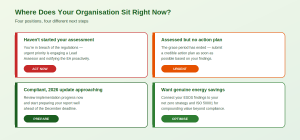
Depending on where your organisation currently sits in the Phase 4 process, your immediate priorities will differ. Here is a practical guide to what you should be doing right now:
If you have not yet started your Phase 4 assessment
You are in breach of the ESOS regulations. Your most urgent priority is to engage a qualified Lead Assessor immediately and begin the compliance process. Contact the Environment Agency to notify them of your situation before they contact you — proactive engagement is always viewed more favourably. Ecotilities can match you with a qualified Lead Assessor and help you begin the assessment process without delay.
If you completed your assessment but have not submitted your action plan
The grace period for action plan submission ended in March 2025. You need to produce and submit your action plan as soon as possible. Work with your Lead Assessor to develop a credible, specific plan based on the findings of your completed assessment.
If you are compliant but approaching the December 2026 progress update
Now is the time to review your action plan and assess implementation progress. Identify which measures have been completed, which are on track, and which need to be reconsidered — along with documented reasons. Begin preparing your progress report well in advance of the December 2026 deadline rather than leaving it to the last minute.
If you want to use Phase 4 to drive genuine energy savings
The most forward-thinking organisations are using Phase 4 as a springboard — connecting ESOS findings to their net zero strategy, ISO 50001 energy management systems and renewable energy procurement. This approach transforms a compliance obligation into a business improvement programme with real financial and reputational returns.
Can ISO 50001 Help With ESOS Phase 4 Compliance?
Yes — and for organisations that are serious about ongoing energy management, ISO 50001 certification represents one of the most valuable investments available in the context of ESOS.
ISO 50001 is an internationally recognised standard for energy management systems. Organisations that hold a valid ISO 50001 certification covering their UK energy consumption can use it as an alternative to a full ESOS energy audit for the areas it covers. This can significantly reduce the cost and administrative burden of ESOS compliance across successive phases.
Beyond the compliance benefit, ISO 50001 provides a structured, ongoing framework for managing energy use — creating the kind of systematic, evidenced approach to energy efficiency that the Phase 4 action plan and progress reporting requirements are designed to encourage. Organisations that hold ISO 50001 are also better positioned for future phases of ESOS, as the standard evolves to remain a recognised compliance route.
Ecotilities provides ISO 50001 certification consultancy as part of its broader bureau services offering — helping organisations achieve certification efficiently and at a transparent, fixed cost.
How Ecotilities Supports ESOS Phase 4 Compliance
Ecotilities provides end-to-end ESOS Phase 4 compliance support for qualifying UK organisations. Whether you are starting from scratch, need to catch up on missed obligations, or want ongoing support through the progress reporting milestones, our team of qualified Lead Assessors and energy management specialists is ready to help.
Our Phase 4 compliance service covers:
- Qualification scoping and compliance route determination
- Matching with a qualified Lead Assessor experienced in your sector
- Full site audit across buildings, processes and transport
- ESOS report, notification of compliance and action plan production
- Progress reporting support for the December 2026 and December 2027 milestones
- Integration with ISO 50001 certification, net zero strategy and renewable energy procurement
| Need ESOS Phase 4 Support? We’re Ready to Help.
From initial assessment to progress reporting, Ecotilities provides fully managed ESOS Phase 4 compliance for large UK organisations. Don’t let the December 2026 progress update catch your organisation unprepared. Visit ecotilities.co.uk/esos or call 0333 2244 050 to speak to our ESOS team today. |
Frequently Asked Questions About ESOS Phase 4
What is the ESOS Phase 4 deadline?
The primary ESOS Phase 4 compliance deadline was 5 December 2024. However, Phase 4 has ongoing obligations — a progress update was due on 5 December 2025, another is due on 5 December 2026, and the final Phase 4 submission deadline is 5 December 2027. Organisations that missed the December 2024 deadline need to complete their assessment and submit their notification of compliance as soon as possible.
What are the new requirements in ESOS Phase 4?
The key new requirements in Phase 4 are: a mandatory written action plan, mandatory progress reporting at interim deadlines, the removal of Display Energy Certificates and Green Deal Assessments as compliance routes, and strengthened Lead Assessor requirements. These changes shift ESOS from a four-yearly compliance event to an ongoing accountability framework.
What happens if I missed the ESOS Phase 4 deadline?
Missing the ESOS Phase 4 deadline exposes your organisation to civil penalties from the Environment Agency. If you have missed the deadline, the most important steps are to begin your assessment immediately and to engage proactively with the Environment Agency. Do not wait to be contacted — voluntary disclosure and proactive compliance is treated more favourably than discovered non-compliance.
Is ESOS Phase 4 the same as Phase 3?
No. Phase 4 is materially different from Phase 3. The most significant differences are the mandatory action plan, the interim progress reporting requirements, and the removal of DECs and Green Deal Assessments as compliance routes. Organisations that approach Phase 4 with a Phase 3 mindset risk non-compliance.
Can ISO 50001 satisfy ESOS Phase 4?
A valid ISO 50001 certification covering all UK energy consumption can satisfy the energy audit requirement for those areas under ESOS Phase 4. However it does not fully replace the ESOS process — a Lead Assessor must still confirm scope, approve the compliance approach and ensure the notification of compliance is submitted correctly. ISO 50001 certification also needs to have been in place and valid during the relevant compliance period.
Will there be an ESOS Phase 5?
Based on the four-year cycle structure, Phase 5 would be expected to begin after the conclusion of Phase 4 in December 2027, with a qualification date likely around December 2026 and a compliance deadline around December 2031. No formal announcement of Phase 5 requirements has been made at the time of publication, but organisations should expect the trend of tightening requirements to continue.