
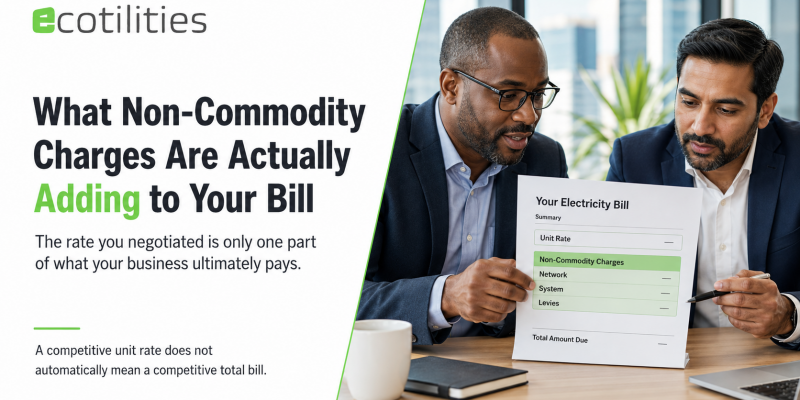
Ask most business owners what they’re paying for on their electricity bill and they’ll describe the unit rate — the price per kilowatt-hour they’ve negotiated with their supplier. What they usually can’t describe is the collection of separate charges sitting alongside that unit rate, often making up 40 to 60 percent of the total bill, that have nothing to do with the supplier’s own margin and everything to do with the cost of running the wider electricity system that delivers power to the premises in the first place.
These are known as non-commodity charges, and their sheer invisibility to most businesses is remarkable given how much of the total bill they represent. A business can negotiate an excellent unit rate through a competitive tender and still end up paying considerably more than expected, simply because nobody explained what the other half of the bill was actually for, or whether any of it carried room for genuine scrutiny.
What Actually Sits Inside Non-Commodity Charges
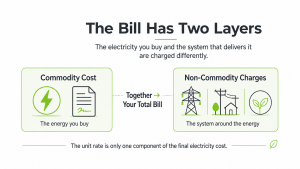
- Distribution Use of System charges, covering the cost of delivering electricity through the local regional distribution network that connects your premises to the wider grid
- Transmission Network Use of System charges, covering the cost of the national high-voltage transmission infrastructure that moves electricity from power stations across the country
- Balancing Services Use of System charges, which fund the ongoing work of keeping supply and demand across the national grid in balance in real time
- The Climate Change Levy, a government environmental tax charged per kilowatt-hour on non-domestic energy consumption, separate from any supplier margin
- Renewables Obligation and Contracts for Difference charges, which fund the ongoing build-out and support of renewable electricity generation across the UK
- Assistance for Areas with High Electricity Distribution Costs and various smaller regulatory levies that vary by region and connection type
Why This Matters More Than Most Businesses Realise
Because these charges are set by industry regulators rather than negotiated directly with your supplier, many businesses assume they’re simply fixed and therefore not worth scrutinising at all.
That assumption is only partly true. While the underlying rates themselves aren’t negotiable in the way a unit rate is, how they’re applied to your account, whether you’re on the correct charging band for your connection type, and whether your contract structure exposes you to their full volatility or shields you from it, are all genuine variables that a properly negotiated contract can influence considerably.
How Contract Type Changes Your Exposure

A fully fixed contract locks in both the commodity rate and the non-commodity charges for the length of the agreement, giving complete cost certainty regardless of how these third-party charges move during the contract term. A standard fixed contract, by contrast, may only lock the commodity rate, leaving non-commodity charges to pass through at whatever the prevailing rate happens to be.
A pass-through contract goes further still, exposing the business to the full movement of these charges throughout the contract. None of these structures is inherently right or wrong — but a business that doesn’t understand which one it’s on has no real way of knowing how exposed it actually is to a cost category that can represent more than half its total bill.
Who This Actually Hits Hardest
- Businesses that compare energy contracts purely on unit rate without ever asking how non-commodity charges are treated within each competing offer
- Businesses on pass-through contracts who assumed they had cost certainty, only to discover a significant proportion of their bill was never actually fixed at all
- Growing businesses whose consumption has changed enough to potentially shift which charging band or connection category they fall into, without anyone reviewing whether that’s been correctly applied
- Businesses that have never had a broker specifically explain the breakdown of their bill beyond the headline unit rate and total cost
Signs This Is Worth Understanding Properly
- You could not currently explain what proportion of your last bill was made up of non-commodity charges versus the unit rate itself
- You don’t know whether your current contract fixes these charges, partially fixes them, or passes them through at market rate
- Your bills have moved noticeably even during a period when you believed your rate was fixed
- Nobody has ever walked you through your bill line by line to explain what each individual charge actually represents
Understanding this part of your bill properly changes how you evaluate contract offers going forward — a headline unit rate that looks marginally worse on paper can still represent better overall value if it comes bundled with non-commodity charges fixed at a favourable point, while a seemingly attractive unit rate on a pass-through structure can end up costing considerably more once the full picture is accounted for across a whole contract term.

| Get a Full Breakdown of What You’re Actually Paying For
Ecotilities explains every component of your energy bill, not just the headline rate, and structures your contract to manage your real exposure to non-commodity charges properly. Visit ecotilities.co.uk/gas-electricity or call 0333 2244 050. |
Questions Businesses Ask
Can we negotiate non-commodity charges the way we negotiate the unit rate?
The underlying regulatory rates themselves aren’t negotiable, but how they’re structured within your contract — fixed, partially fixed, or passed through — is a genuine choice worth understanding before signing.
Why do these charges make up such a large proportion of the bill?
They fund the physical infrastructure and system-balancing work required to actually deliver electricity to your premises, alongside government environmental levies — costs that exist regardless of which supplier you choose.
Is a fully fixed contract always the best option because of this?
Not necessarily — it depends on your risk appetite and how these charges are trending; a fully fixed contract offers certainty but sometimes at a premium compared to accepting some exposure to movement.
How would we check what contract structure we’re currently on?
Your existing contract documentation or your supplier can confirm this, though a proper review is the most reliable way to understand your actual exposure clearly.
Do these charges vary by region?
Yes — distribution charges in particular vary by regional network operator, meaning identical consumption at two different locations can carry different non-commodity costs.
Is getting a full bill breakdown something we’d be charged for?
No — reviewing and explaining your bill composition is included as standard as part of any energy comparison or contract review.