
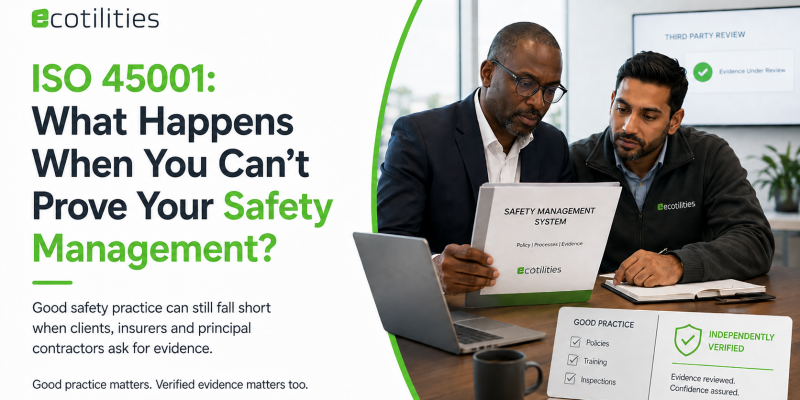
Businesses in construction, manufacturing, engineering and logistics have generally always taken health and safety seriously — it’s not an area most operators treat casually, given the obvious human and legal stakes involved.
What’s changed is what clients, insurers and principal contractors now expect as proof of that seriousness. A strong safety record and a set of internal procedures used to be sufficient evidence. Increasingly, they’re not, and ISO 45001 has become the specific, independently verified certificate that closes the gap between ‘we take safety seriously’ and evidence a client or insurer can actually check.
This shift matters practically because it changes where the evidence burden sits. Without certification, a business is asked to describe its safety management approach in words, on request, every time a new client or contract requires it. With certification, the description has already been independently audited and verified once, and simply needs to be produced rather than reconstructed and defended from scratch for every new relationship.
Where This Is Already Costing Businesses
- Losing principal contractor approval on construction and engineering projects where ISO 45001 has become a standard prequalification requirement rather than a differentiator worth mentioning
- Facing higher insurance premiums or more restrictive terms than certified competitors, as insurers increasingly factor formal safety management system certification into risk assessment
- Losing tender opportunities in manufacturing and logistics supply chains where client due diligence now specifically asks for ISO 45001 rather than a general safety policy description
- Extended, repetitive safety questionnaires for every new client relationship, when a valid certificate would answer the majority of what those questionnaires are actually trying to establish in one document
Why Good Informal Practice Doesn’t Satisfy This Anymore

Many businesses genuinely do have strong, effective safety practices in place — regular toolbox talks, proper PPE provision, reasonable incident reporting.
What ISO 45001 certification demonstrates is different from any of this: a systematic, independently audited occupational health and safety management system covering hazard identification, risk assessment, incident investigation, worker consultation and continuous improvement as a coherent, evidenced whole, verified by someone outside the business rather than simply asserted by the business itself.
The distinction matters enormously to a client or insurer who cannot directly observe your day-to-day practices and has to rely on some form of verified evidence instead.
What Certification Actually Requires in Practice
Achieving ISO 45001 means building a genuine occupational health and safety management system around how your business actually operates — documented risk assessments that are actively used and updated, worker consultation processes that genuinely function rather than exist on paper, incident investigation procedures that are followed consistently, and management review that actually drives improvement rather than simply recording that a meeting happened.
Auditors interview staff directly during certification, and a system that looks complete on paper but isn’t genuinely embedded in daily practice tends to be identified quickly during that process.

Who This Actually Hits Hardest
- Construction, engineering and manufacturing subcontractors bidding for work with principal contractors who mandate ISO 45001 as a standard supply chain requirement
- Logistics and warehousing businesses handling higher-risk operations where clients and insurers increasingly expect formal, certified safety management evidence
- Businesses that already hold ISO 9001 and are being asked directly by clients why they haven’t also pursued safety management certification
- Growing businesses stepping up into larger contracts or principal contractor relationships where safety due diligence is considerably more rigorous than smaller clients previously required
Signs You’re Already Behind on This
- A tender, principal contractor approval process, or insurance renewal has specifically asked for ISO 45001 and you were unable to provide it
- You hold ISO 9001 but have never seriously evaluated adding ISO 45001, despite operating in a sector where safety credentials are increasingly scrutinised
- A client or insurer has asked detailed safety management questions that you could only answer with general descriptions rather than certified, auditable evidence
- You’ve noticed competitors with certification being approved for principal contractor panels or frameworks you’ve been excluded from
Because ISO 45001 shares the same Annex SL structure as ISO 9001 and ISO 14001, businesses already holding either of those standards typically find 45001 considerably faster and more cost-effective to add than pursuing it as a standalone certification from a completely blank starting point.
| Turn Your Safety Practices Into Evidence Clients Can Verify
Ecotilities provides fixed-cost ISO 45001 certification consultancy, built around your actual operations rather than a generic safety template that won’t survive audit scrutiny. Visit ecotilities.co.uk/iso-standard-certification or call 0333 2244 050. |
Questions Businesses Ask
We already have strong safety practices — is certification really necessary on top?
Certification doesn’t replace good practice, it independently verifies and documents it — which is increasingly what clients and insurers specifically require rather than accepting your own assurance alone.
Is ISO 45001 only relevant for high-risk industries like construction?
It’s most commonly requested in higher-risk sectors, but any business with employees and operational hazards can benefit, and requirements are broadening into sectors that previously weren’t asked for it.
How long does ISO 45001 certification typically take to achieve?
This depends on how close your existing safety management practices already are to the standard’s requirements, which a proper gap analysis establishes specifically for your business.
Do we need to already hold ISO 9001 before pursuing 45001?
No, though it does make the process more efficient if you already hold it, given the shared underlying structure between the standards.
Will this certification reduce our insurance premiums?
Many insurers do factor certified safety management systems into risk assessment favourably, though the specific impact varies by insurer and should be discussed directly with your broker.
What’s the risk of pursuing a cheap, fast certification for this standard specifically?
Given the direct link between this certification and actual workplace safety outcomes, a superficial system that isn’t genuinely embedded carries particular risk — both to certification credibility and to actual safety performance.