

The mandatory action plan is the single biggest change Phase 4 introduced to ESOS, and it’s also the part most organisations underestimate. It’s tempting to treat it as a formality attached to the end of the assessment — a list of recommendations copied out of the report and submitted alongside the notification.
Organisations that take that approach discover the problem later, when the first progress report comes due and there’s genuinely very little substance behind the plan to report against.
A thin action plan doesn’t just look weak on paper. It creates a specific, recurring problem: Phase 4 requires organisations to report on implementation progress at defined milestones, and a vague, unresourced plan produces an awkward progress report almost by design, since there was never anything concrete enough behind it to actually track or deliver.
What Separates a Credible Plan From a Paper Exercise
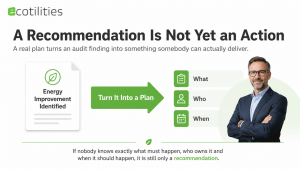
- Specific measures drawn directly from the assessment findings, rather than generic energy-saving statements that could plausibly apply to almost any organisation regardless of what the audit actually found
- Realistic, quantified estimates of energy and cost savings for each measure, based on the assessment data rather than optimistic assumptions that won’t survive scrutiny later
- Clear ownership assigned to a named individual or team for each measure, rather than the plan sitting with no accountable owner once the assessment itself is complete
- Defined implementation timelines that are genuinely achievable given the organisation’s actual capital planning and operational calendar, not aspirational dates chosen to look impressive on submission
- A documented prioritisation rationale explaining why certain measures were selected over others, demonstrating the plan reflects genuine strategic thinking rather than an unfiltered list
Why Vague Plans Get Written in the First Place
Action plans often end up thin not because anyone deliberately cuts corners, but because the plan gets produced at the tail end of a long assessment process, when momentum and internal engagement have often already faded.
The Lead Assessor’s job is largely complete once the audit findings are documented, and turning those findings into a genuinely owned, resourced internal plan requires engagement from people within the organisation — finance, operations, facilities — who weren’t necessarily closely involved in the assessment itself and haven’t yet been brought into the conversation about what happens next.
What Progress Reporting Actually Exposes
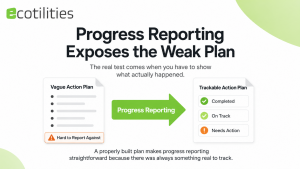
The real test of an action plan’s quality doesn’t arrive at submission — it arrives at the first progress reporting milestone, when the organisation has to state honestly which measures have been implemented, which are on track, and which have stalled with an explanation required.
A plan built on vague, unresourced commitments produces a progress report that’s either embarrassingly thin or requires uncomfortable explanations for why almost nothing has moved. A plan built properly, with real ownership and realistic timelines from the outset, produces a progress report that’s straightforward to complete because there was always something genuine to track.
Who This Actually Hits Hardest
- Organisations that treated their Phase 4 assessment purely as a compliance exercise to complete quickly, without engaging the internal teams who would need to actually implement any resulting recommendations
- Organisations where the action plan was drafted by the Lead Assessor with minimal internal review or challenge before submission
- Multi-site organisations where measures identified during the assessment were never properly allocated to specific site-level owners
- Organisations now approaching their first Phase 4 progress reporting deadline with genuine uncertainty about what was actually committed to in their own plan
Signs Your Action Plan Won’t Hold Up
- Nobody in your organisation could currently explain, without checking the document, what your action plan actually commits to
- The measures listed read as generic recommendations rather than specific actions tied to your assessment’s actual findings
- No individual or team has been formally assigned ownership of implementing any of the measures listed
- The plan was finalised and submitted without meaningful internal review from finance or operations before it went out
Building a plan that genuinely holds up means engaging the right internal stakeholders before submission, not after — turning the assessment’s technical findings into commitments that people within the organisation actually understand, own, and have a realistic path to delivering, rather than a document produced to satisfy a submission deadline and then quietly forgotten until the next reporting milestone forces it back into view.

| Build an ESOS Action Plan That Holds Up to Progress Reporting
Ecotilities develops action plans with genuine internal ownership and realistic timelines from the outset, so your Phase 4 progress reporting is straightforward rather than a scramble. Visit ecotilities.co.uk/esos or call 0333 2244 050. |
Questions Organisations Ask
Can we strengthen an action plan that’s already been submitted?
Yes — action plans can be revisited and developed further ahead of the next progress reporting milestone, and doing so proactively is far better than waiting for the reporting deadline to expose the gaps.
How specific do the measures in the plan actually need to be?
Specific enough that a named owner could pick up the plan and know exactly what they’re responsible for delivering and by when, rather than a general statement of intent.
Who should actually be involved in building the plan internally?
Ideally finance, operations and facilities representatives alongside the Lead Assessor, since the people who’ll implement the measures need genuine input before commitments are finalised.
What happens if we genuinely can’t implement a measure we committed to?
Phase 4 requires a written explanation where committed measures haven’t been implemented — this is manageable if handled honestly, but repeated unexplained non-delivery across multiple measures is a weaker position.
Does a stronger action plan cost more to produce?
Not necessarily more in fees, but it requires more internal engagement time — time that’s considerably better spent upfront than scrambling to explain a weak plan at the progress reporting stage.
Can our action plan connect to our wider net zero strategy?
Yes, and it often should — the measures identified through ESOS frequently form a natural, evidenced starting point for broader decarbonisation planning if the plan is built with that connection in mind.