
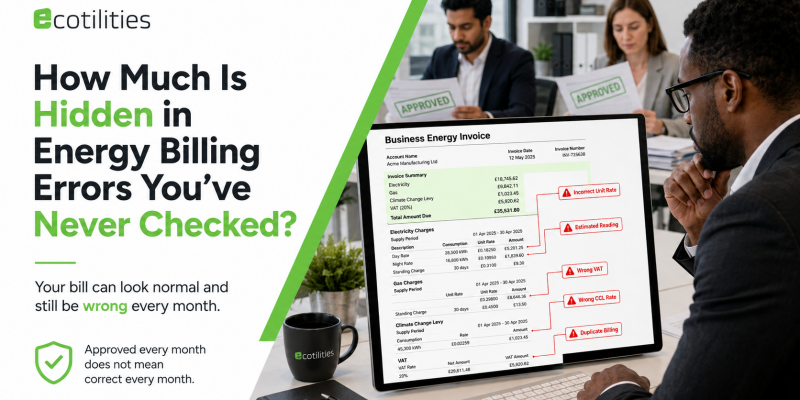
Most businesses pay their energy bill the same way every month — the total looks broadly consistent with previous months, so it gets approved and paid without a second look. Nobody on the finance team is individually checking whether the unit rate, the standing charge, the VAT rate and the Climate Change Levy component are all correct against the contract.
Suppliers have no financial incentive to flag their own overcharges. If nobody checks, nothing gets caught, and the same error can sit unnoticed on an account for years.
What Actually Goes Wrong
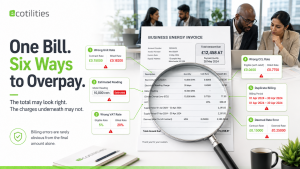
| Error Type | What Goes Wrong |
| Incorrect unit rate | Billed at a different rate than your contract states |
| Estimated readings | Bills based on estimates, often overstating usage |
| Wrong VAT rate | Charged 20% when eligible for the reduced 5% rate |
| Wrong CCL rate | Charged standard CCL when eligible for relief |
| Duplicate billing | Same period billed twice, common during switches |
| Deemed rate errors | Billed at a deemed rate despite a valid contract |
Why This Almost Never Gets Caught Internally
Business energy billing involves multiple parties — suppliers, network operators, metering agents — and manual processes at several points in that chain, each one a place an error can creep in undetected. A finance team reconciling a monthly total against a budget line has no realistic way to see a wrong unit rate buried three lines down on an invoice, or a VAT rate that’s been wrong since a supplier switch eighteen months ago and has simply been paid correctly-looking totals ever since.
The problem compounds because most internal finance processes are built to catch anomalies — a bill that suddenly looks unusually high or low — rather than systematic errors that are consistently wrong in the same direction every month. A unit rate that’s fractionally off the contracted rate produces a bill that looks entirely normal month after month, which is precisely why it goes unnoticed for so long: there’s nothing about it that trips the usual checks.
What’s Realistically Sitting Unclaimed
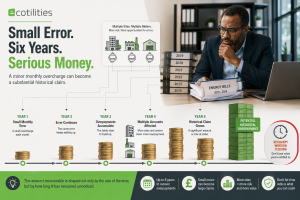
Claims can typically be pursued going back up to six years — which means a small, unnoticed error compounds significantly over time into a total that surprises most businesses when it’s finally quantified.
Businesses that have never had their bills independently checked, that operate across multiple sites or meters, or that have switched suppliers in the last few years carry the highest likelihood of an undetected overcharge sitting on their account right now, simply because each of those factors adds another point at which an error could have been introduced.
Larger and more complex accounts — multiple meters, half-hourly settlement, flexible purchasing contracts — carry proportionally more risk simply because there are more individual charge calculations happening, and therefore more opportunities for one of them to be wrong.
But smaller, simpler accounts are not immune; a single incorrect VAT rate applied from day one of a contract can still add up to a meaningful sum over several years even on a modest energy spend.
Why a Quick Glance at Your Bill Won’t Find It
Spotting these errors requires cross-referencing every individual charge against your actual contract terms, meter data and the correct tax rates applicable to your specific circumstances — not eyeballing a total and confirming it’s roughly in the expected range. It’s exactly the kind of check that’s easy to skip when nobody has explicit ownership of it, which is precisely why it goes unchecked for years at a time in the majority of UK businesses, regardless of size or sector.
It’s also worth understanding that identifying an error is only half the process — recovering it requires formally raising the discrepancy with the supplier, providing the evidence to support the claim, and negotiating the refund, which suppliers do not process automatically or quickly without a properly evidenced case being put to them. A business that spots a possible error but doesn’t have the time or expertise to pursue the claim through to resolution often ends up no better off than one that never checked at all.

Who This Actually Hits Hardest
- Businesses that have stayed with the same supplier for many years without ever switching or triggering a natural review point
- Multi-site or multi-meter businesses, where more individual charge calculations mean more opportunities for an error to sit undetected
- Businesses that have switched supplier or meter in the last few years, a common point at which duplicate charges and reading errors are introduced
- Half-hourly metered businesses, where the complexity of settlement data creates more scope for processing errors than simpler accounts
Signs You Likely Have an Unclaimed Error Sitting on Your Account
- Your bills have never been checked line by line against your actual contract terms
- You’ve had a supplier switch or meter change in the last six years
- You operate multiple sites or meters that are reconciled as a combined total rather than individually
- Your VAT or CCL eligibility has never been specifically confirmed against your current billing
- Nobody in your finance team owns energy billing accuracy as a specific responsibility
| Get Your Energy Bills Checked — Free, No Obligation
Ecotilities reviews your current and historical energy bills, checking every charge against your contract and applicable rates, and manages any refund claim on your behalf. Visit ecotilities.co.uk/bill-validation or call 0333 2244 050. |
Questions Businesses Ask Before Getting Checked
We’ve been with the same supplier for years without issue — is it worth checking?
That’s exactly the profile most likely to have an undetected error, since long-standing accounts are the ones least likely to have ever been independently reviewed and the most likely to have accumulated a meaningful historical claim.
Does this cost anything if nothing is found?
No — the review is free, with fees only applying if a recoverable overcharge is identified and successfully claimed, so there’s no financial downside to having your bills checked.
Will this affect our current contract or supplier relationship?
No — bill validation is entirely separate from your supply contract. It reviews billing accuracy only and doesn’t involve switching or renegotiating anything unless you separately choose to act on other findings.
How long does the review process typically take?
Initial data collection and analysis typically takes a few weeks, largely dependent on how quickly your suppliers respond to the data request — the actual analysis itself is usually the fastest part of the process.
What if we’re mid-contract — can we still get a historical review done?
Yes — validation of historical billing is entirely independent of your current contract status and doesn’t require you to be switching or renewing to be worthwhile.
Is it worth checking bills across multiple sites individually or just once overall?
Each site or meter should ideally be checked individually, since errors are typically specific to a particular meter or account rather than applied uniformly across a whole business — a multi-site business checking only its head office account could easily miss significant errors at other locations.