

Commercial waste collection is one of the least scrutinised recurring costs on a business’s overheads. It gets set up once, invoiced monthly, and largely forgotten while the rate, the collection frequency and the bin sizing that were right for the business three years ago often no longer match what the business actually needs today.
Nobody revisits a waste contract the way they revisit an energy contract or an insurance renewal, and that gap is exactly where money quietly leaks out.
Where the Overspend Actually Sits
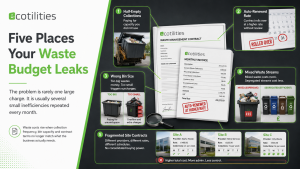
- Bins collected at a fixed frequency regardless of how full they actually are, meaning businesses pay for empty or half-empty collections week after week
- Contracts that auto-renewed onto a higher rate without anyone reviewing the market at the renewal point, exactly the same trap businesses fall into with unmanaged energy contracts
- Bin sizes and numbers set for a business at a different stage of growth — either now too small, forcing overflow charges, or too large for current volumes
- No separation of recyclable or food waste streams, missing the lower collection rates that segregated waste typically attracts compared to general waste
- Multiple sites each individually contracted with different providers at different rates, with no consolidated buying power being used to negotiate better terms across the group
Why This Goes Unquestioned for Years
Waste collection invoices tend to be small relative to a business’s other overheads, which is exactly why they escape scrutiny. A rate that’s 15 or 20 percent above what’s achievable in the market doesn’t set off any alarms on a bill that’s already modest in absolute terms — but multiplied across every collection, every month, for years on end, it adds up to a material sum that most finance teams have never actually quantified.
The contract itself is also part of the problem. Waste contracts are frequently structured with automatic rollover clauses and narrow cancellation windows that are easy to miss, meaning a business that intends to review its contract at renewal often finds it has already auto-renewed for another term before anyone got round to it.
What Competitive Procurement Actually Finds
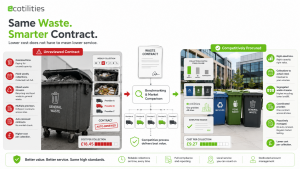
When a waste contract is properly benchmarked against the market — rather than simply renewed with the incumbent provider — it’s common to find that comparable service from a different provider is available at a meaningfully lower rate, that a mix of bin sizes and collection frequencies more accurately matched to actual volumes reduces cost without reducing service, and that segregating recyclable and food waste from general waste both lowers collection costs and improves compliance with duty of care obligations at the same time.
None of this requires reducing service quality or accepting a worse outcome — in most cases it simply requires someone running a proper competitive process across multiple providers instead of accepting whatever the incumbent quotes at renewal, which is rarely their most competitive offer.
Why Doing This Yourself Is Harder Than It Looks
Comparing waste contracts properly means understanding the true cost per collection once bin size, frequency and any surcharges are factored in — not just comparing headline monthly figures, which can be structured very differently between providers and mask which one is actually cheaper. It also means knowing which providers operate competitively in your specific area, since waste collection is a regional market with significant variation in who serves which postcodes at what price, information that isn’t readily available without doing the market research directly.
Who This Actually Hits Hardest

- Multi-site retail, hospitality and leisure businesses where each location has historically arranged its own waste contract independently
- Businesses with seasonal or fluctuating footfall whose collection frequency was set once and never revisited as volumes changed
- Businesses that inherited a waste contract from a previous occupier or management team with no record of when it was last reviewed
- Any business that has never separated recyclable or food waste from general waste collection
Signs You’re Likely Overpaying Right Now
- You can’t recall the last time your waste contract was benchmarked against another provider
- Your bins are rarely full at collection time, or regularly overflow before the next collection
- You have general waste, recycling and food waste all going into the same collection stream
- Your contract auto-renewed at some point without anyone reviewing the new rate
- Different sites in your business are on different providers or rates with no coordination between them
| Find Out What Your Business Should Be Paying for Waste Collection
Ecotilities compares commercial waste collection contracts across the market on your behalf, negotiating rates and consolidating multi-site accounts where possible — at no cost to review. Visit ecotilities.co.uk/waste-management or call 0333 2244 050. |
Questions Businesses Ask Before Reviewing Their Waste Contract
We’re mid-contract — is there any point checking now?
Yes — knowing what’s achievable in the market means you’re ready to act the moment your renewal or cancellation window opens, rather than missing it again because nobody was tracking the date.
Will switching provider disrupt our collections?
A properly managed switch is designed to avoid any gap in service — the new provider’s collection schedule is set up before the old contract ends, so there’s no disruption to normal operations.
Is it worth reviewing if we only have one small bin collected weekly?
Smaller accounts are exactly where obvious inefficiencies like oversized bins or unnecessary collection frequency tend to sit unnoticed longest, since the absolute cost is low enough that nobody questions it.
How do multi-site businesses benefit from a review?
Consolidating multiple site contracts under a coordinated procurement process typically unlocks better rates through combined volume, plus simpler account management than dealing with several separate provider relationships.
Does this cost anything to find out?
No — reviewing your current contract and benchmarking it against the market is free, with no obligation to switch if the current arrangement turns out to be competitive.
What if our contract has strict cancellation terms?
These terms need to be understood and worked with rather than around — knowing your exact notice period and any penalties means the switch can be timed correctly rather than triggering an unnecessary cost.