
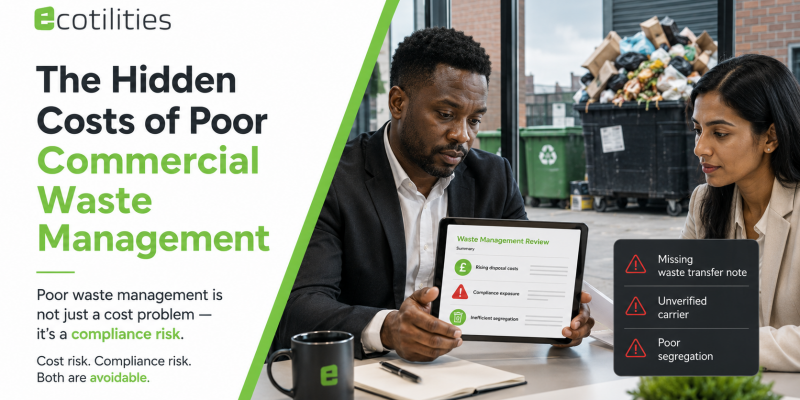
Waste management gets treated as a purely operational task — bins go out, a lorry collects them, the invoice gets paid. What most businesses don’t realise is how much risk and unnecessary cost sits inside that routine, from compliance exposure under duty of care obligations to missed savings that a slightly different approach to segregation and collection would unlock without any change in service quality.
The Compliance Risk Most Businesses Don’t Realise They’re Carrying
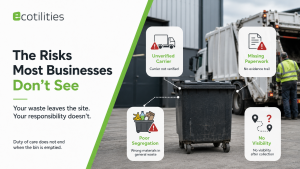
Every UK business has a legal duty of care obligation for its commercial waste — meaning responsibility for how that waste is handled doesn’t end the moment the bin is emptied. Businesses are required to take reasonable steps to confirm their waste is being handled, transported and disposed of by an authorised carrier, and to keep records — including waste transfer notes — demonstrating this. Many businesses using an informal or unmanaged waste arrangement, particularly smaller operators or those who inherited a waste contract from a previous occupier, cannot actually produce this evidence if asked.
- Using an unlicensed or unverified waste carrier without realising it, which leaves the business exposed even though the failure sits with the carrier
- No retained waste transfer documentation, meaning there’s no evidence trail if the Environment Agency or a client audit asks for one
- General waste streams containing material that should legally have been segregated, risking penalties tied to incorrect waste classification
- No visibility into where waste actually ends up after collection, which matters increasingly to clients running their own supply chain due diligence
The Cost Side: What Poor Segregation Actually Costs
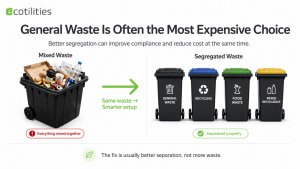
General waste is consistently the most expensive waste stream to dispose of, while recyclable materials and food waste typically attract lower collection and disposal rates when properly segregated. Businesses that mix everything into general waste bins are not just missing an environmental opportunity — they are paying general waste rates on material that could have been collected far more cheaply through a dedicated recycling or food waste stream.
Food waste in particular is often overlooked. Hospitality, food retail, healthcare and education businesses generating meaningful volumes of food waste frequently have it collected as general waste by default, when a dedicated food waste collection — increasingly required under evolving UK waste regulations for businesses producing food waste above certain thresholds — is both more compliant and typically cheaper per tonne.
Why Internal Reviews of This Rarely Happen
Waste management sits in an odd gap within most businesses — not quite significant enough to warrant a dedicated procurement review, but carrying enough compliance and cost exposure that ignoring it indefinitely is a genuine risk. It tends to fall to whoever happens to manage facilities or premises, who is rarely resourced or positioned to run a full market comparison and compliance check across multiple waste streams and providers.
The compliance side compounds this further — most facilities managers are not waste regulation specialists, and confirming that every carrier used is properly licensed, that segregation obligations specific to the business’s waste volumes and sector are being met, and that documentation is being retained correctly requires expertise that sits outside most people’s day-to-day role.
What Getting This Right Actually Delivers
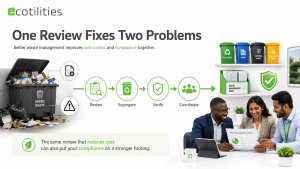
Businesses that properly manage this typically see two simultaneous outcomes: a lower total waste cost through better segregation and right-sized collection, and a clean compliance position that holds up if the Environment Agency, an insurer or a client’s own supply chain audit ever asks for evidence. The two are not competing priorities — they are usually solved by the same underlying fix, which is why treating waste management as worth a proper review pays off on both fronts at once.
Who This Actually Hits Hardest
- Hospitality, food retail, healthcare and education businesses producing meaningful food waste volumes with no dedicated collection stream
- Businesses using an informal or inherited waste arrangement with no clear record of carrier licensing or documentation
- Businesses now facing supply chain sustainability audits from larger clients who ask for waste handling evidence as standard
- Multi-site operators where waste compliance varies site to site with no central oversight
Signs You’re Already Exposed on Compliance
- You can’t locate recent waste transfer notes for your business
- You’ve never verified that your waste carrier is properly licensed
- You don’t know where your waste actually ends up after collection
- Your food waste, if you produce any, goes into general waste rather than a dedicated stream
- A client or insurer has never asked about your waste compliance, but you also couldn’t answer confidently if they did
| Get Your Waste Management Reviewed for Cost and Compliance
Ecotilities reviews commercial waste arrangements for cost efficiency and duty of care compliance, coordinating segregation, collection and documentation across single or multiple sites. Visit ecotilities.co.uk/waste-management or call 0333 2244 050. |
Questions Businesses Ask About Waste Compliance and Cost
How do we know if our current waste carrier is properly licensed?
This is exactly the kind of check that should be part of any waste management review — carrier licensing can and should be verified rather than assumed, since the business remains exposed under duty of care regardless of the carrier’s own compliance status.
Do small businesses really need to worry about duty of care obligations?
Yes — duty of care applies regardless of business size, and smaller businesses with informal waste arrangements inherited from a previous occupier or set up without proper review are often the most exposed, simply because nobody has ever checked the paperwork trail.
Is food waste collection actually required for our business?
Requirements depend on the volume of food waste produced and are evolving under current UK waste regulation — it’s worth confirming your specific obligations rather than assuming general waste collection covers everything adequately.
Will improving segregation actually save us money or just improve compliance?
Both, in most cases — segregated recyclable and food waste streams typically cost less to collect and dispose of than the equivalent volume sent to general waste, so the compliance improvement and the cost saving tend to arrive together.
What happens if we’ve been non-compliant without realising it?
The priority is establishing current compliant arrangements going forward — most reviews focus on getting the business into a defensible position from this point on rather than pursuing historical issues, unless a specific incident has already triggered scrutiny.
Does this only apply to businesses with a lot of waste?
No — the compliance obligations apply regardless of volume, though the cost-saving opportunity from better segregation and right-sizing tends to be more material in absolute terms for higher-volume waste producers.