
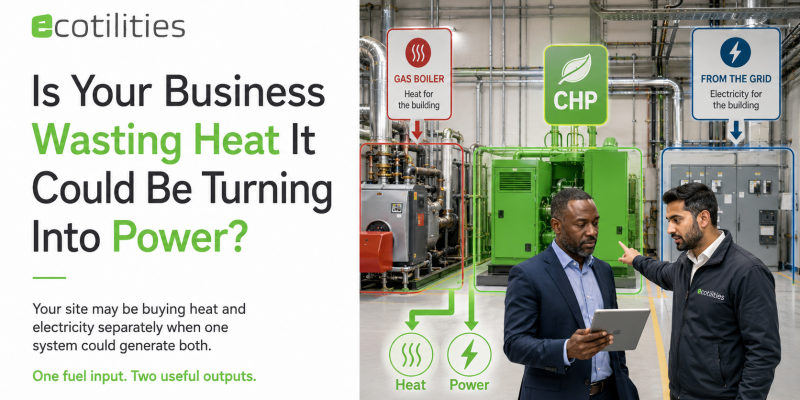
If your site runs a gas boiler for heating or hot water and separately buys electricity from the grid, there’s a decent chance you’re paying for energy twice over — once for the heat, once for the power — when both could be generated from the same fuel input at the same time. That’s the gap combined heat and power closes, and it’s a gap that goes unaddressed at a huge number of sites simply because nobody has ever run the numbers on it.
Where This Shows Up as Wasted Money
- Continuous or near-continuous heat demand — manufacturing processes, hospitals, leisure centres, food production, hotels — running alongside a separately purchased electricity supply that could be partially displaced
- Sites with electricity consumption high enough that even a modest CHP unit generates a meaningful proportion of on-site demand, cutting grid purchase volume directly
- Businesses exposed to the full volatility of grid electricity prices with no on-site generation buffering that exposure at all
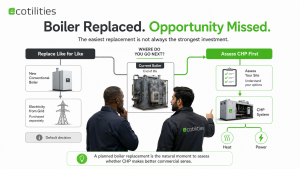
- Sites where boiler replacement is coming up as a routine capital decision, without anyone having evaluated whether a CHP unit is a better use of that same capital
Why This Opportunity Gets Missed

CHP is not a technology most facilities or finance teams evaluate as a matter of course — it typically only gets considered when someone specifically raises it, usually a consultant, and most businesses with the right consumption profile simply never have that conversation. The default path is far more passive: the old boiler gets replaced with a new boiler when it fails, and electricity continues to be bought separately, because that’s the path of least resistance, not because anyone compared it against the alternative.
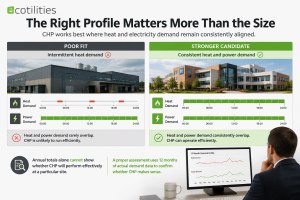
There’s also a common misconception that CHP is only viable for very large industrial sites. In practice, the economics work for a much broader range of businesses than most people assume — the real determining factor is the pattern and consistency of heat demand relative to the site’s electricity consumption, not simply the overall size of the business.
The Capital Cost Barrier — and Why It’s Not the Full Picture
The upfront cost of a CHP installation is real, and it’s often the reason the conversation stops before it starts — a business assumes it can’t justify the capital outlay and moves on without checking what funded or financed alternatives might be available that remove that barrier entirely. Treating CHP as a capital-only decision, when funded routes exist that don’t require the business to find the money upfront, closes off an option that might otherwise make clear financial sense.
Why Assessing This Properly Is Not a DIY Exercise
Establishing whether CHP genuinely makes sense for a specific site requires modelling actual heat and power demand profiles across a full year, not just looking at annual consumption totals — because CHP economics depend heavily on how consistently that demand occurs throughout the day and across seasons, not simply how much energy is used in total. Getting this modelling wrong in either direction is costly: overestimating viability leads to an installation that never delivers the projected savings, while underestimating it means walking away from a genuine opportunity because a rough back-of-envelope calculation looked unconvincing.
Who This Actually Hits Hardest
- Manufacturing sites running continuous or near-continuous process heat alongside a separate electricity supply
- Healthcare and leisure facilities with constant hot water and heating demand across long operating hours
- Hotels and hospitality businesses with predictable, sustained heat demand from kitchens, laundry and guest areas
- Food and drink production sites where process heat is a significant and continuous cost
Signs Your Site Is a Candidate Worth Checking
- You run a boiler close to continuously rather than intermittently
- Your electricity and gas bills are both individually substantial, not just one or the other
- A boiler replacement decision is coming up in the next capital planning cycle
- You’ve never had anyone specifically assess CHP viability for your site
- Your business is exposed to full grid electricity price volatility with no on-site generation at all
| Find Out If CHP Makes Sense for Your Site
Ecotilities assesses whether combined heat and power is viable for your specific consumption profile, and can advise on funded installation routes that avoid upfront capital cost. Visit ecotilities.co.uk/power-generators or call 0333 2244 050. |
Questions Businesses Ask Before Considering CHP
How do we know if our site even has the right demand profile for this?
This is exactly what a proper assessment establishes — modelling your actual heat and electricity demand patterns rather than guessing based on overall consumption figures, which on their own don’t tell you enough to make the call either way.
Is CHP only worth considering for very large sites?
No — viability depends more on the consistency of heat demand relative to electricity consumption than on overall business size, which means some mid-sized sites with the right profile are strong candidates while some larger sites with intermittent heat demand are not.
Does this require a large upfront capital investment?
Not necessarily — funded and financed routes exist that remove the need to find capital upfront, similar in principle to how solar PPAs work, and these should be explored before ruling CHP out on cost grounds alone.
We’re about to replace our boiler anyway — is this relevant timing?
Very relevant — a routine boiler replacement decision is exactly the point at which comparing against a CHP unit makes sense, since the capital decision is already being made regardless.
How long does an assessment take before we’d know if it’s worth pursuing?
An initial viability assessment based on your consumption data can typically indicate quickly whether the site profile justifies a fuller feasibility study, so you’re not committing significant time before getting an early signal either way.
What sectors typically have the best fit for CHP?
Manufacturing, healthcare, leisure and hospitality, food and drink production, and any site with continuous or near-continuous heat demand tend to be strong candidates, though the specific profile always needs checking rather than assumed from sector alone.