
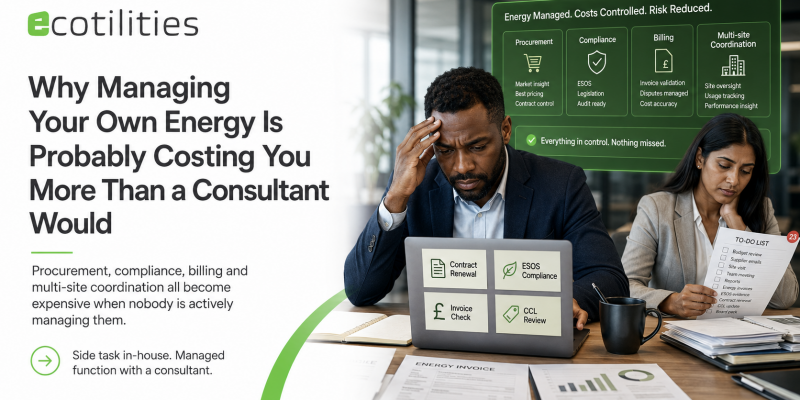
Most businesses handle energy the same way they handle any other overhead — someone in finance or facilities deals with it alongside a dozen other responsibilities, renewals get actioned when they land rather than planned for in advance, and nobody has the time or specialist knowledge to properly interrogate whether the business is getting a competitive deal across procurement, compliance and billing accuracy at once. That gap between managing energy passively and managing it properly is where a consistent, quiet cost sits.
The Areas Where DIY Energy Management Typically Falls Short
- Contract renewals actioned reactively against whatever the incumbent supplier quotes, rather than benchmarked proactively against the wider market months in advance
- No one tracking wholesale market movements to identify favourable windows to lock in rates, meaning contracts get fixed at whatever point the renewal happened to fall
- Compliance obligations like ESOS treated as a late scramble against the deadline rather than a planned, budgeted process, increasing both cost and risk of missing it
- Billing accuracy never independently checked, leaving errors and overcharges to accumulate silently for years
- Climate Change Levy relief and exemption eligibility never assessed, despite many businesses qualifying without realising it
- No coordinated view across multiple sites, meaning each location’s energy position is managed in isolation rather than leveraged collectively for better terms
Why This Is a Structural Problem, Not a People Problem

This isn’t a reflection of any individual doing a bad job — it’s what happens when energy management is one responsibility among many for someone whose core role is something else entirely. Energy procurement, compliance and billing accuracy each require ongoing market knowledge that takes real time to build and maintain, and that time competes directly with the responsibilities the role actually exists for. The business ends up with energy management as a background task rather than a managed function, and background tasks are where cost quietly accumulates.
The compounding effect is what makes this expensive over time rather than just occasionally. A slightly uncompetitive rate, a missed CCL relief eligibility, an ESOS deadline handled reactively at higher cost, a billing error that’s never checked — none of these individually feels like a crisis, but stacked together across a full year, and repeated year after year, they represent a meaningful and entirely avoidable cost that most businesses have never actually totalled up.
What Dedicated Energy Management Actually Changes
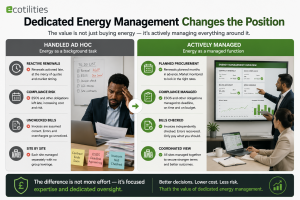
The difference isn’t about working harder on energy — it’s about someone with the specific market knowledge and dedicated time actively managing the position across all of these areas simultaneously, rather than each one being handled in isolation, late, or not at all. Contract timing gets planned rather than reactive. Compliance gets budgeted and managed to deadline rather than scrambled. Billing gets checked as a matter of course rather than assumed correct. And multi-site businesses get the benefit of a coordinated position rather than each site fending for itself.
Who This Actually Hits Hardest
- Multi-site businesses where energy is managed independently at each location with no coordinated group strategy
- Growing businesses where energy management has stayed a side responsibility for someone whose role has scaled well beyond it
- Businesses approaching an ESOS compliance deadline with no dedicated resource managing the process
- Businesses that have never separated out procurement, compliance and billing accuracy as distinct things worth actively managing
Signs Energy Management Is Already Costing You

- Contract renewals happen reactively, close to or after the existing contract has already ended
- Nobody currently owns energy as a specific, dedicated responsibility
- Your last ESOS submission was a last-minute scramble rather than a planned process
- You’ve never had your billing independently checked for accuracy
- Different sites in your business are managed on an ad hoc, uncoordinated basis
| Get Dedicated Energy Management Without Hiring for It
Ecotilities’ bureau services provide ongoing energy procurement, compliance and billing management — covering the ground an internal team rarely has the time or specialist knowledge to manage alone. Visit ecotilities.co.uk/bureau-services or call 0333 2244 050. |
Questions Businesses Ask Before Handing This Over
We already have someone managing this internally — is a consultant still worth it?
Often yes, precisely because that person is managing energy alongside other responsibilities rather than as a dedicated focus — a consultant adds specialist market knowledge and time capacity that complements rather than replaces the internal role.
How is this different from just using an energy broker for procurement?
A broker typically focuses on the procurement transaction itself; ongoing energy management covers procurement plus compliance, billing accuracy and multi-site coordination as a continuous service rather than a one-off switch.
Does this make sense for a single-site business or only larger multi-site operations?
Both — single-site businesses benefit from the same procurement timing, billing accuracy and compliance management, even though the coordination advantage across multiple sites is naturally more pronounced for larger operations.
What’s the actual cost of this kind of service?
This depends on the scope of what’s being managed and the size of the business — the more useful starting point is understanding what’s currently being missed across procurement, compliance and billing, which usually makes the cost-benefit clear quickly.
Would we lose visibility or control by handing this over?
No — ongoing reporting and decision points remain with the business; the service manages the ongoing market monitoring, compliance tracking and billing checks that nobody currently has time to do, not the final decisions themselves.
Is this only relevant for businesses already struggling with energy costs?
No — even businesses who believe their current energy position is fine rarely have someone actively confirming that across procurement, compliance and billing simultaneously, which is usually the first thing a proper review reveals.