
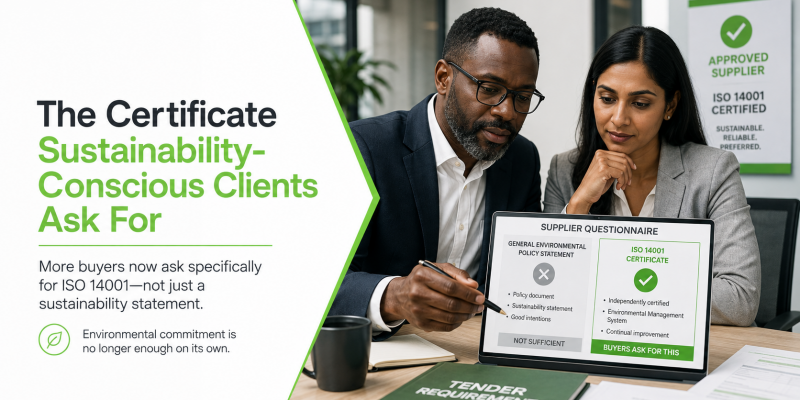
A growing number of tender questionnaires and supply chain reviews no longer just ask if your business is ‘environmentally responsible’ in a general sense — they ask specifically for ISO 14001. It’s become the default piece of evidence buyers reach for when they need something more concrete and independently verified than a sustainability statement on your website, and businesses without it are increasingly finding themselves unable to answer the question the way a certified competitor sitting alongside them in the same tender process can.
This shift has happened gradually enough that many businesses haven’t fully registered it yet. A few years ago, a paragraph about environmental commitment in a tender response was often sufficient.
Procurement teams are now trained to look past that kind of language and ask for the specific accredited evidence behind it — and a business that can only offer the paragraph, with no certificate to point to, is at a genuine and growing disadvantage against those that can.
Where This Is Costing Businesses Right Now
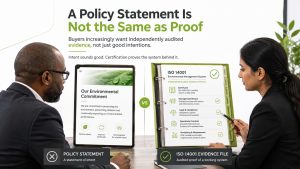
- Losing supply chain reviews to competitors who can produce a UKAS-accredited certificate on request rather than a written policy statement that reads well but carries no independent verification behind it
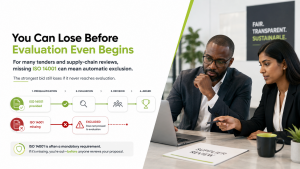
- Missing out on public sector frameworks that now list ISO 14001 alongside ISO 9001 as a standard prequalification requirement, meaning exclusion happens automatically before evaluation even begins
- Being unable to answer environmental due diligence questions from larger corporate clients with the level of specificity their own internal reporting obligations increasingly demand from suppliers
- Falling behind competitors who hold both ISO 9001 and ISO 14001 together as a pair, since procurement teams increasingly expect that combination as the norm rather than treating either as a standalone differentiator
- Losing existing client relationships at renewal, where a client’s own sustainability commitments have tightened since the contract was first signed and now require evidence the original agreement never asked for
Why a Sustainability Policy Doesn’t Satisfy This Anymore
A written environmental policy is fundamentally a statement of intent — it describes what a business says it does or aims to do. ISO 14001 is independently audited evidence that your business actually identifies its environmental impacts systematically, sets measurable improvement objectives against them, and can demonstrate genuine, evidenced progress over time through a formal management system.
Buyers doing real due diligence increasingly understand this distinction clearly, and a policy alone no longer closes the credibility gap the way it arguably still might have done a few years ago.
Who This Actually Hits Hardest
- Construction, manufacturing and facilities management businesses bidding into supply chains that carry explicit environmental prequalification criteria as a standard part of their tender process
- Businesses that already hold ISO 9001 and are increasingly being asked directly why they haven’t also pursued environmental management certification alongside it
- Businesses whose clients have their own net zero or ESG commitments and are actively pushing those specific certification requirements down through their own supply chains as a condition of continued business
- Businesses competing against larger rivals who treat ISO 14001 as a routine cost of doing business in their sector, making its absence conspicuous rather than neutral
Signs You’re Already Behind on This
- A tender or supply chain questionnaire has specifically asked for ISO 14001 certification and you were unable to provide it or had to explain its absence
- You hold ISO 9001 but have never seriously considered adding ISO 14001, despite the two sharing a similar underlying structure and being genuinely cheaper to implement together than pursued separately
- A client has asked for specific environmental data or evidence that you could only answer with general statements rather than documented, auditable proof
- You’ve noticed a pattern of losing bids to a particular class of competitor and haven’t specifically checked whether certification differences explain part of that pattern
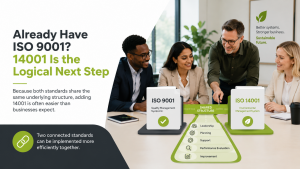
Because ISO 14001 shares the same Annex SL structure as ISO 9001, businesses that already hold one standard find the other considerably faster and cheaper to add on than starting entirely from scratch — a detail that materially changes the cost-benefit calculation for a lot of businesses currently sitting on the fence about whether to pursue it at all.
It’s also worth noting that the value of ISO 14001 doesn’t stop at winning the next tender. Businesses that implement it properly, rather than as a paperwork exercise, typically find it also sharpens genuine cost control around waste, energy and resource use — meaning the certification pays for itself in more than just the contracts it unlocks, provided it’s built around how the business actually operates rather than bolted on as a formality.
It’s also worth thinking about the compounding effect of delay here specifically. As more competitors in a given sector achieve certification, the businesses still without it don’t simply stay at a neutral disadvantage — they become increasingly conspicuous by their absence, since buyers grow accustomed to seeing the certificate as standard and start actively questioning why a particular supplier doesn’t have it, rather than simply not asking the question at all.
| Stop Losing Ground on Environmental Credentials
Ecotilities provides fixed-cost ISO 14001 certification consultancy, and can implement it alongside ISO 9001 far more efficiently than pursuing the two standards entirely separately. Visit ecotilities.co.uk/iso-standard-certification or call 0333 2244 050. |
Questions Businesses Ask
We already have ISO 9001 — is adding 14001 a lot of extra work?
Considerably less than starting entirely from scratch, since both standards share the same underlying Annex SL structure and a meaningful amount of the groundwork already in place carries across directly.
Is ISO 14001 only relevant for businesses with an obvious environmental impact like manufacturing?
No — it applies to any organisation regardless of sector, and it’s increasingly requested across a wide range of industries as supply chain sustainability requirements continue to broaden beyond the traditionally high-impact sectors.
How long does ISO 14001 certification typically take to achieve?
This depends significantly on your starting point and whether you already hold ISO 9001, which is exactly what an initial gap analysis establishes clearly and specifically for your business.
Does holding this certification connect meaningfully to our net zero or ESOS position?
Yes — ISO 14001 data overlaps meaningfully with both areas, and can genuinely support wider sustainability reporting rather than sitting as an isolated, standalone certificate with no other use.
What’s the real, practical cost of simply not having this certification?
Increasingly, exclusion from tenders and supply chain reviews before evaluation even properly begins — essentially the same disqualification risk that already applies to businesses missing ISO 9001.
Is a cheap, fast certificate from a non-UKAS-accredited body worth considering as a shortcut?
No — UKAS accreditation is specifically what most serious buyers actually check for during due diligence, and non-accredited certification often fails to satisfy the very requirement it was purchased to meet in the first place.