

Switching energy supplier is usually presented as a simple, almost mechanical process- compare the market, sign the new contract, the switch happens in the background, and savings begin from that point onward. What rarely gets mentioned anywhere in that pitch is that the switch moment itself is one of the highest-risk points for billing errors across the entire life of a business energy account.
Two different suppliers, two different billing systems, a meter reading handover between them, and an account closure and opening happening around roughly the same date all create exactly the conditions in which errors tend to thrive undetected.
None of this is a reason to avoid switching — regular market comparison remains one of the most valuable things a business can do for its energy costs. It’s simply a reason to treat the switch as a moment that specifically needs verification afterward, rather than assuming that because the new rate on paper looks correct, everything behind the scenes was necessarily handled correctly as well.
What Commonly Goes Wrong at the Switch Point
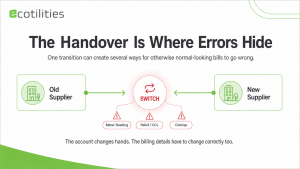
- Final and opening meter readings between the old and new supplier that don’t reconcile cleanly with each other, leading to a period of consumption that ends up billed twice by both suppliers, or occasionally billed by neither and simply lost in the handover
- VAT or Climate Change Levy relief that was correctly applied and recognised with the previous supplier, which doesn’t automatically carry over to the new account and quietly defaults back to the standard rate unless someone actively confirms and reapplies it
- A brief overlap period around the switch date where both the old and new suppliers each believe they remain the active account holder, occasionally resulting in genuinely duplicate charges for the same period of consumption
- New contract terms not being correctly applied to the account from day one, with billing briefly defaulting to an incorrect or generic rate before eventually being corrected internally by the supplier — assuming anyone at either end actually catches and flags the discrepancy
- Standing charges calculated incorrectly for the transition period itself, since the exact number of days attributable to each supplier around the switch date is a common point of confusion in supplier billing systems
Why Nobody Notices at the Time It Happens
A supplier switch is usually treated internally as a completed task the moment the new contract is signed and confirmed — the business moves on to its next priority, and nobody circles back specifically to verify that the first few bills received from the new supplier are genuinely accurate against the agreed contract terms. Any error introduced at the handover point can then sit uncorrected for months or even years afterward, quietly compounding with every billing cycle, precisely because the switch itself was the last moment anyone in the business was paying particularly close attention to the details.
Who This Actually Hits Hardest
- Businesses that have switched supplier at some point within the last few years without ever running a specific, dedicated post-switch billing accuracy check
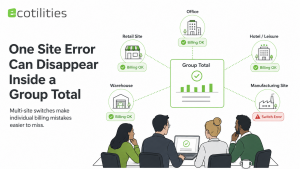
- Multi-site businesses switching several separate accounts around roughly the same time, where an error affecting one or two individual sites is easy to miss entirely within a combined, consolidated group total
- Businesses that held a VAT or CCL relief in place before switching supplier, and simply assumed without checking that it would automatically transfer across to the new account
Signs You Should Check Your Last Switch
- You’ve switched supplier at any point within the last six years and have never independently verified the billing accuracy during that specific transition period
- You had a VAT or CCL relief correctly in place before switching and haven’t specifically and formally confirmed whether it carried over properly to the new supplier’s account
- The switch itself happened to fall around a meter reading date or existing billing cycle boundary, rather than cleanly aligning with the start of a fresh billing period
- You’ve never had your bills independently validated at all, meaning a switch-related error would sit alongside any other unrelated billing issues, all equally undetected
Confirming whether a past switch introduced a billing error means specifically checking the bills covering that handover period against both the old and new contract terms in detail — not simply glancing at whether the ongoing, current rate now happens to look broadly correct on the most recent invoice.
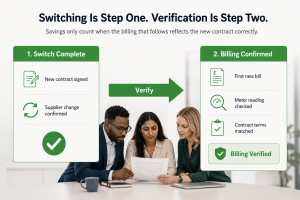
There’s also a broader point worth making about switching in general. The savings advertised at the point of switching are only real if the billing that follows actually reflects them accurately — a competitive new rate undermined by an unnoticed handover error can end up delivering far less benefit than expected, which is exactly why the switch and the subsequent billing check need to be treated as two separate, equally important steps rather than one single event.
| Get Your Last Supplier Switch Checked for Errors
Ecotilities reviews billing accuracy specifically around supplier switch points, alongside a full historical bill validation covering your wider account — free to check, with no obligation. Visit ecotilities.co.uk/bill-validation or call 0333 2244 050. |
Questions Businesses Ask
We switched supplier years ago — is it still genuinely worth checking now?
Yes — historical claims can typically be pursued going back up to six years from the point of the review, so an error introduced at a switch several years ago may still be fully recoverable today.
How would we actually know if something went wrong at our last switch?
In most cases you wouldn’t know, without a dedicated check specifically looking for it — this is precisely the kind of error that produces a bill which still looks broadly normal and unremarkable on the surface.
Does having this checked cost anything upfront?
No — the review itself is free of charge, with fees only ever applying if a genuinely recoverable overcharge is identified and then successfully claimed back on your behalf.
Is this a different service from a general bill validation review?
It’s part of the same overall process, with particular and specific attention paid to the switch transition period itself, since that’s statistically where errors are most likely to have originated in the first place.
What if we’re actually planning to switch again fairly soon?
It’s worth checking your current and previous billing beforehand in that case, so that any existing unresolved issue is properly identified and dealt with rather than simply carried forward unnoticed into the next switch as well.
Will having this checked affect our relationship with our current supplier in any way?
No — this is purely a billing accuracy review, entirely separate from and unrelated to your ongoing supply relationship or contract terms with your current supplier.