
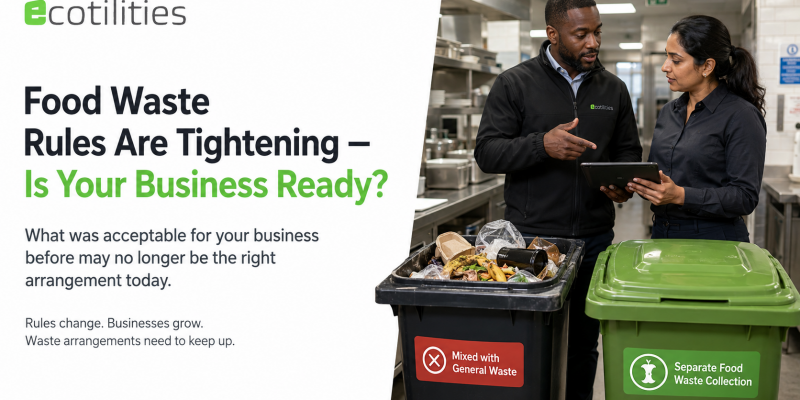
UK food waste regulation has been moving consistently in one direction over recent years: toward mandatory separate collection for a steadily growing range of businesses, with general waste as a catch-all destination becoming progressively less acceptable regardless of the specific sector involved.
Businesses that have always simply sent food waste out with everything else, without a second thought, are increasingly finding that arrangement is no longer merely inefficient from a cost perspective, it’s moving squarely toward being non-compliant, and the businesses least prepared for that shift tend to be exactly the ones who assumed, often reasonably at the time, that this simply didn’t apply to them.
The direction of travel here isn’t ambiguous or uncertain. Government policy on food waste has been signalling this shift for some time, driven partly by environmental targets around landfill diversion and partly by a recognition that segregated food waste can be processed far more usefully than when it’s mixed indiscriminately into general waste.
What’s less well understood by many businesses is exactly where the current thresholds and obligations sit, and whether their own specific operation already falls within scope.
Where Businesses Get Caught Out
- Assuming food waste rules only apply to large hospitality chains or major food production facilities, when smaller producers of all kinds are increasingly being brought within scope as thresholds tighten over successive regulatory updates
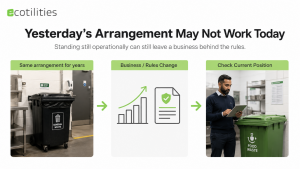
- Continuing an existing general waste arrangement unchanged for years without ever checking whether current volumes now trigger a separate collection requirement that didn’t previously apply when the arrangement was first set up
- Having no record or documented evidence trail showing that food waste has been handled appropriately and compliantly, which becomes a genuinely real and immediate problem the moment anyone — an inspector, an insurer, or a client’s own audit — actually asks for it
- Treating this entirely as a future issue to deal with at some later, unspecified point, when the regulatory direction has already been clear and consistent for a meaningful period of time
- Assuming that because nobody has raised the issue yet, the current arrangement must be adequate, rather than recognising that a lack of enforcement so far says nothing about the underlying legal position
Why This Gets Missed So Often
Waste compliance generally sits fairly low on the list of things a typical business actively and regularly monitors for regulatory change — it’s simply not reviewed with anything like the same regularity or attention as, say, tax obligations or employment law, and updates to waste regulation don’t always reach the specific people actually managing bins and day-to-day collections on site in a timely or clear way.
A business can quite easily drift out of compliance simply by standing still operationally while the regulatory bar around it continues to move forward without anyone noticing.
Who This Actually Hits Hardest
- Hospitality, food retail and catering businesses of all sizes producing food waste as a routine, everyday part of their normal operations
- Healthcare, education and care settings with substantial kitchen operations that may not naturally think of themselves as food-waste-producing businesses in a formal regulatory sense, despite generating meaningful volumes
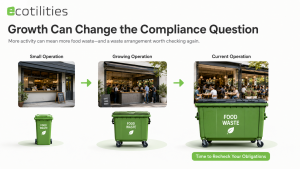
- Growing food businesses whose volumes have increased steadily past a relevant threshold over time, without anyone specifically checking whether that growth had also changed their underlying legal obligations
- Multi-site food-related businesses where compliance may be handled inconsistently from one location to the next, with some sites unknowingly ahead and others meaningfully behind
Signs You Should Check Your Position Now
- Your food waste currently goes into general waste collection rather than into any dedicated, separate stream
- You’ve never specifically checked your current legal obligations against your actual, current food waste volumes with anyone who genuinely understands the regulation
- Nobody within your business actively tracks changes in UK waste regulation as they happen and are published
- Your business has grown or changed its operations since you last considered your food waste arrangements, without revisiting the compliance question in light of that change
Getting properly ahead of this means confirming your specific obligations against your actual current volumes and putting a genuinely compliant, properly documented collection arrangement in place now — not waiting passively until an inspection, an insurer’s question, or a client’s supply chain audit eventually forces the issue at a moment not of your own choosing.
It’s also worth thinking about this alongside a business’s wider sustainability position, where relevant. Businesses already working on net zero commitments or environmental credentials often find that getting food waste segregation right delivers a visible, easily evidenced improvement that supports those wider claims — turning what might otherwise be viewed purely as a compliance obligation into something that also strengthens the business’s broader environmental story.
It also helps to view this as an operational improvement rather than purely a compliance burden. Businesses that get food waste segregation right often find it simplifies other aspects of their waste management at the same time, since the process of properly separating streams tends to bring broader visibility and control to an area of the business that previously received very little active attention at all.

| Get Your Food Waste Compliance Checked Before It’s an Issue
Ecotilities reviews your current food waste arrangements against your actual obligations and coordinates compliant, cost-effective collection wherever a change turns out to be needed. Visit ecotilities.co.uk/waste-management or call 0333 2244 050. |
Questions Businesses Ask
How do we actually know for certain if the rules apply to our specific business?
This depends on your food waste volumes and the precise nature of your business activities, which is exactly what a proper, specific review establishes rather than assuming one way or the other based on sector alone.
Is separate food waste collection actually more expensive than general waste collection?
Often the opposite is true — properly segregated food waste typically costs less per tonne to collect and dispose of than the equivalent volume sent as part of mixed general waste.
We’re a fairly small operation — does this realistically still apply to us?
Possibly, and increasingly so as thresholds and expectations continue to tighten over time — it’s genuinely worth checking properly rather than simply assuming smaller scale automatically exempts you from any obligation.
What actually happens if we’re found to be non-compliant at some point?
Consequences vary depending on the specific circumstances, but the immediate priority in any case is establishing a compliant position going forward — a proper review focuses on resolving this rather than dwelling unnecessarily on past arrangements.
Does sorting this out connect at all to our wider waste contract more generally?
Yes — food waste collection is typically best addressed as part of a full, holistic waste management review rather than treated as an isolated, standalone fix disconnected from everything else.
Is having our current position checked something we’d be charged for?
No — reviewing your current arrangements against your actual legal obligations carries no cost or commitment of any kind.