
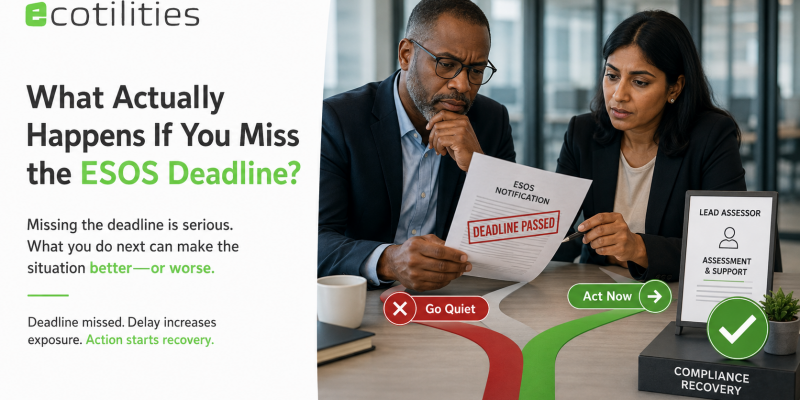
Organisations that miss an ESOS deadline tend to fall into one of two camps: those that act immediately and get ahead of the situation, and those that go quiet, hoping it resolves itself or won’t be noticed.
Only one of those camps comes out the other side in reasonable shape — and the difference isn’t luck, it’s how quickly and visibly the organisation responds once the deadline has already passed.
It’s worth being honest about why organisations end up in this position in the first place. It’s rarely wilful non-compliance. More often it’s a combination of factors — uncertainty about whether the organisation genuinely qualifies, an assumption that a previous phase’s assessment would somehow still be sufficient, or simply the process starting too late and running out of runway before the deadline arrived.
None of those explanations change the compliance position, but they do matter for how the organisation should respond next.
What’s Actually at Risk
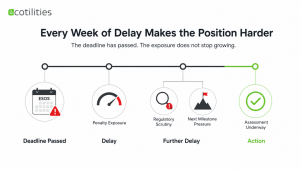
- Civil penalties from the Environment Agency, which can be substantial and are applied at the Agency’s discretion based on the severity, duration and circumstances of the non-compliance rather than a fixed, published tariff
- Reputational exposure, particularly for organisations that have made public sustainability or ESG claims that a missed statutory energy compliance deadline now sits uncomfortably alongside if it becomes known
- Increased regulatory scrutiny going forward, since a documented history of late compliance in one phase tends to invite closer attention and less benefit of the doubt in future cycles
- Lost time that compounds on itself — every month spent undecided about how to respond is a month the eventual assessment still has to be completed within, layered on top of whatever penalty exposure has already accrued during the delay
- Knock-on pressure on the next compliance milestone, since a late start on one cycle often leaves less breathing room before the following phase’s obligations begin
Why Going Quiet Is the Worst Possible Response
The Environment Agency’s general approach to enforcement across environmental regulation tends to distinguish meaningfully between organisations that proactively disclose and remediate non-compliance, and those that are identified through the Agency’s own monitoring and checks. Waiting and hoping is, in practice, the highest-risk response available to an organisation in this position — it maximises the period of non-compliance, removes any credit for proactive engagement, and means that if and when the Agency does follow up, the organisation is starting from the weakest possible negotiating position rather than one built on demonstrated good faith.
Who This Actually Hits Hardest
- Organisations that qualified for ESOS for the first time this cycle and genuinely weren’t aware of the obligation until after the deadline had already passed
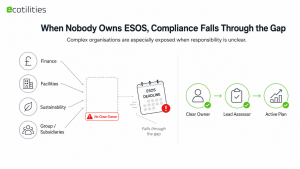
- Multi-entity groups where responsibility for ESOS compliance fell into a gap between departments, subsidiaries, or a change in group structure that nobody explicitly reassigned ownership for
- Organisations that started an assessment in good time but couldn’t complete it before the deadline due to data availability, site access issues, or resourcing constraints that weren’t anticipated early enough
- Organisations relying on an assessor who themselves ran out of capacity or missed their own commitments, leaving the client exposed through no direct fault of their own
Signs You Need to Act Now, Not Later
- A compliance deadline has already passed and no assessment has been completed or submitted
- You’ve started the process but progress has stalled, with no clear active plan or timeline to actually finish it
- Nobody in your organisation has formally taken ownership of resolving the situation, and it’s sitting in an ambiguous zone of responsibility
- You’re uncertain whether your organisation genuinely qualifies and have been putting off finding out definitively
The right response to a missed deadline is to move quickly, engage a qualified Lead Assessor without further delay, and put a credible, properly documented plan in motion — the details of managing that process well, including how and when to approach the Environment Agency, are best handled with proper support rather than worked out from first principles under pressure and with imperfect information.
It is also worth remembering that ESOS exists to identify genuine energy saving opportunities, not simply to generate paperwork for its own sake. An organisation that resolves a missed deadline properly, with a genuinely thorough assessment rather than the fastest possible box-ticking exercise, often ends up better positioned than one that never missed a deadline but has been quietly repeating a thin, low-value assessment every phase without ever extracting real value from it.
Organisations sometimes assume that because ESOS penalties are applied at the Environment Agency’s discretion, the practical risk is lower than it actually is. In reality, discretion cuts both ways — an organisation that has clearly ignored the obligation for an extended period, with no evidence of any attempt to engage, is in a materially weaker position than one that can demonstrate it is actively working to resolve the situation, however late that action began.

| Missed a Deadline? Get Moving Before It Gets Worse.
Ecotilities helps organisations that have missed an ESOS deadline get compliant quickly and manage the process properly from this point forward, minimising further exposure. Visit ecotilities.co.uk/esos or call 0333 2244 050. |
Questions Organisations Ask
Is it too late to do anything if we’ve already missed the deadline?
No — starting now, even after the deadline has passed, is far better than continued delay, and is the single most important decision an organisation in this position can make.
Will we definitely be penalised for missing the deadline?
Penalties are applied at the Environment Agency’s discretion based on the specific circumstances involved, which is exactly why how you respond from this point onward genuinely matters to the outcome.
Should we contact the Environment Agency ourselves before they contact us?
Proactive engagement is generally viewed more favourably than waiting to be identified and contacted, though the right specific approach depends on your organisation’s individual circumstances and history.
How long would it realistically take to become compliant from this point?
This depends heavily on your organisation’s size, number of sites and data readiness — starting the scoping conversation now is what establishes a genuinely realistic timeline rather than guessing.
Does a missed deadline affect how future ESOS cycles are handled for us?
A documented history of late compliance can invite closer scrutiny going forward, which is another strong reason to resolve the current situation properly now rather than let the same pattern repeat next cycle.
What’s the very first practical step we should take today?
Engaging a qualified Lead Assessor to properly scope the situation and begin the assessment process is the immediate priority — every additional week of delay adds to the overall exposure your organisation is carrying.