
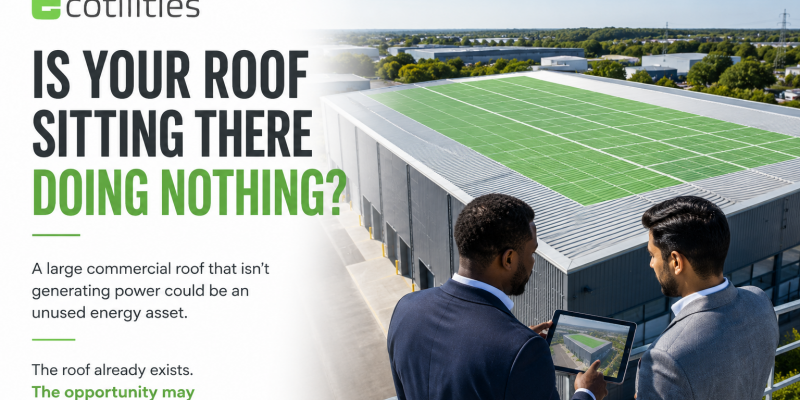
A large flat or south-facing commercial roof is one of the few genuinely underused assets most businesses own outright without even thinking of it as an asset at all. It sits exposed to sunlight every single day of the year, generating precisely nothing, while the business operating beneath it buys every unit of electricity it needs from the grid at full contracted rate.
That gap between an idle roof and a fully funded solar installation is one of the most straightforward, financially obvious and consistently overlooked opportunities in commercial energy.
What makes this particularly striking is that the roof itself already exists — it was built, paid for, and maintained as part of the property regardless of whether it ever generates electricity. Unlike most business investments, which require weighing a new cost against a new benefit, commercial solar on an existing roof is closer to activating value from an asset the business already owns and is already paying to maintain.
Why This Keeps Getting Overlooked
- Solar gets mentally filed under ‘expensive capital project requiring board approval and a lengthy business case’ even in situations where fully funded routes exist that require no upfront capital spend at all from the business
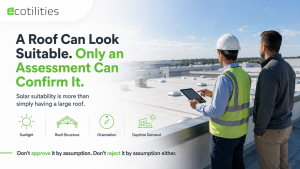
- Nobody has actually assessed whether the specific roof genuinely qualifies — the opportunity often gets dismissed on assumption or a quick visual guess rather than a proper structural and orientation site check by someone qualified to make that call
- Businesses renting rather than owning their premises frequently assume solar isn’t possible for them at all, when Power Purchase Agreement arrangements are very often structured specifically around exactly this kind of leased-premises situation
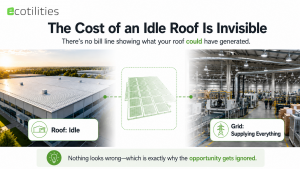
- The daily cost of not having solar is completely invisible on paper — there’s no bill line item that reads ‘roof not generating electricity, cost to you this month’, so the opportunity cost never naturally surfaces the way an overspend on an existing bill would
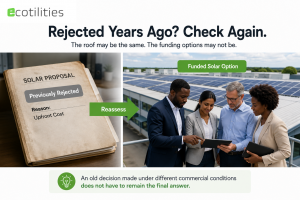
- Previous informal conversations about solar may have stalled years ago over cost concerns that no longer reflect current funded models, and the topic was quietly dropped rather than revisited as the market changed
What a Genuinely Suitable Site Can Deliver
For a site with strong daytime electricity consumption and suitable roof characteristics, a properly sized solar installation can meaningfully offset grid electricity purchases, generating that offset at a materially lower cost per unit than buying the equivalent power from a supplier. Combined with a funded model that removes the capital barrier entirely, the practical result for a qualifying business is savings that begin from the point of installation, without the multi-year payback calculation that outright purchase would otherwise require.
Who This Actually Hits Hardest
- Warehouse, logistics and distribution businesses with large flat roofs and substantial daytime electricity consumption tied to continuous operations
- Manufacturing sites running significant daytime process loads that align particularly well with typical solar generation hours across the day
- Retail and hospitality businesses with sizeable roof or car park canopy space that currently sits entirely unused and unconsidered as anything other than a roof
- Multi-site businesses where one or two locations were assessed for solar years ago and rejected, without the wider portfolio ever being revisited under current funded arrangements
Signs Your Site Is Worth Checking
- You have a roof or land area of at least 500 square metres that’s largely unshaded across most of the day
- Your annual electricity spend is £20,000 or more, which is broadly the point at which the economics of a funded installation start to work strongly in the business’s favour
- Nobody has ever formally assessed your specific premises for solar suitability, even if the topic has come up informally in the past
- Your operations run predominantly during daylight hours, which is when solar generation is at its highest and self-consumption value is greatest
Whether a specific roof is genuinely viable depends on precise orientation, shading patterns across the seasons, structural load-bearing capacity and your actual half-hourly consumption pattern — factors that only a proper site assessment can reliably confirm, not a rough visual guess made from ground level or an assumption carried over from a conversation that happened several years ago under different market conditions.
It’s also worth being clear about what happens if a site turns out not to be suitable — a proper assessment will say so honestly, rather than force a marginal site into an installation that won’t perform well. That honesty matters, because the businesses who benefit most from commercial solar are the ones where the assessment was rigorous enough to confirm genuine suitability before any commitment was made, not simply agreed to because the conversation had already gone too far to say no.
It also helps to think about timing here. Site suitability doesn’t change quickly, but the funded models available and the achievable savings rate can shift as the market evolves, meaning a site assessed and rejected several years ago on cost grounds alone is genuinely worth revisiting now rather than assumed to still carry the same conclusion under current conditions.
| Find Out If Your Roof Qualifies for Fully Funded Solar
Ecotilities offers a free site assessment to confirm whether your premises qualifies for a zero-capital-cost solar PPA, and exactly what the savings would look like for your business. Visit ecotilities.co.uk/solar-power-scheme or call 0333 2244 050. |
Questions Businesses Ask
Does this require us to own the building outright?
Not necessarily — PPA arrangements can often be structured for leased premises with a sufficient remaining lease term, so not owning the freehold isn’t automatically a barrier to proceeding.
What if we’re not sure whether our roof is actually suitable?
That’s exactly what a proper site assessment establishes — orientation, shading and structural capacity all need checking accurately rather than guessed at from the ground or assumed based on how the building looks generally.
Is there any cost involved in finding out if we qualify?
No — an initial site assessment to confirm suitability and model potential savings is free of charge and carries no obligation to proceed further.
How much roof space do we actually need for this to be worthwhile?
Roughly 500 square metres of usable, largely unshaded space is a reasonable general starting benchmark, though smaller sites can sometimes still work well depending on the specific consumption profile involved.
Does this opportunity apply to car parks as well as building roofs?
Yes — car park canopies are a common and frequently underused option, particularly for sites where the main roof space is limited, unsuitable, or already committed to other equipment.
How long does an initial suitability assessment actually take?
An initial assessment based on your site details and consumption data can typically indicate viability fairly quickly, well before any more detailed technical survey work would be required.