
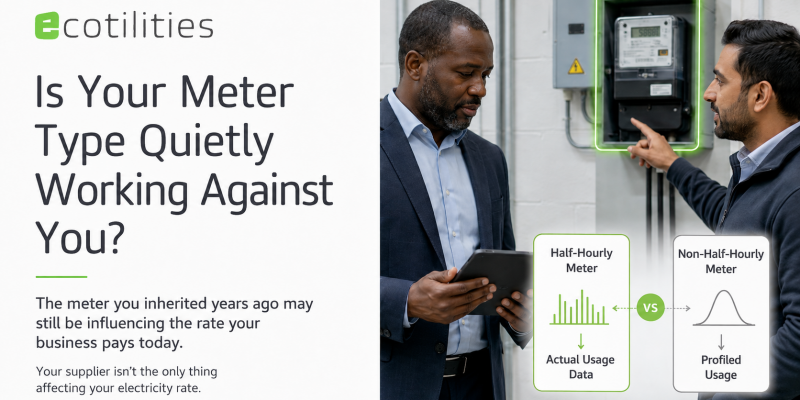
Two businesses with identical annual consumption can end up on materially different unit rates purely because of their meter type — and almost nobody outside energy procurement ever thinks to check which one they actually have. It’s not a decision most businesses ever consciously made; it was set at some point in the past, often by whoever originally connected the site, usually without anyone weighing up whether it was still the right fit as the business grew.
Meter type sits in that category of technical detail that feels too dry to investigate unless someone specifically flags it as relevant — which is exactly why it goes unexamined in so many businesses for years at a time, even as consumption and circumstances change considerably around it.
Why Meter Type Actually Matters to Price

- Half-hourly meters settle consumption every 30 minutes, giving suppliers a precise, granular usage picture that reduces the uncertainty they have to price into your rate — and less uncertainty for the supplier typically translates into a more competitive rate for you
- Non-half-hourly meters are settled on estimates and standardised consumption profiles rather than actual real-time data, meaning suppliers price in more risk to cover the possibility that actual usage differs from the profile assumption, and that risk premium is passed on as a higher effective rate
- Businesses that have grown significantly since their meter arrangement was last reviewed may now sit well past the consumption threshold where switching meter type would pay for itself many times over across the life of a new contract
- The difference isn’t always dramatic on a small account, but for medium and larger consumers the gap between the two settlement types can represent a meaningful proportion of the total annual electricity bill
Why This Rarely Gets Reviewed
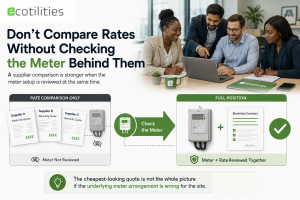
Most businesses only think about their meter when something goes wrong with it — a fault, a reading dispute, an installation issue — not as a routine part of assessing whether their energy costs are competitive. Brokers and consultants who focus purely on comparing unit rates between suppliers can miss this entirely too, if meter type isn’t specifically part of what gets reviewed, because on the surface it looks like a fixed, unchangeable piece of infrastructure rather than a genuine lever worth investigating.
Who This Actually Hits Hardest
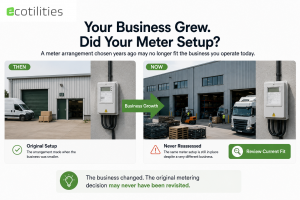
- Growing businesses whose consumption has increased well past the level it was at when the meter type was originally set, without anyone revisiting whether that original decision still makes sense
- Businesses that have never had a broker or consultant specifically flag meter type as a factor separate from the headline unit rate comparison
- Multi-site businesses where meter types vary inconsistently across locations, with some sites on the more favourable settlement basis and others not, purely by historical accident rather than deliberate decision
- Businesses that inherited their energy setup from a previous occupier or a different management team, with no clear record of why the current meter arrangement was chosen in the first place
Signs This Is Worth Checking
- Nobody in your business can confirm your current meter type without checking paperwork or calling the supplier directly
- Your consumption has grown notably since your energy contract or metering arrangement was first set up at the premises
- A recent rate comparison has come back higher than you expected relative to what you’ve heard businesses of similar size are paying
- You’ve never had anyone specifically raise meter type as a factor in your energy costs, despite having reviewed rates in other respects
Establishing whether a meter change is genuinely worthwhile requires weighing the switching cost and lead time against the rate improvement achievable over the remaining contract term — not a decision to make from a rough guess, since getting it wrong in either direction costs money: switching unnecessarily wastes the transition cost, while not switching when it would pay off leaves ongoing savings on the table indefinitely.
The wider lesson here applies beyond meter type specifically — energy costs are made up of several individually small decisions, most of which were made once, a long time ago, and never revisited as circumstances changed. Meter type is simply one of the more overlooked examples, precisely because it sounds technical enough that most people assume someone else must already have checked it properly.
It also helps to think about meter type alongside the other factors that determine your rate rather than in isolation. Consumption volume, load profile, contract length and procurement approach all interact with meter type to determine your final cost, which is exactly why a proper whole-market comparison needs to consider all of these together rather than treating meter type as a separate, standalone question to be answered on its own.
| Find Out If Your Meter Type Is Costing You
Ecotilities reviews your meter type alongside your full rate comparison, and advises honestly on whether a change would genuinely pay off for your specific business. Visit ecotilities.co.uk/gas-electricity or call 0333 2244 050. |
Questions Businesses Ask
How do I find out what meter type we currently have?
Your energy bill or your current supplier can confirm this directly — it’s worth checking as part of any wider rate comparison rather than simply assuming it was set correctly at the outset and never needs revisiting.
Does changing meter type cost anything or take long?
There can be a cost and a lead time involved in changing meter type, which is exactly why it needs to be weighed carefully against the rate benefit before committing, rather than assumed to be automatically worthwhile regardless of the numbers.
Is this relevant for small businesses too?
Less commonly, since the economics of a meter change tend to favour higher consumption levels where the rate difference has more absolute value, but it’s still worth confirming your position rather than assuming it doesn’t apply to you without checking.
How long does the physical process of a meter change actually take?
This varies considerably by site and by what infrastructure is currently in place, and is one of the practical factors properly assessed before any change is recommended or scheduled.
Would changing our meter type affect our current energy contract?
A meter change is typically planned around your contract renewal timing specifically to avoid unnecessary disruption, additional cost, or complications with an existing agreement still in its term.
Is checking this something we’d be charged for?
No — reviewing your meter type as part of a wider energy comparison carries no cost or obligation, and is included as standard when your overall rate position is assessed.