

Businesses with more than one site almost always end up with waste arrangements that grew site by site rather than being planned as a coordinated whole from the outset. Each individual location signed up with whichever provider happened to be convenient at the time it opened, on whatever terms were on offer that particular day, and nobody at group level ever stepped back to look at the total picture across the business as it grew.
The result, several years later, is a set of individual contracts that each look reasonable enough in isolation and collectively cost considerably more than a coordinated group approach would.
This pattern is especially common in businesses that have grown organically, opening new locations one at a time over a period of years, or that have grown through acquisition and simply inherited whatever waste arrangements came bundled with each acquired site. In both cases, waste contracts end up as an afterthought bolted onto each location individually, rather than a deliberate, centrally managed function of the business as a whole.
Where the Leakage Actually Sits

- Different providers operating at different sites means there’s no combined group volume being used as leverage to negotiate genuinely better rates, even in situations where the total waste output across the whole business is actually quite substantial and would carry real negotiating weight if presented together
- Inconsistent contract end dates scattered across sites make it genuinely difficult to ever run a single, comprehensive market comparison covering the whole business at once — there’s almost always some contract sitting mid-term somewhere in the group, so the full review keeps getting deferred rather than properly completed
- Sites with meaningfully different bin sizes, collection frequencies and segregation practices for what is essentially very similar waste, with no standardisation across the group driving the efficiency that consistency would otherwise unlock
- No central visibility whatsoever into total group waste spend, meaning the true combined cost of waste across the entire business is rarely, if ever, actually calculated in one place, let alone properly benchmarked against what a coordinated group contract would realistically achieve instead
- Different sites negotiating renewal terms independently and at different times, meaning any improvement negotiated at one location never gets applied consistently across comparable sites elsewhere in the group
Why This Never Gets Fixed On Its Own
Fixing this properly requires someone taking a genuine whole-business view of waste management specifically, which rarely happens naturally because responsibility for waste typically sits at site level with whoever manages each individual location, rather than with anyone specifically overseeing the group as a whole.
Each site manager reasonably optimises their own local contract in isolation, if they optimise it at all, and the opportunity that only becomes properly visible at group level — combined volume, standardised terms, a single coordinated renewal cycle — never actually gets identified because nobody within the organisation is positioned or resourced to see the full picture across every location simultaneously.
Who This Actually Hits Hardest
- Retail, hospitality and leisure chains with multiple locations that have historically been managed entirely independently of one another from a procurement standpoint
- Businesses that have grown through acquisition over time, inheriting whatever waste contracts happened to come bundled with each individually acquired site as part of the wider transaction
- Franchise or multi-branch operations where individual site managers retain full autonomy over their own local supplier relationships, with no group-level oversight or coordination requirement
- Fast-growing businesses opening new sites regularly, where waste is set up quickly at each new location purely to get operational, with no time or priority given to checking it against group-wide terms
Signs Your Group Is Paying the Multi-Site Penalty
- You cannot quickly and easily produce a single, accurate figure for total group waste spend across every site combined
- Different sites are visibly on different rates or contract terms for what is broadly comparable waste volume and type
- Nobody within the business has ever run a coordinated, group-wide market comparison covering every site simultaneously
- Waste procurement decisions are made entirely independently at each site with no reference to what other locations in the same group are currently paying
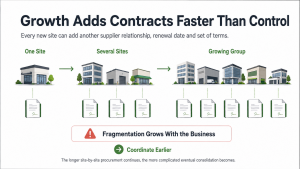
Consolidating multi-site waste properly means mapping every single site’s contract terms, end dates and actual volumes centrally in one place, then running a genuinely coordinated procurement process across the whole group — a fundamentally different exercise from simply asking each individual location to independently shop around on its own, since it captures the combined negotiating leverage that fragmented, site-by-site procurement structurally cannot.
It’s also worth recognising that this kind of consolidation tends to get harder, not easier, the longer it’s left unaddressed. E
very new site added under the existing fragmented approach adds another contract, another renewal date and another set of terms to eventually reconcile — meaning the businesses that act on this earlier in their growth generally find the process considerably more straightforward than those who wait until the number of sites and contracts involved has grown significantly larger.

| Get Your Waste Contracts Coordinated Across Every Site
Ecotilities maps and consolidates multi-site waste arrangements, negotiating group terms and aligning renewal dates so your business stops paying the fragmentation penalty year after year. Visit ecotilities.co.uk/waste-management or call 0333 2244 050. |
Questions Multi-Site Businesses Ask
Our sites are all currently on different providers already — is switching all of them at once actually realistic?
Yes, though it’s typically phased carefully around each individual site’s existing contract end date rather than attempted all at once, which avoids unnecessary early termination costs across the group.
Do our smaller sites genuinely benefit from being included in a group negotiation?
Yes — combined group volume typically improves the achievable rate meaningfully, even at individual sites that wouldn’t have had much negotiating leverage of their own if approaching the market alone.
How long does properly mapping and consolidating multiple sites usually take?
This depends significantly on the number of sites involved and how varied their current individual contracts already are, which is exactly what an initial review of your group establishes clearly from the outset.
Will this process disrupt collections at any of our individual sites during the transition period?
A properly managed consolidation process is specifically phased to avoid any gap whatsoever in collection service at any single location throughout the transition.
Is this genuinely only worth pursuing for very large multi-site operations?
No — even a relatively modest number of sites can carry meaningful unrealised leakage once contracts have grown independently over time without coordination, regardless of the overall scale of the business.
Does having this reviewed cost anything at the outset?
No — reviewing your current multi-site position and identifying the scale of the opportunity is entirely free, with absolutely no obligation to proceed further afterward.