
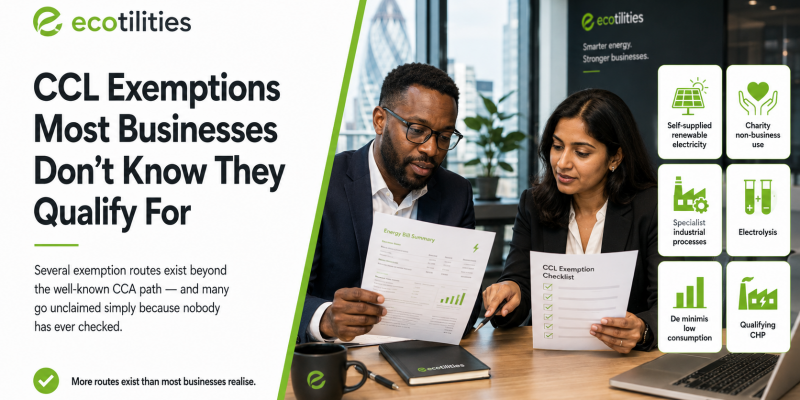
Most businesses that have heard of Climate Change Levy relief know about Climate Change Agreements for energy-intensive industry, and reasonably assume that if they’re not operating in a heavy manufacturing sector, no relief of any kind applies to them.
That assumption turns out to be wrong far more often than businesses expect — several other exemption routes exist alongside the well-known CCA route, each with its own narrower and considerably less well-known eligibility criteria, and most of these go entirely unclaimed simply because nobody outside a genuine specialist in this area ever raised them as a possibility.
The Climate Change Levy legislation itself is dense and technical, written in the language of tax law rather than plain business English, and most finance teams reasonably treat it as a fixed, non-negotiable line item rather than something with genuine variation depending on specific circumstances.
That’s a completely understandable assumption, but it’s one that leaves real money on the table for a meaningful number of businesses who would qualify for relief if only someone had asked the right questions about their specific activities.
Exemption Routes Beyond the Obvious
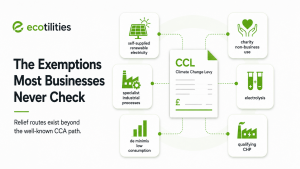
- Self-supplied renewable electricity generated on site, which can qualify for exemption because it doesn’t pass through the same taxable supply chain that grid-purchased electricity does, meaning businesses with any on-site generation should have this specifically reviewed
- Certain mineralogical and metallurgical processes that qualify for specific exemption regardless of the business’s overall sector classification, applying to the particular process rather than the business as a whole
- Electrolysis processes, which carry their own distinct and specific exemption provision entirely separate from the broader industrial relief routes most businesses assume are the only options available
- Non-business use by charities, which can apply even to organisations that also carry out some taxable business activity from the very same premises, provided the energy use is properly apportioned between the two
- De minimis exemption for genuinely low consumption levels, which some smaller businesses qualify for automatically without ever having actually checked their eligibility formally
- Combined Heat and Power exemptions for businesses operating qualifying CHP installations, which carry their own specific treatment under CCL rules distinct from standard grid electricity
Why These Go Unclaimed So Consistently
Most of these exemptions require the business to actively apply for them and provide supporting evidence — critically, they are not applied automatically by suppliers based on sector or activity classification alone.
A business can genuinely meet the qualifying criteria for one or more of these routes for years on end without ever benefiting from the relief, simply because nobody within the organisation was aware the specific exemption existed in the first place, let alone understood clearly that it applied to their particular circumstances and activities.
Who This Actually Hits Hardest

- Businesses generating some of their own renewable electricity on site, whether through solar or another source, without having ever formally reviewed the CCL treatment of that specific self-generated supply
- Charities and mixed-use organisations that have never formally and properly apportioned business versus non-business energy use across their premises and activities
- Specialist manufacturers using qualifying industrial processes without realising a specific, narrow exemption exists for their exact activity, separate from the general industrial relief they may have assumed didn’t apply to them
- Businesses that have changed activities, expanded, or diversified over time without ever revisiting their original CCL position against their current operations
Signs You Should Have This Checked
- You generate any of your own electricity on site, through any method, and have never specifically reviewed how that generation interacts with your CCL billing position
- Your business carries out any kind of specialist industrial process without having formally checked it against the full, detailed list of exemption categories available under CCL legislation
- You’re a charity or non-profit organisation and have never formally split business from non-business energy use for the purposes of your CCL liability
- Your business has changed or expanded its activities since your CCL position was last actively reviewed by anyone with specific knowledge of the exemption categories
Establishing genuine eligibility means checking your specific activities methodically against each individual exemption category, then gathering the supporting evidence needed to properly support a claim — not a general assumption made in either direction, since both wrongly assuming ineligibility and incorrectly submitting a claim you don’t actually qualify for both carry real, practical cost to the business.
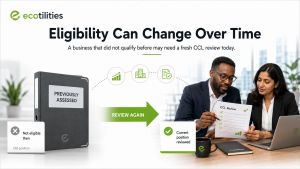
It’s worth adding that exemption eligibility isn’t always a permanent, one-off status either — a business that qualifies today could lose eligibility if its activities change, just as a business that doesn’t currently qualify might become eligible later as it evolves. Treating this as a periodic check rather than a single one-time exercise is what keeps a business from drifting back into overpayment after an initial claim has been resolved.
It’s also worth flagging that exemption categories are occasionally updated or clarified by HMRC, meaning a business correctly assessed as ineligible several years ago could plausibly qualify under current rules without ever having been told the position had changed. This is another reason a periodic review, rather than a single historical check, tends to serve businesses better over the medium term.
| Find Out Which CCL Exemptions Actually Apply to You
Ecotilities reviews your business methodically against every CCL relief and exemption category, not just the obvious well-known ones, and manages any resulting claim on your behalf from start to finish. Visit ecotilities.co.uk/climate-change-levy or call 0333 2244 050. |
Questions Businesses Ask
We’re not in an energy-intensive sector — is there any real point in checking?
Yes — several exemption routes have nothing whatsoever to do with sector classification and instead depend on specific activities or circumstances that apply far more broadly across the economy than most businesses assume.
Does having self-generated solar power on site affect our CCL position?
It can do — self-supplied renewable electricity is treated differently to grid-purchased electricity for CCL purposes specifically, and it’s genuinely worth having this reviewed by someone who understands the distinction properly.
Can charities claim CCL relief even if they also trade commercially from the same premises?
Yes, in many cases they can — the relief applies specifically to the non-business proportion of energy use, which needs to be properly and formally apportioned rather than simply assumed either way without evidence.
Is there any cost involved in having our CCL position reviewed?
No — the initial review is entirely free of charge, with fees only ever applying if a genuine claim is identified and subsequently pursued and successfully secured on your behalf.
How far back can an exemption claim actually go once one is identified?
Historical claims can typically be pursued going back up to six years from the point of the claim, which is precisely why checking your position sooner rather than later genuinely matters to the amount recoverable.
What happens if it turns out we’ve been claiming under the wrong exemption category?
This is also well worth checking properly — an incorrectly applied exemption carries its own separate risk, and a proper review confirms with certainty that you’re on the correct one going forward from this point.