

Every additional site a business operates is, in energy terms, another contract to manage, another renewal date to track, another supplier relationship to maintain, and another set of billing that needs to stay accurate — and in the vast majority of growing businesses, each one of these ends up being managed entirely independently rather than as part of a genuinely coordinated whole.
That fragmentation is rarely a deliberate strategic choice made consciously by anyone. It’s simply what naturally happens when sites are added to a business one at a time over a period of years, and nobody ever formally steps back to build a proper group-level approach that spans the whole business.
This pattern tends to become more entrenched, not less, the longer it goes unaddressed. Each new site that opens inherits the same fragmented approach as the ones before it, because that’s simply how things have always been done, and the accumulated inefficiency compounds quietly across every additional location added to the group over time, without ever presenting itself as a single, obvious problem that demands a fix.
What Gets Lost When Every Site Manages Its Own Energy
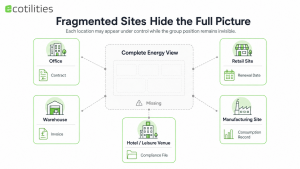
- Combined group buying power that a genuinely coordinated, group-wide procurement approach would naturally unlock, left entirely unused because each individual site negotiates alone against its own smaller, less significant volume
- Inconsistent contract terms and staggered renewal dates scattered across sites, making it genuinely difficult to ever run a single, comprehensive comparison covering the whole business simultaneously at any one point in time
- No consolidated, accurate view of total group energy spend anywhere within the business, meaning genuine group-level savings opportunities are essentially never identified, because nobody within the organisation actually holds the full combined picture
- Compliance obligations such as ESOS being managed inconsistently, reactively, or in some cases separately at individual site level, when a properly coordinated group-wide approach would handle the entire obligation once, correctly, for the whole business together
- Billing accuracy checks happening reliably at some sites and not consistently at others, since there’s no single standard practice being applied evenly across every location in the group
- Renewal timing that varies wildly by site, meaning market conditions favourable for procurement at one point are captured at some locations and completely missed at others purely due to accident of timing
Why This Persists Even in Genuinely Well-Run Businesses
This gap isn’t usually a sign of any failure on the part of individual site managers — each one is typically doing a perfectly reasonable job managing their own specific location’s energy needs day to day. The real gap here is structural in nature: nobody within the business has actually been given clear ownership of energy as a group-level function in its own right, so the meaningful coordination that would genuinely unlock real, tangible value across the business simply never happens, because it was never formally anyone’s specific job to make it happen in the first place.
Who This Actually Hits Hardest
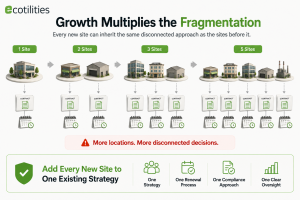
- Retail, hospitality and franchise operations that have grown one site at a time over a period of years without a formal group energy strategy ever being deliberately established at any point
- Businesses that have expanded specifically through acquisition, inheriting a patchwork of entirely different suppliers, rates and contract terms across the various locations brought into the group over time
- Multi-site groups now approaching an ESOS obligation for the first time, where compliance genuinely needs coordinating properly across every single qualifying site simultaneously rather than tackled piecemeal
- Businesses undergoing rapid growth, where new sites are being added faster than the internal processes needed to manage them consistently can realistically keep pace
Signs Your Business Is Paying the Fragmentation Cost
- You genuinely cannot quickly produce a single, accurate figure for total group energy spend across every site in the business combined
- Different individual sites are visibly sitting on quite different rates or contract terms for what is otherwise broadly comparable consumption and circumstances
- Nobody within the business currently owns energy management as a specific, explicit group-wide responsibility with clear accountability attached to it
- Site managers are left entirely to their own devices when it comes to energy procurement decisions, with no group-level guidance, oversight or coordination applied at any point
Building a genuine group energy strategy means centrally mapping every single site’s contracts, actual consumption and compliance position in one place, then actively managing procurement, renewals and reporting as one properly coordinated function across the whole business — a fundamentally different and more effective exercise than simply leaving each individual location to manage its own, smaller piece of a much bigger picture in isolation.
It’s also worth noting that the benefit of a coordinated strategy tends to grow, not shrink, as a business continues to add sites over time. Each new location added under a properly established group approach benefits immediately from existing negotiated terms and processes, rather than starting from scratch the way earlier sites did — meaning the earlier this coordination is put in place, the more value it captures across the full lifetime of the group’s growth.

| Bring Your Multi-Site Energy Under One Coordinated Strategy
Ecotilities manages energy procurement, renewals, compliance and billing accuracy across every site in your business as a single, properly coordinated service. Visit ecotilities.co.uk/bureau-services or call 0333 2244 050. |
Questions Multi-Site Businesses Ask
Do all of our sites need to be moved onto the same supplier for this approach to work?
No — consolidation is fundamentally about coordinated management and timing across the group rather than necessarily forcing every single site onto identical contracts immediately.
How many sites does a business realistically need before this kind of approach becomes genuinely worthwhile?
There’s no fixed threshold that applies universally — even a relatively modest number of sites can carry meaningful unrealised value once individual contracts have grown independently and without coordination over time.
Will bringing our sites under one strategy disrupt energy supply at any of our current locations?
No — bringing sites under a coordinated strategy is carefully managed around each site’s existing contract terms specifically to avoid any unnecessary disruption or additional cost during the transition.
Does this kind of coordinated approach genuinely help with ESOS compliance across multiple sites?
Yes — coordinating ESOS properly at group level, rather than handling it inconsistently site by site, is significantly more efficient overall and meaningfully reduces the risk of gaps appearing in coverage across the group.
How long does it typically take to build a coordinated strategy starting from a fragmented position?
This depends considerably on how many sites and existing contracts are involved across the group, which is exactly what an initial mapping exercise properly establishes at the outset.
Is there any cost involved in simply finding out what’s currently being missed across our sites?
No — an initial review of your current multi-site position and what it’s costing you is entirely free, with no obligation whatsoever to proceed further afterward.