
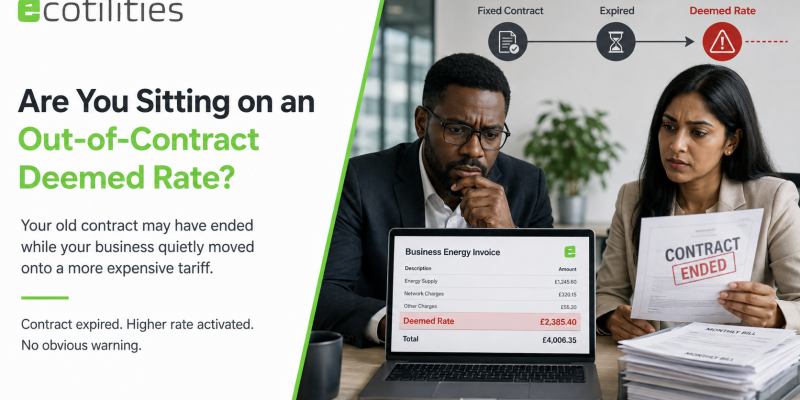
If your business energy contract ended and nobody actively renewed it, you’re not on a default rate — you’re on the most expensive rate your supplier offers. Deemed rates exist specifically to discourage businesses from drifting out of contract without engaging, and they do that job well: 30 to 50 percent above what a competitive fixed contract would cost is common, and it applies from the day the old contract ended, not from whenever someone finally notices.
The frustrating part is how invisible this is while it’s happening. There’s no warning notification that says ‘you are now on the most expensive tariff we offer.’ The bill simply arrives, the total looks somewhat higher than usual, and in a lot of businesses that increase gets absorbed into a general sense that energy costs are rising everywhere — which they often are — rather than investigated as a specific, fixable problem with a specific, identifiable cause.
Why This Happens More Than You’d Expect
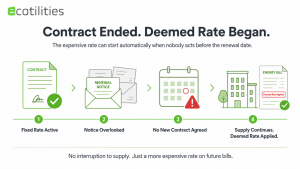
- Renewal notices typically arrive by post or email several months in advance, get filed among routine supplier correspondence, and don’t carry the same urgency signal as an invoice or a demand — so they get deprioritised against whatever else is happening that week
- Staff turnover in finance or facilities roles means the person who understood the contract’s terms and end date has moved on, and nobody formally inherited that specific piece of knowledge
- Multi-site businesses lose track of individual site renewal dates when there’s no central register — one site’s contract can lapse quietly while attention is focused on a different, more visible priority elsewhere in the business
- The bill total doesn’t obviously spike overnight in a way that triggers an investigation, because deemed rates are applied gradually as the previous contract’s billing cycle winds down, blending into what already looked like a normal, fluctuating cost line
- Businesses that have never compared their rate against the market have no baseline to notice the increase against — without knowing what a competitive rate looks like, there’s nothing to flag the deemed rate as unusually high
What This Actually Costs Over Time
The gap between a deemed rate and a competitively procured fixed contract compounds every single billing cycle it goes unaddressed. A business that discovers it’s been on a deemed rate for six months has already paid the premium six times over, and that’s before accounting for the fact that many businesses don’t discover the situation for considerably longer than that — sometimes not until a new finance hire happens to review the accounts with fresh eyes, or a broker runs an unprompted comparison and flags the discrepancy.
Who This Actually Hits Hardest
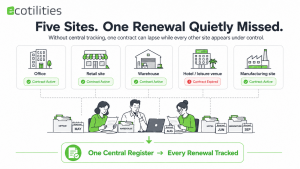
- Multi-site businesses managing several contracts with different end dates and no centralised tracking system to flag approaching renewals
- Businesses that have gone through a period of staff turnover in finance or facilities roles, where institutional knowledge of contract terms left with the departing employee
- Businesses that historically auto-renewed with the same supplier without ever comparing the market, and have therefore never had a reason to closely scrutinise their rate
- Growing businesses whose energy responsibilities have stayed informally attached to whoever originally set up the account, long after that person’s role expanded well beyond actively managing it
Signs You’re Already on a Deemed Rate
- You can’t recall the last time you actively signed a new energy contract, or confirm off the top of your head when your current one is due to end
- Your unit rate looks notably higher than figures you’ve seen quoted elsewhere for similarly sized businesses, but nobody has formally checked the comparison
- Nobody in your business can tell you your current contract end date without going away to check paperwork or contact the supplier directly
- Your bills have crept upward over recent months without a corresponding, clearly explained reason tied to wholesale market movements
Confirming whether you’re on a deemed rate, and getting off it properly, means running a genuine whole-market comparison rather than accepting whatever your existing supplier proposes when asked — since suppliers have no commercial incentive to proactively move you off their most profitable tariff, and a quiet phone call asking ‘are we out of contract’ rarely produces the full, urgent picture.
None of this requires a dramatic overhaul of how your business handles energy — it requires one focused check, done properly, against the actual market rather than a rough assumption either way. Businesses that treat this as a five-minute task to tick off, rather than something worth doing thoroughly, are usually the ones who end up back in the same position again at the next renewal, having fixed the symptom without addressing why it happened in the first place.
A useful way to think about this is that a competitive energy contract is not a one-time achievement but an ongoing state that needs actively maintaining. The rate you secured two or three years ago, however good it was at the time, tells you nothing about whether it remains competitive today, and a business that only ever checks its energy position when something has visibly gone wrong will always be managing the problem after the cost has already been incurred rather than before.
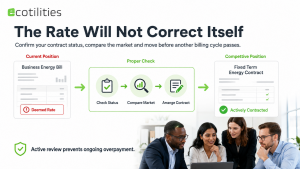
| Find Out If You’re Overpaying on a Deemed Rate
Ecotilities checks your current rate against the market for free and manages the switch if you’re better off moving — with no gap in supply and no cost to find out. Visit ecotilities.co.uk/gas-electricity or call 0333 2244 050. |
Questions Businesses Ask
How would we know for certain if we’re on a deemed rate?
Your most recent bill or a direct call to your supplier will confirm your contract status — if there’s no active fixed-term end date on record, you’re very likely on a deemed rate right now, and it’s worth checking rather than assuming your contract is still live.
Can we switch immediately if we are?
Yes — there’s no penalty or notice period for leaving a deemed rate, since it was never a fixed-term contract to begin with. You can move to a competitively procured contract as soon as one is arranged.
How fast can a switch actually happen once we decide to move?
A business energy switch typically completes within about five working days once a new contract has been agreed, so the exposure to the deemed rate can be closed off quickly once the decision is made.
Will switching supplier disrupt our physical energy supply?
No — switching supplier doesn’t affect the physical supply to your premises in any way, only who bills you and at what rate. There’s no interruption to the electricity or gas itself.
Could this have been happening for a long time without us noticing?
Yes — this is exactly the kind of situation that goes unnoticed for months or even longer, since the bill total rarely triggers an obvious alarm on its own, especially if energy costs generally have been rising.
Is checking our current rate against the market actually free?
Yes, a market comparison to confirm your current position and whether you’re overpaying costs nothing and carries no obligation whatsoever to switch if you decide not to.